
The landscape of modern manufacturing is undergoing a profound transformation, driven by the relentless pursuit of nanometer-level precision and the integration of advanced automation. At the heart of this evolution lies a material that has been the bedrock of metrology for decades, yet is now finding new life as a critical component in high-performance Computer Numerical Control (CNC) machinery: precision granite. As industries such as semiconductor fabrication, aerospace engineering, and medical device manufacturing push the boundaries of what is physically possible, the limitations of traditional materials like cast iron and steel are becoming increasingly apparent. This article explores how precision granite components are unlocking new levels of CNC accuracy, providing the stability and reliability required for the next generation of industrial excellence.
To understand why granite has become the gold standard for precision engineering, one must first look at its inherent geological properties. Unlike metals, which are subject to internal stresses from casting and machining, natural granite is a material that has been seasoned by the earth over millions of years. This natural aging process results in a material that is exceptionally stable and free from the internal tensions that can cause subtle warping in metal components over time. When processed into precision components, granite offers a surface that is not only incredibly hard but also remarkably flat, providing a reference plane that remains consistent even under the rigors of high-speed machining.
One of the most significant challenges in CNC machining is thermal expansion. Even the most advanced cooling systems cannot entirely eliminate the heat generated by high-speed spindles and friction. In traditional machines built with cast iron or steel frames, temperature fluctuations of just a few degrees can lead to dimensional changes that compromise the accuracy of the final part. Precision granite, however, possesses a coefficient of thermal expansion that is significantly lower than that of most metals. This thermal inertia means that granite components expand and contract far less in response to environmental changes, ensuring that the machine’s geometry remains stable throughout long production runs. For manufacturers operating in environments where climate control is challenging, the use of granite bases and columns can be the difference between meeting tight tolerances and producing scrap.
Beyond thermal stability, the vibration damping characteristics of granite are perhaps its most transformative feature for CNC applications. In any machining process, vibration is the enemy of surface finish and tool life. Traditional metal frames tend to ring like a bell when subjected to the frequencies generated by cutting tools, leading to chatter marks and accelerated wear on delicate components. Granite, with its dense and non-homogeneous structure, acts as a natural absorber of kinetic energy. It possesses damping properties that are up to ten times greater than those of cast iron. This ability to dissipate energy quickly allows CNC machines to operate at higher speeds and feeds without sacrificing surface quality, effectively increasing throughput while maintaining the highest standards of precision.
The durability of precision granite also contributes to its growing popularity in the industry. In the harsh environment of a machine shop, components are often exposed to coolants, lubricants, and various chemicals. While metal surfaces require constant maintenance and protective coatings to prevent rust and corrosion, granite is chemically inert and non-porous. It does not oxidize, nor does it react with the majority of industrial fluids. This resistance to environmental degradation ensures that the precision-lapped surfaces of granite components maintain their accuracy for years, if not decades, with minimal maintenance. Furthermore, the hardness of granite makes it highly resistant to scratches and wear, preserving the integrity of the machine’s guideways and mounting surfaces.
As we look toward the future of CNC technology, the integration of granite is becoming more sophisticated. Engineers are no longer just using granite for machine bases; they are incorporating it into moving components, air-bearing systems, and hybrid structures. The rise of “epoxy granite” or mineral casting—a composite of granite aggregates and specialized resins—has also provided manufacturers with more flexibility in design. While natural granite remains the choice for the highest levels of precision due to its superior stiffness and stability, mineral casting offers a cost-effective alternative that retains many of the vibration-damping benefits of the natural stone. The synergy between these materials and advanced sensor technology is enabling the creation of “smart” machines that can compensate for even the smallest deviations in real-time.
The impact of precision granite is particularly evident in the semiconductor industry, where the production of microchips requires tolerances measured in atoms rather than millimeters. In this sector, the use of granite-based motion stages and inspection systems is non-negotiable. The extreme stability of granite provides the necessary foundation for the lithography and metrology tools that define the modern digital age. As other industries begin to adopt these high-precision standards, the demand for granite components is expected to surge. Aerospace manufacturers, for instance, are increasingly turning to granite-reinforced CNC machines to produce the complex, lightweight components required for next-generation aircraft engines and satellite systems.
In conclusion, the transition toward precision granite components represents a fundamental shift in how we approach machine design. By leveraging the natural properties of one of the earth’s most stable materials, manufacturers are able to overcome the physical limitations that have long hindered the pursuit of absolute accuracy. Whether it is through superior thermal stability, unmatched vibration damping, or long-term environmental resistance, granite is proving to be the essential ingredient for unlocking the full potential of modern CNC technology. As we move further into an era of ultra-precision manufacturing, the role of granite will only continue to grow, serving as the silent, steadfast partner in the creation of the world’s most advanced technological marvels. The investment in granite components is not merely a choice of material; it is a commitment to the highest levels of quality and a safeguard for the future of industrial innovation.
The technical superiority of granite in CNC applications is further highlighted when considering the mechanical design of high-speed linear motor systems. In traditional machines, the weight of the components can be a double-edged sword. While mass provides stability, it also introduces inertia that can limit acceleration and deceleration rates. Precision granite components, however, offer a unique balance of high stiffness-to-weight ratio and exceptional dimensional stability. This allows engineers to design machine structures that are rigid enough to handle the forces of high-speed motion while maintaining the geometric integrity required for sub-micron positioning. When paired with air-bearing technology, where a thin film of pressurized air supports the moving parts, granite provides the ideal counter-surface. The natural flatness of lapped granite ensures that the air gap remains consistent across the entire travel range, eliminating the friction and wear associated with mechanical contact. This combination of granite and air bearings is a cornerstone of ultra-precision machining, enabling the production of optical components and high-precision molds that were previously impossible to manufacture.
Furthermore, the economic implications of adopting precision granite components are becoming increasingly favorable for long-term manufacturing strategies. While the initial cost of high-quality natural granite or precision-engineered mineral casting may be higher than that of standard cast iron, the total cost of ownership often tells a different story. The longevity of granite components means that machines retain their accuracy for much longer periods, reducing the frequency of costly recalibrations and repairs. In high-volume production environments, the reduction in scrap rates and the ability to maintain tighter tolerances can lead to significant savings that far outweigh the initial investment. Additionally, the energy efficiency of machines with superior vibration damping and lower friction can contribute to lower operational costs over time. As manufacturers face increasing pressure to improve sustainability and reduce waste, the durability and reliability of granite-based machinery align perfectly with these global trends.
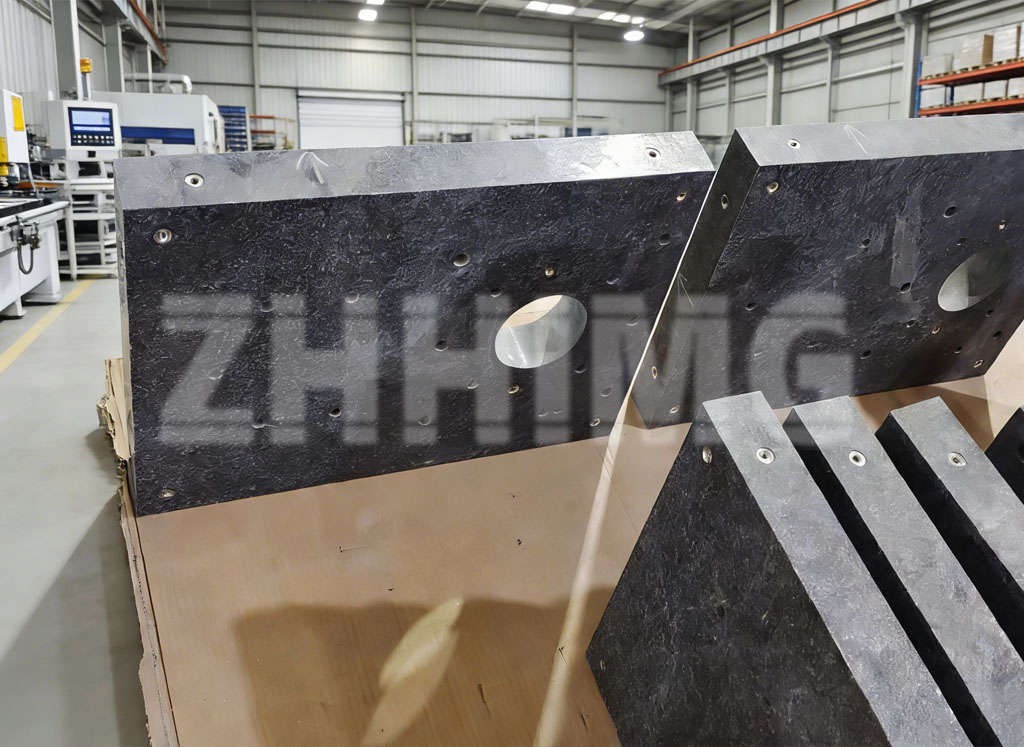
The manufacturing process of these precision components is itself a feat of engineering. It begins with the careful selection of granite blocks from specific quarries known for their uniform grain structure and lack of defects. Once the raw material is extracted, it undergoes a series of cutting and grinding operations to achieve the basic shape. However, the true precision is achieved through the process of hand-lapping. Skilled technicians use abrasive pastes and specialized tools to manually refine the surface, checking the flatness with electronic levels and laser interferometers. This artisanal approach, combined with modern metrology, allows for the creation of surfaces that are flat to within a few millionths of an inch. This level of precision is simply unattainable through automated machining alone, highlighting the unique blend of traditional craftsmanship and cutting-edge technology that defines the precision granite industry.
In the context of global competition, the ability to deliver superior accuracy is a key differentiator for machine tool builders. As emerging markets develop their own manufacturing capabilities, established players in Europe, North America, and Asia are turning to advanced materials like granite to maintain their technological edge. The integration of granite into CNC machines is not just about improving a single metric; it is about enhancing the entire ecosystem of the machine. From the base that provides the foundation to the columns that support the spindle, every granite component works in harmony to create a stable environment for the cutting process. This holistic approach to machine design is what allows for the creation of complex geometries and superior surface finishes that are the hallmarks of high-end manufacturing.
Looking ahead, the role of precision granite is set to expand even further with the advent of Industry 4.0 and the Internet of Things (IoT). Modern CNC machines are increasingly equipped with sensors that monitor everything from temperature and vibration to tool wear and energy consumption. The stability of granite provides a consistent baseline for these sensors, making it easier to distinguish between normal operational variations and potential issues. This data-driven approach to manufacturing relies on the predictability of the machine’s physical structure, and there is no material more predictable than precision granite. By providing a stable platform for digital twins and predictive maintenance algorithms, granite is helping to bridge the gap between the physical and digital worlds of manufacturing.
The versatility of granite also extends to its use in custom-engineered solutions for specific industrial challenges. For example, in the field of large-scale metrology, granite structures spanning several meters are used to support the measurement of aircraft wings and automotive chassis. The same principles of thermal stability and vibration damping that make granite ideal for small-scale CNC machines apply equally to these massive structures. As the demand for larger and more complex parts grows, the ability to scale granite components without losing precision will be a critical factor in the success of these industries. The ongoing research into hybrid materials, which combine the strengths of granite with the flexibility of carbon fiber or other advanced composites, promises to push the boundaries of what is possible even further.
In summary, the use of precision granite components is a testament to the enduring value of natural materials in an increasingly synthetic world. By understanding and harnessing the unique properties of granite, the manufacturing industry is able to achieve levels of precision that were once thought to be the stuff of science fiction. As we continue to innovate and push the limits of CNC technology, granite will remain at the forefront, providing the solid foundation upon which the future of industry is built. The journey from a raw block of stone to a high-precision CNC component is a long and meticulous one, but the results speak for themselves in the form of the high-quality products that power our modern world. For any manufacturer looking to unlock the maximum potential of their CNC operations, the path forward is clear: it begins with the precision and stability of granite.
Post time: May-19-2026