
In the high-precision world of modern manufacturing, where aerospace components, maritime engines, and massive energy turbines define the limits of human ingenuity, the foundation of quality control is often found in something deceptively simple: the heavy-duty cast iron platform. While high-tech lasers and digital scanning systems often steal the spotlight, these massive, stabilized surfaces remain the silent, indispensable bedrock of large-scale engineering. As industries push toward tighter tolerances and larger physical scales, understanding the pivotal role of these platforms is essential for any engineering professional focused on long-term structural integrity and measurement accuracy.
The Foundation of Precision in Large-Scale Environments
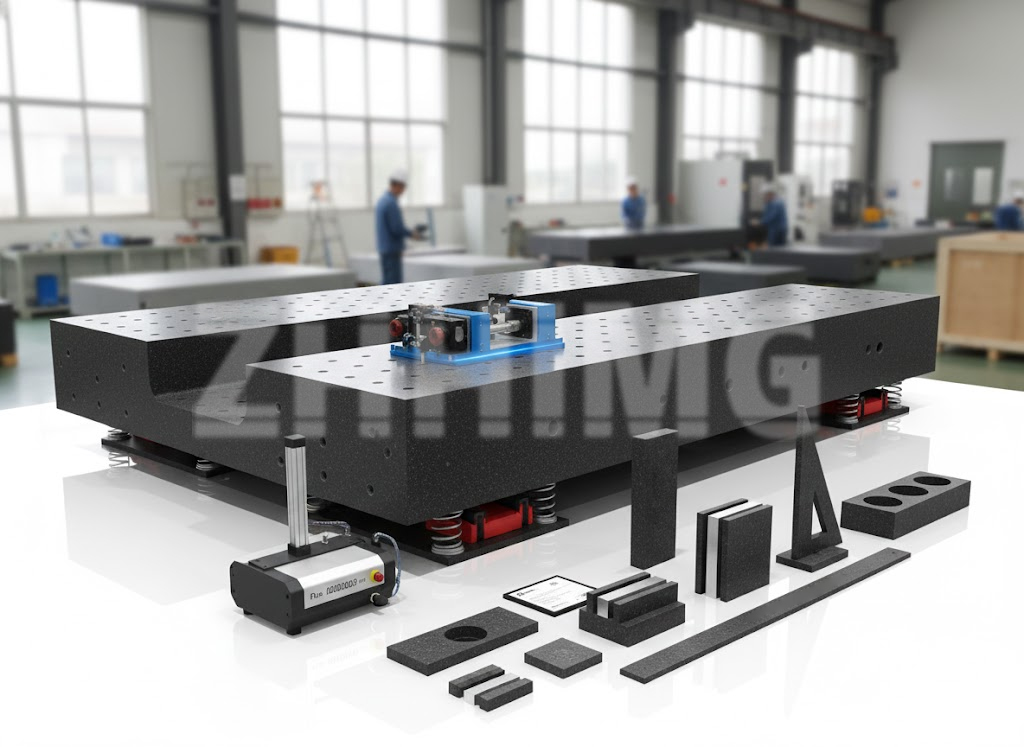
A heavy-duty cast iron platform, often referred to as a surface plate or a marking-off table in larger formats, is not merely a heavy slab of metal. It is a highly engineered reference plane. In large-scale engineering, the primary challenge is not just measuring a part, but ensuring that the measurement is taken against a perfectly flat, vibration-resistant, and thermally stable “zero point.” When dealing with a ship’s crankshaft or a wind turbine housing, even a microscopic deviation at the base can lead to catastrophic alignment errors across several meters of the component’s length.
The choice of cast iron—specifically high-grade gray cast iron or HT200-300—is deliberate. Unlike steel, which can be prone to internal stresses and significant thermal expansion, cast iron undergoes a natural or artificial “aging” process. This seasoning allows the internal crystalline structure to settle, ensuring that the platform does not warp or “walk” over time. This stability is why, even in the age of carbon fiber and composites, the foundational inspection tool for a multi-million dollar turbine remains a meticulously scraped cast iron block.
Why Cast Iron Dominates the Engineering Landscape
One might wonder why heavy-duty engineering hasn’t shifted entirely to granite, which is common in smaller laboratory settings. The answer lies in the mechanical demands of large-scale workpieces. Heavy-duty engineering involves parts weighing tens of tons. Cast iron platforms offer superior load-bearing capacity and, crucially, the ability to be machined with T-slots, holes, and or mounting points.
A granite plate is brittle; drop a ten-ton engine block on it, and it may crack. In contrast, a cast iron platform is ductile and robust. Furthermore, cast iron possesses unique vibration-damping qualities. In a busy factory environment where heavy machinery creates constant floor tremors, the dense molecular structure of a cast iron platform acts as a natural buffer, absorbing micro-vibrations that would otherwise interfere with sensitive metrology equipment like coordinate measuring machines (CMMs) or electronic levels.
The Art of Scraping and Surface Geometry
The surface of a professional-grade inspection platform is rarely “smooth” in the way a mirror is. Instead, it features a characteristic “scraped” finish. This manual or semi-automated process involves removing high spots to create a surface that is flat to within microns. However, the resulting texture actually helps in practical engineering applications. The tiny valleys in a scraped surface prevent “wringing”—a vacuum effect where flat gauges stick to the plate—and allow for a thin film of oil to protect the surface from rust while maintaining the accuracy of the measurement tools sliding across it.
In large-scale applications, these platforms are often modular. Multiple heavy-duty plates are joined together and leveled as a single unit to create an inspection floor that can span thirty or forty meters. This allows engineers to assemble and inspect entire vehicle chassis or fuselage sections on a single, unified reference plane.
Maintenance and Longevity: A Century of Accuracy
One of the reasons these tools are so highly valued in industry news and procurement cycles is their incredible lifespan. A well-maintained cast iron platform can serve an engineering firm for over fifty years. Maintenance, however, is a rigorous discipline. Because cast iron is susceptible to corrosion, moisture control and regular lubrication are paramount.
Furthermore, “calibration” is a recurring necessity. Over years of use, the heavy sliding of parts can wear down specific areas of the plate. Specialized technicians use electronic levels and laser interferometers to map the “topography” of the platform, identifying any deviations from the absolute plane. If the plate falls out of tolerance, it is re-scraped or ground back to its original specifications. This “renewable” nature makes it a more sustainable and cost-effective investment than many digital-only solutions that become obsolete within a decade.
Thermal Stability: The Hidden Challenge
In large-scale engineering, the enemy of precision is heat. A temperature shift of just a few degrees can cause a five-meter steel component to expand by several microns. Heavy-duty cast iron platforms have a high thermal mass, meaning they change temperature very slowly. This inertia provides a “thermal buffer,” giving inspectors a consistent environment even if the workshop temperature fluctuates during a work shift.
Modern engineering facilities often install these platforms on deep, isolated concrete foundations to further decouple them from the building’s thermal and structural movements. This level of environmental control is what allows for the sub-millimeter precision required in the assembly of high-speed rail components or aerospace bulkheads.
The Intersection of Tradition and Technology
While the platforms themselves are traditional, their use is increasingly integrated with 21st-century technology. Today, a heavy-duty cast iron platform often serves as the “stage” for portable CMM arms, laser trackers, and 3D scanners. By placing a component on a certified flat surface, the software driving these digital tools can establish a much more accurate coordinate system.
For instance, when inspecting a large pump casing, the cast iron platform provides the “primary datum.” The laser tracker then maps the casing’s features relative to the plate. Without the physical stability of the cast iron base, the digital measurements would be prone to “drift,” as the sensors would have no fixed, unmoving point of truth to reference.
Conclusion: The Bedrock of Industrial Quality
As we look toward the future of large-scale engineering—be it in the construction of modular nuclear reactors or the next generation of deep-sea exploration vessels—the demand for heavy-duty cast iron platforms shows no signs of waning. They represent the perfect marriage of metallurgical science and practical mechanical engineering.
These platforms are more than just tables; they are the physical manifestation of the “zero” in the XYZ coordinate system. They provide the confidence that a part manufactured in one part of the world will fit perfectly with a component made in another. In an era of rapid digital transformation, the heavy-duty cast iron platform remains a powerful reminder that high-level engineering still relies on a solid, stable, and perfectly flat foundation. For any facility aiming for the pinnacle of manufacturing excellence, these tools are not just an option—they are an essential requirement for accuracy, reliability, and long-term success.
Post time: May-18-2026