
In the world of advanced manufacturing, precision is no longer a competitive advantage—it is a prerequisite. As semiconductor feature sizes shrink below 3 nanometers, aerospace components demand sub-micron tolerances, and optical systems require nanometer-level surface accuracy, the instruments that underpin these measurements must deliver performance that was unthinkable just two decades ago. Yet behind every breakthrough in high-precision measurement lies a foundational choice: the material from which measuring tools are constructed.
Two materials have dominated precision metrology for decades—granite and ceramic. Each brings a distinct set of properties that profoundly influence measurement outcomes, equipment longevity, and operational cost. Understanding their nuanced differences is essential for engineers, quality managers, and procurement decision-makers tasked with equipping inspection laboratories or production floors.
The Growing Stakes of Precision Measurement
Modern manufacturing has entered an era where tolerances are measured in microns and sometimes nanometers. The semiconductor industry works with structures measured in angstroms. Aerospace manufacturers must verify turbine blade clearances where a few micrometers can determine engine safety. Optical manufacturers produce lenses for lithography systems where surface errors of even a fraction of a wavelength can compromise entire production lines.
These demands have elevated precision measuring instruments from simple inspection tools to strategic assets. Variations in temperature, vibration from nearby machinery, material fatigue over time, and chemical exposure can silently introduce systematic measurement errors that compound through production processes. The reference surfaces and structural foundations upon which measurements are made must themselves exhibit extraordinary dimensional stability—this is where material selection becomes a critical strategic decision.
Why Granite Measuring Tools Remain the Backbone of Precision Metrology
Granite has served as the foundational material in dimensional metrology for well over half a century, and its continued dominance is no accident. The appeal of granite measuring tools lies in a combination of material properties that are difficult to replicate synthetically.
Thermal Stability in Real-World Conditions
One of granite’s most compelling advantages is its behavior under variable thermal conditions. High-quality precision granite—such as the UNPARALLELED® black granite used by ZHHIMG®鑫中惠, with a density of approximately 3,100 kg/m³—exhibits a low and highly uniform coefficient of thermal expansion. More importantly, its substantial thermal mass acts as a natural buffer against ambient temperature fluctuations. When a production floor experiences temperature swings during shift changes, equipment cycling, or seasonal variation, a granite structure responds slowly and evenly, preventing the localized distortion that can compromise measurement accuracy.
In environments where absolute thermal control is impractical or prohibitively expensive, this thermal inertia alone can be the deciding factor in maintaining measurement repeatability. Many calibration laboratories and inspection rooms around the world still rely on granite surface plates precisely because they tolerate the imperfect thermal conditions of real industrial settings.
Vibration Damping That Machines Cannot Easily Replicate
Precision measurement environments are rarely quiet. Motors, air handlers, moving equipment, and foot traffic generate vibrations that propagate through measurement systems and introduce noise into readings. Granite’s natural microstructure acts as an effective mechanical energy dissipator, providing inherent vibration damping without the need for complex auxiliary isolation systems.
This property is particularly valuable in manufacturing facilities where vibration sources cannot be fully eliminated. A coordinate measuring machine base or precision gantry constructed from granite absorbs and dampens these disturbances, helping sensitive instruments maintain their specified repeatability. Ceramic materials, while exceptionally stiff, offer limited internal damping—a trade-off that becomes noticeable in high-vibration industrial environments.
Proven Scalability and Long-Term Reliability
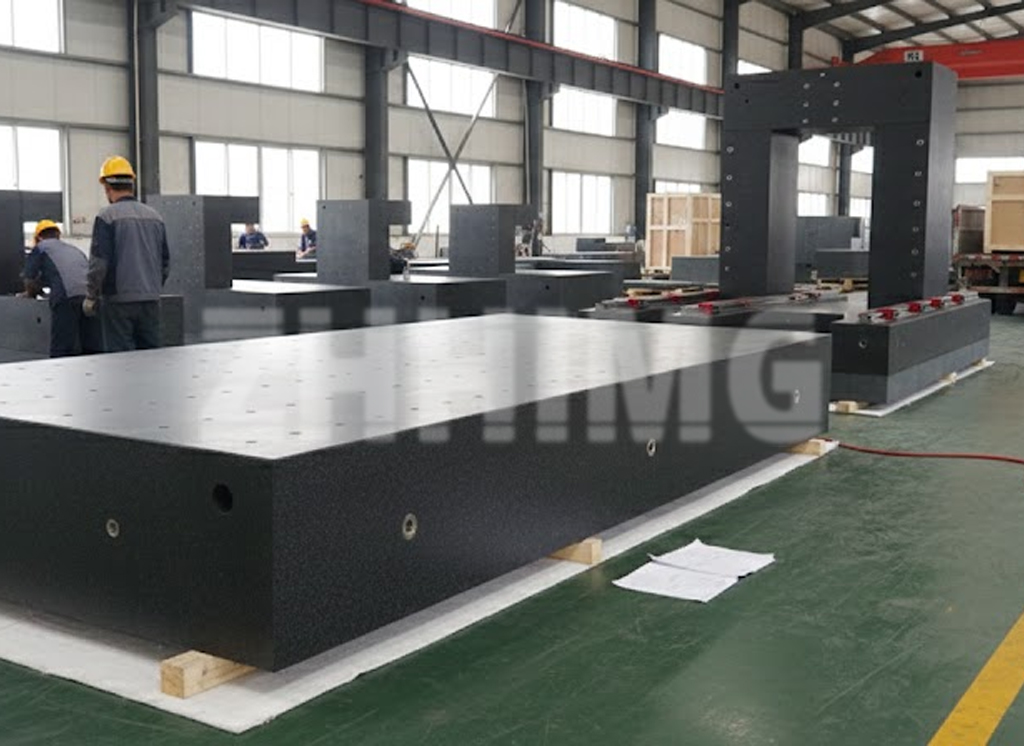
Precision granite components can be manufactured in large formats while maintaining tight flatness tolerances through controlled grinding, lapping, and hand-finishing processes. ZHHIMG®鑫中惠, for example, produces precision granite components with single-piece machining lengths reaching 20 meters, widths up to 4,000 mm, and thicknesses up to 1,000 mm—a range that remains extremely challenging to achieve with ceramic materials.
The combination of long-term dimensional stability, natural vibration damping, non-magnetic and corrosion-resistant properties, and proven scalability makes granite the material of choice for CMM bases, large-format surface plates, granite straight edges, granite square rulers, granite V-blocks, granite parallels, and precision machine tool structures. For applications where the reference surface must remain accurate over decades, granite’s proven longevity is difficult to beat.
The Rising Role of Ceramic Precision Measuring Instruments
While granite has deep roots in metrology tradition, ceramic precision measuring instruments have emerged as powerful alternatives for specific high-performance applications. Technical ceramics—including alumina (Al₂O₃), zirconia (ZrO₂), and silicon carbide (SiC)—offer a different profile of properties that addresses certain limitations of natural stone.
Exceptional Hardness and Wear Resistance
Ceramic materials rank among the hardest substances used in industrial manufacturing, with Vickers hardness values ranging from 1,200 HV for zirconia to over 2,000 HV for certain alumina grades. This translates directly into outstanding wear resistance. In applications involving repeated contact cycles—gauge blocks inserted and removed hundreds of times per day, pin gauges used for batch inspection, or measurement surfaces subjected to sliding workpieces—ceramic components demonstrably outperform steel and granite surfaces.
Industry testing has shown that zirconia ceramic gauge blocks can last ten to twenty times longer than conventional steel gauge blocks under continuous use, with wear depths remaining below 0.3 micrometers after 10,000 cycles. For quality control departments managing high-throughput inspection workflows, this extended service life directly reduces calibration frequency and replacement costs.
Near-Zero Thermal Expansion for Temperature-Sensitive Applications
Advanced ceramics can exhibit thermal expansion coefficients an order of magnitude lower than structural metals. Some engineered ceramic compositions achieve CTE values below 1 × 10⁻⁶/°C, with select cordierite-based materials reported below 0.03 × 10⁻⁶/°C at room temperature. This near-zero thermal expansion makes ceramic precision measuring instruments exceptionally well-suited for optical inspection systems, semiconductor wafer stages, and applications where dimensional changes driven by ambient temperature shifts must be minimized.
Chemical Inertness and Practical Handling Advantages
Ceramic precision measuring instruments are inherently resistant to corrosion, oxidation, and chemical attack from acids, alkalis, cutting fluids, and most industrial solvents. This chemical inertness eliminates the need for protective coatings, rust-prevention treatments, or special storage conditions. Unlike steel gauge blocks, which require oil films and controlled humidity to prevent corrosion, ceramic measuring tools can be handled directly and stored without special precautions. Their non-magnetic and electrically insulating nature further extends their applicability in environments near magnetic fixtures, electromagnetic interference sources, or dusty production areas.
Direct Comparison: Where Each Material Holds the Advantage
Understanding the individual strengths of granite and ceramic is only part of the decision-making process. The practical choice often comes down to how these materials perform relative to each other across the criteria that determine real-world measurement system performance.
When it comes to dimensional stability over decades, granite’s geological origin provides a natural advantage. Properly aged, stress-relieved, and machined granite retains its dimensions with remarkable consistency, backed by decades of field experience and inclusion in international metrology standards. Ceramic dimensional behavior, while excellent, is more sensitive to manufacturing process control and residual stresses from sintering. For reference standards that must remain traceable to national metrology institutes over years, granite’s proven longevity carries significant weight.
On thermal response and environmental tolerance, granite’s high thermal mass gives it slow, uniform response—a genuine advantage in environments with imperfect temperature control. A granite surface plate experiences gradual, predictable dimensional changes as ambient temperature shifts, and these changes tend to be homogeneous across the structure. Ceramic materials, with lower thermal inertia, respond more rapidly to temperature fluctuations. The practical implication is that granite performs better in stable, real-world thermal environments with slow gradients, while ceramic materials may be preferred in tightly controlled, constant-temperature facilities.
Regarding wear resistance and surface degradation, ceramic materials are demonstrably harder and more wear-resistant than granite in high-cycle applications. However, when a granite surface does suffer chipping from dropped workpieces or abrasive debris, the damage is usually contained to a visible chip and the surrounding flat surface remains usable. Ceramic materials, while harder, are more brittle and can develop crack propagation from impact damage that is more difficult and costly to repair.
For manufacturing scalability, granite is the undisputed leader. The ability to machine monolithic granite pieces exceeding several meters in length while maintaining sub-millimeter flatness tolerances is well-established. Ceramic manufacturing is constrained by kiln sizes and sintering limitations, making large ceramic surface plates or structural components significantly more expensive and technically challenging.
On cost considerations, granite measuring tools generally offer a more favorable cost-to-performance ratio for standard industrial applications, particularly at larger sizes. Ceramic precision measuring instruments carry higher upfront manufacturing costs, but their longer service life and reduced calibration frequency can offset initial cost differences in demanding chemical or high-cycle environments.
Matching Material to Application
The choice between granite and ceramic ultimately depends on the specific demands of your measurement application, operational environment, and long-term quality objectives.
For coordinate measuring machine bases, large-format inspection surfaces, and heavy-load precision stages, granite measuring tools remain the established standard. Their vibration damping, thermal stability, proven longevity, and manufacturing scalability make them the default choice for CMM manufacturers, calibration laboratories, and precision machining shops worldwide. ZHHIMG®鑫中惠’s granite product line—including surface plates, straight edges, square rulers, V-blocks, and parallels—reflects this reality, with components manufactured in 10,000 m² of temperature-controlled workshop space to tolerances traceable through German Mahr, Swiss WYLER, and British Renishaw laser interferometers.
For semiconductor inspection stages, optical alignment systems, high-speed measurement stations, and environments involving aggressive chemicals or magnetic fields, ceramic precision measuring instruments offer compelling advantages that granite cannot easily match. The growing adoption of ceramic gauge blocks, ceramic measuring pins, and ceramic reference surfaces in semiconductor and precision optics manufacturing reflects this shift.
For most general-purpose precision manufacturing workshops, calibration laboratories, and multi-purpose quality control environments, a hybrid approach often yields the best results. A large CMM base might be granite for structural stability and vibration damping, while critical reference blocks and measurement inserts are ceramic for wear resistance and thermal precision. ZHHIMG®鑫中惠 exemplifies this integrated philosophy by maintaining both precision granite and precision ceramic product lines, enabling customers to specify the optimal material for each component within a single measurement system.
Industry Trends: The Convergence of Two Materials
The metrology industry increasingly recognizes that granite and ceramic are complementary rather than competing materials. Forward-thinking manufacturers are adopting hybrid designs that leverage granite’s structural advantages with ceramic’s performance at critical measurement interfaces.
ZHHIMG®鑫中惠, as part of UNPARALLELED Group—the only precision granite manufacturer to hold ISO 9001, ISO 45001, ISO 14001, and CE certifications simultaneously—exemplifies this integrated approach. By operating both granite components and ceramic components divisions, they serve customers whose requirements span both materials, providing solutions that combine granite’s proven stability with ceramic’s extreme precision where each is most effective.
Looking ahead, both materials will continue to evolve alongside tightening tolerances and more demanding environmental conditions in semiconductor, aerospace, optical, and precision manufacturing industries. The question is no longer which material wins, but which material—or combination of materials—best serves each specific application.
Making the Right Choice for Your Measurement Needs
Selecting between granite and ceramic measuring tools is ultimately a matter of matching material properties to application requirements. For most standard industrial metrology applications, granite measuring tools offer the most balanced combination of stability, damping, manufacturability, and lifecycle value. For specialized applications requiring extreme hardness, minimal thermal expansion, or chemical resistance, ceramic precision measuring instruments provide performance advantages that granite cannot match.
The most reliable approach is to work with a manufacturer capable of evaluating your specific requirements and recommending the optimal material solution. Whether you operate a calibration laboratory maintaining traceability to national standards, a semiconductor fabrication facility requiring ultra-stable measurement references, or a precision machine shop demanding durable, long-lasting inspection tools, the right material choice will deliver dividends in measurement accuracy, equipment longevity, and operational cost.
Explore ZHHIMG®鑫中惠’s complete range of precision granite and ceramic measuring tools at www.zhhimg.com, or contact their technical team to discuss your specific application requirements.
Post time: May-18-2026