
As semiconductor manufacturing pushes toward increasingly advanced process nodes—where tolerances are measured in angstroms and stability requirements approach physical limits—the foundations upon which these machines operate have never been more critical. Precision granite components have emerged as the material of choice for semiconductor equipment manufacturers seeking to achieve nanoscale positioning accuracy, thermal stability, and vibration isolation. Yet sourcing these components remains a complex undertaking, fraught with technical subtleties that can determine the success or failure of an entire fabrication facility.
Why Semiconductor Equipment Demands Precision Granite
The semiconductor industry is undergoing unprecedented expansion. According to industry reports, 78 new 300mm fabrication facilities are currently under construction globally, driven by demand for advanced logic and memory chips. Each of these facilities will house hundreds of pieces of precision equipment—all requiring rock-solid foundations that maintain micrometer-level accuracy under continuous 24/7 operation.
Unlike conventional machine tool applications, semiconductor manufacturing presents unique challenges that make traditional materials inadequate. Metal structures, despite their strength, are vulnerable to thermal fluctuations and humidity variations that directly impact operational accuracy. A steel machine base exposed to temperature variations of even ±2°C will expand and contract measurably, introducing positioning errors that compound across thousands of wafer-processing steps.
Precision granite, by contrast, exhibits remarkable dimensional stability that remains largely unaffected by environmental variations. Its coefficient of thermal expansion measures approximately 0.6–1.2×10⁻⁶/°C—roughly ten times lower than steel. This inherent property allows granite machine bases to maintain geometric integrity across wide temperature ranges, eliminating the need for expensive constant-temperature environments and reducing calibration frequency by up to 60% compared to polymer composite alternatives.
The vibration damping characteristics of granite deserve particular attention. With natural damping ratios of 0.012–0.015—compared to just 0.001 for cast iron—granite surfaces absorb and dissipate vibrations with remarkable efficiency. In semiconductor fabrication environments where hundreds of machines operate simultaneously, this vibration isolation proves essential for maintaining process stability and yield rates.
Applications Across the Semiconductor Manufacturing Ecosystem
The integration of precision granite components spans virtually every critical subsystem within semiconductor fabrication equipment. Understanding these applications is essential for engineers and procurement decision-makers tasked with specifying components that meet exacting performance requirements.
Lithography Machine Foundations
Modern lithography systems, particularly extreme ultraviolet (EUV) machines operating at 13.5nm wavelength, represent the pinnacle of precision engineering. These systems require granite base plates and guide rail assemblies that provide ultra-stable reference surfaces for nanoscale positioning. The combination of granite’s vibration-damping properties—three to five times higher than cast iron—and its geometric permanence ensures positioning repeatability of less than 5 nanometers, a requirement that would be impossible to achieve with conventional materials.
The stakes could not be higher: a single EUV lithography machine costs more than $150 million, and any dimensional instability in its foundational components translates directly into defective chips and lost productivity. Equipment manufacturers increasingly specify granite components with flatness tolerances below 2 micrometers per square meter to ensure these demanding requirements are met consistently.
Air Bearing Stage Platforms
Granite air bearing systems have become the de facto standard for high-precision wafer handling and inspection stages. The planar guideways fabricated from precision granite provide frictionless motion reference surfaces that, when combined with aerostatic bearing technology, enable sub-micron accuracy without particle generation. This contamination-free operation is paramount in cleanroom environments where even microscopic particles can destroy expensive wafers.
The granite air guideway must maintain linearity and parallelism tolerances measured in micrometers per meter, with surface flatness often specified below 2 micrometers per square meter. These requirements demand suppliers with demonstrated expertise in precision grinding and lapping techniques. Installation alignment specifications for such guideways typically require laser interferometer verification, with allowable errors measured in mere fractions of a millimeter.
Wafer Processing and Metrology Platforms
Beyond lithography, precision granite surfaces serve as the foundation for chemical mechanical polishing (CMP) equipment, thin-film deposition systems, wafer inspection tools, and coordinate measuring machines used for wafer geometry verification. Each application requires specific combinations of flatness, surface roughness, and chemical resistance that only carefully selected and processed granite can provide consistently.
Metrology systems present particularly demanding requirements. Coordinate measuring machines (CMM) utilizing granite surface plates must maintain dimensional accuracy over decades of continuous use. Premium granite components have demonstrated the ability to retain flatness specifications of better than 0.5 micrometers per square meter for periods exceeding fifteen years, representing extraordinary long-term stability.
Critical Technical Specifications for Component Selection
Evaluating precision granite components requires understanding a set of interconnected technical parameters. These specifications determine whether a component will deliver the performance semiconductor equipment demands.
Material Density and Composition
The density of precision granite serves as an indicator of overall material quality and structural integrity. High-performance granite for semiconductor applications typically exhibits densities exceeding 3,000 kg/m³, with premium black granite achieving approximately 3,100 kg/m³. This density correlates directly with superior vibration-damping characteristics and long-term dimensional stability.
Equally important is material authenticity. The industry has seen cases where suppliers substitute marble—a material with significantly inferior physical properties—for genuine granite. While visually similar, marble lacks the hardness, thermal stability, and durability required for semiconductor applications. The Mohs hardness of true granite ranges from 6 to 7, compared to marble’s 3 to 4, and marble’s thermal expansion coefficient is approximately twice that of granite. The consequences of such substitution can range from premature surface wear to complete equipment failure.
Surface Quality Metrics
Surface flatness represents perhaps the most critical specification for semiconductor applications. Industry standards establish precision grades ranging from commercial grade (±0.02mm/m²) suitable for woodworking applications, through precision grade (±0.005mm/m²) used in automotive tooling, to ultra-high precision grade (±0.0015mm/m²) required for optical alignment systems and semiconductor equipment.
Achieving these tolerances requires meticulous hand-lapping processes that skilled craftsmen have perfected over decades of practice. Automated machine grinding can approach these specifications, but the final hand-lapping step remains essential for reaching the sub-micrometer level demanded by semiconductor applications.
Surface roughness, measured as Ra value, must typically remain below 0.2 micrometers for applications involving air bearings or optical components. This level of finish eliminates micro-vibration sources and ensures consistent bearing performance. Achieving such specifications requires both advanced machining equipment and rigorous quality control protocols.
Thermal and Environmental Performance
The coefficient of thermal expansion deserves particular attention when specifying components for advanced semiconductor equipment. Premium granite materials exhibit thermal expansion coefficients below 4.5×10⁻⁶/°C, with hysteresis effects remaining below 0.2 micrometers per meter even after thousands of thermal cycles per ISO 8512-2 standards.
Humidity resistance and chemical inertness round out the environmental performance requirements. Non-porous granite surfaces resist chemical attack from process gases and cleaning solutions, with pH stability demonstrated across the range of 1 to 14. The elimination of static buildup proves equally important, as electrostatic attraction can draw particles toward sensitive wafer surfaces.
Evaluating and Qualifying Suppliers
The technical complexity of precision granite components makes supplier selection a critical business decision with long-term implications for equipment performance and maintenance costs.
Certification and Quality Assurance
Reputable manufacturers should demonstrate compliance with internationally recognized management system standards. ISO 9001 certification indicates commitment to quality management processes, while ISO 14001 and ISO45001 certifications demonstrate dedication to environmental responsibility and workplace safety respectively. The CE marking ensures conformity with European health, safety, and environmental protection standards. Among global manufacturers, ZHHIMG Group stands as the only precision granite producer simultaneously holding all four of these certifications.
Beyond quality management systems, look for metrology certification traceable to national standards, such as NIST-traceable calibration reports in the United States or equivalent national metrology institute certifications in other jurisdictions.
Manufacturing Infrastructure
Production infrastructure tells much about a supplier’s capability to meet demanding specifications consistently. Key indicators include climate-controlled manufacturing environments—essential for maintaining dimensional accuracy during processing—and advanced metrology equipment capable of verifying tolerances to sub-micrometer levels.
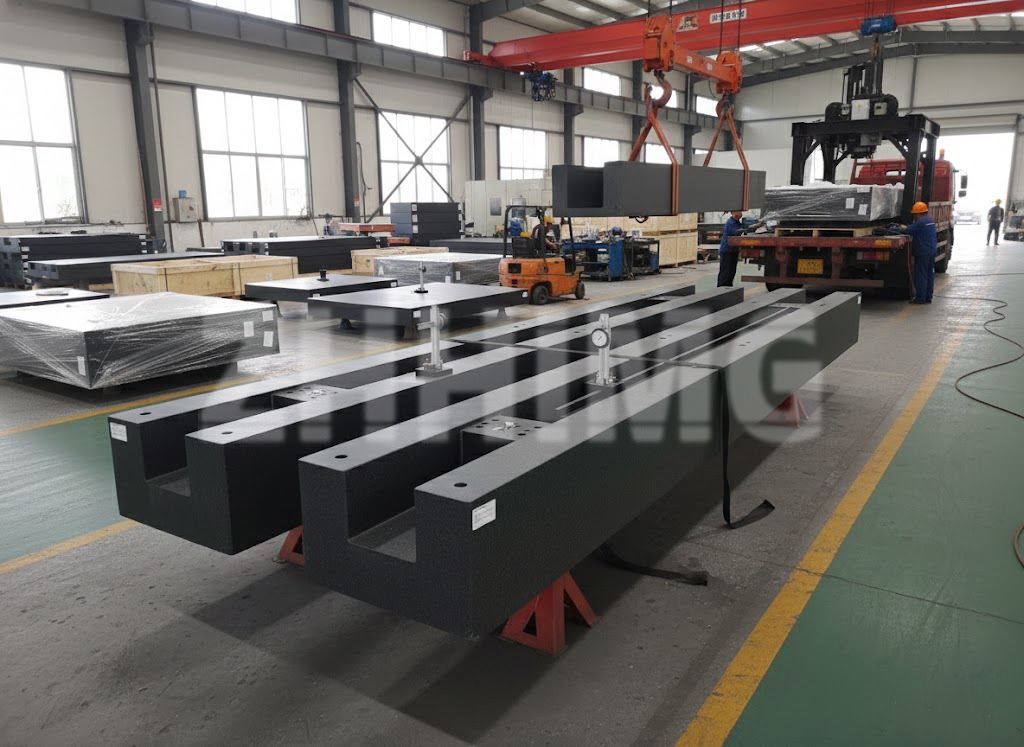
Facilities equipped with German Mahr precision measuring systems achieving 0.5 micrometer resolution, Swiss Wyler level indicators, and Renishaw laser interferometers demonstrate commitment to measurement accuracy that matches their machining precision. The availability of large-scale processing capabilities, including the ability to machine components reaching 20 meters in length, 4,000mm width, and 1,000mm thickness becomes essential as semiconductor equipment continues scaling up in size. Some manufacturers operate climate-controlled workshops exceeding 10,000 square meters with isolation trenches 500mm wide and 2,000mm deep to prevent ambient vibration transmission.
Material Verification and Traceability
Request detailed material certifications including mineral composition analysis, physical property testing, and origin documentation. Suppliers should maintain comprehensive records demonstrating that granite materials meet specified density, absorption, and thermal expansion requirements. Water absorption rates should remain below 0.01% for premium applications.
The most reliable manufacturers conduct extensive testing on various granite sources worldwide, maintaining detailed performance analysis reports for each material type. This scientific approach to material selection ensures consistent quality across production batches and protects customers from the material substitution issues that periodically affect the industry.
Industry Trajectory and Future Considerations
The precision granite components market is experiencing growth driven by semiconductor industry expansion, with projections indicating continued increases in demand through the end of the decade. Several trends are shaping the future landscape.
Advanced packaging technologies, including chiplet architectures and 3D stacking, are creating new applications for precision granite in bonding and inspection equipment. Simultaneously, the drive toward larger wafer sizes—transitioning from 300mm to 450mm processing—will require granite components of unprecedented scale, testing the limits of manufacturing capabilities.
Materials innovation continues alongside traditional granite applications. Hybrid structures combining granite with ceramic or composite elements are emerging for applications requiring specific balances of stiffness, weight, and thermal performance. Carbon fiber reinforced granite offers improved damping characteristics, while silicon carbide components provide higher stiffness-to-weight ratios for certain motion system applications.
For procurement professionals and technical managers, staying informed about these developments while establishing relationships with capable, certified suppliers will prove essential for maintaining competitive advantage in an increasingly demanding semiconductor equipment marketplace.
Ready to explore precision granite solutions engineered specifically for semiconductor manufacturing requirements? Visit www.ZHHIMG-group.com to discover how certified manufacturing capabilities and decades of precision expertise can support your next-generation equipment development.
Post time: May-18-2026