
In the exacting realm of precision metrology and high-tech manufacturing, the accuracy of any measurement is fundamentally limited by the stability of the reference plane upon which it is conducted. Whether supporting a Coordinate Measuring Machine (CMM), serving as a master surface plate, or forming the structural base of a precision machine tool, the material chosen for this foundation is a critical engineering decision. As industries such as aerospace, semiconductor manufacturing, and automotive engineering push toward increasingly tighter tolerances—often venturing into the sub-micron range—the debate over the optimal material for these foundational components has intensified. The three primary contenders in this arena are Cast Iron, Granite, and Advanced Technical Ceramics. Each material offers a distinct profile of physical properties, advantages, limitations, and cost implications. This comprehensive analysis will explore the characteristics of granite, ceramic, and cast iron, providing a detailed comparison to guide engineers and metrologists in selecting the most appropriate material for their specific precision measurement applications.
The Traditional Standard: Cast Iron
For over a century, cast iron served as the undisputed bedrock of industrial measurement and machine tool construction. Its historical dominance is rooted in a unique combination of mechanical properties that made it highly suitable for the demands of traditional manufacturing environments.
Advantages of Cast Iron
The primary advantage of cast iron lies in its exceptional stiffness and structural rigidity. With a high modulus of elasticity, cast iron platforms can support immense loads without undergoing significant deflection . This characteristic makes cast iron indispensable in heavy-duty applications, such as the assembly and inspection of large engine blocks or massive aerospace structural components, where the sheer weight of the workpiece could potentially deform a less rigid material .
Furthermore, cast iron is renowned for its outstanding vibration damping capacity. The microstructure of gray cast iron contains graphite flakes, which act as internal friction points, effectively absorbing and dissipating vibrational energy . In a dynamic shop floor environment—characterized by the movement of heavy machinery, forklifts, and stamping presses—these vibrations can severely disrupt sensitive measurements. Cast iron’s ability to attenuate these disturbances ensures that measurements remain stable even in less-than-ideal conditions .
Additionally, cast iron is relatively easy to machine and scrape. The traditional art of hand scraping allows skilled technicians to create a highly accurate surface with specific “bearing points.” These points can hold lubricating oil, which reduces friction for sliding components and measuring instruments, facilitating smooth operation . From a cost perspective, cast iron is generally the most affordable of the three materials, both in terms of raw material and manufacturing processes .
Limitations of Cast Iron
Despite its historical prevalence, cast iron possesses significant drawbacks that limit its utility in modern, ultra-high-precision metrology. The most critical vulnerability is its high coefficient of thermal expansion (CTE), typically around 11 × 10⁻⁶/°C . Iron expands and contracts noticeably with even minor temperature fluctuations. In environments without strict climate control, the daily thermal cycling of a factory can cause a cast iron plate to warp or change dimensions, leading to unacceptable measurement drift . To maintain high precision, cast iron requires a strictly constant temperature environment, which significantly increases facility operating costs .
Moreover, cast iron is highly susceptible to corrosion. Without rigorous and continuous maintenance, including regular oiling and cleaning, rust can quickly form. Rust pits the surface, permanently destroying the accuracy of the tool . Cast iron is also vulnerable to impact damage in a specific way: if a heavy object is dropped on it, the ductile iron deforms and raises a “burr”—a protruding ridge of metal . This burr will lift measuring probes or workpieces, causing immediate measurement errors, and must be painstakingly stoned down to restore the surface’s flatness .
The Modern Metrology Benchmark: Granite
In the latter half of the 20th century, granite emerged as a superior alternative for high-precision metrology, largely supplanting cast iron for CMM bases and laboratory-grade surface plates. Sourced from natural igneous rock formations that have stabilized over millions of years, granite offers an internal stability that is difficult for man-made materials to replicate.
Advantages of Granite
The most critical advantage of granite is its exceptionally low coefficient of thermal expansion, typically around 5.6 × 10⁻⁶/°C, which is roughly half that of cast iron . This thermal stability means that granite platforms are far more forgiving of ambient temperature variations . They act as thermal heat sinks, maintaining their flatness and dimensional integrity even in environments where perfect climate control is challenging to achieve . This makes granite the ideal choice for maintaining strict tolerances over extended periods.
Beyond its thermal characteristics, granite is chemically inert. It does not rust, nor does it react with coolants, oils, or acids commonly found in manufacturing environments . This non-corrosive nature significantly reduces the maintenance burden compared to cast iron; a simple wipe-down with an appropriate cleaner is often sufficient to keep the surface in pristine condition .
Another unique and highly beneficial property of granite is its behavior upon impact. Unlike cast iron, which raises a burr, granite is a brittle, crystalline structure. When struck by a heavy object, it tends to chip or crater . In a measurement context, a depression (crater) is far less detrimental to accuracy than a protrusion (burr), as it does not lift the measuring probe or the part being inspected . The surrounding surface remains flat, ensuring that the overall inspection plane is uncompromised . Furthermore, granite is naturally non-magnetic and electrically non-conductive, which is essential for inspecting electronic components or delicate magnetic materials where electromagnetic interference must be strictly avoided .
Limitations of Granite
While granite is the industry standard, it is not without its limitations. As a brittle material, it handles static loads exceptionally well but has lower impact resistance compared to the ductility of iron . A severe shock can crack or fracture the stone, rendering it useless. Additionally, granite is slightly porous. If not properly sealed or if incorrect, water-based cleaning agents are used, it can absorb moisture, which could potentially lead to subtle warping over extended periods .
Granite is also heavy, requiring robust support structures, and it is difficult to modify. Unlike cast iron, one cannot simply drill and tap a granite plate for custom fixtures without specialized equipment and a significant risk of compromising the structural integrity or surface flatness .
The High-Performance Specialist: Advanced Ceramics
As manufacturing demands push into the nanometer realm, particularly in the semiconductor and advanced optics industries, technical ceramics (such as Alumina or Silicon Carbide) have entered the metrology arena as the ultimate high-performance material.
Advantages of Ceramics
Ceramics are engineered to deliver unparalleled performance for the most demanding applications. Their standout feature is an exceptionally low coefficient of thermal expansion, often near zero and significantly lower than even granite . This ensures that the measurement structure remains virtually invariant regardless of thermal gradients, providing the ultimate in dimensional stability .
Furthermore, technical ceramics offer a specific stiffness (the ratio of stiffness to density) that is vastly superior to both granite and cast iron . Ceramics are exceptionally stiff yet significantly lighter . This property is crucial for the design of moving structures, such as CMM bridges or high-acceleration linear stages. The lightweight nature allows for rapid acceleration—increasing inspection throughput—while the extreme rigidity prevents vibration or deflection during dynamic measurement .
Ceramics are also incredibly hard, often significantly harder than granite, offering superior wear resistance in high-intensity production lines or when measuring abrasive materials . This extreme hardness translates to a lifespan that can exceed that of both iron and stone, maintaining pristine geometric integrity over long periods of heavy use. Like granite, ceramics are chemically inert, non-magnetic, and immune to corrosion.
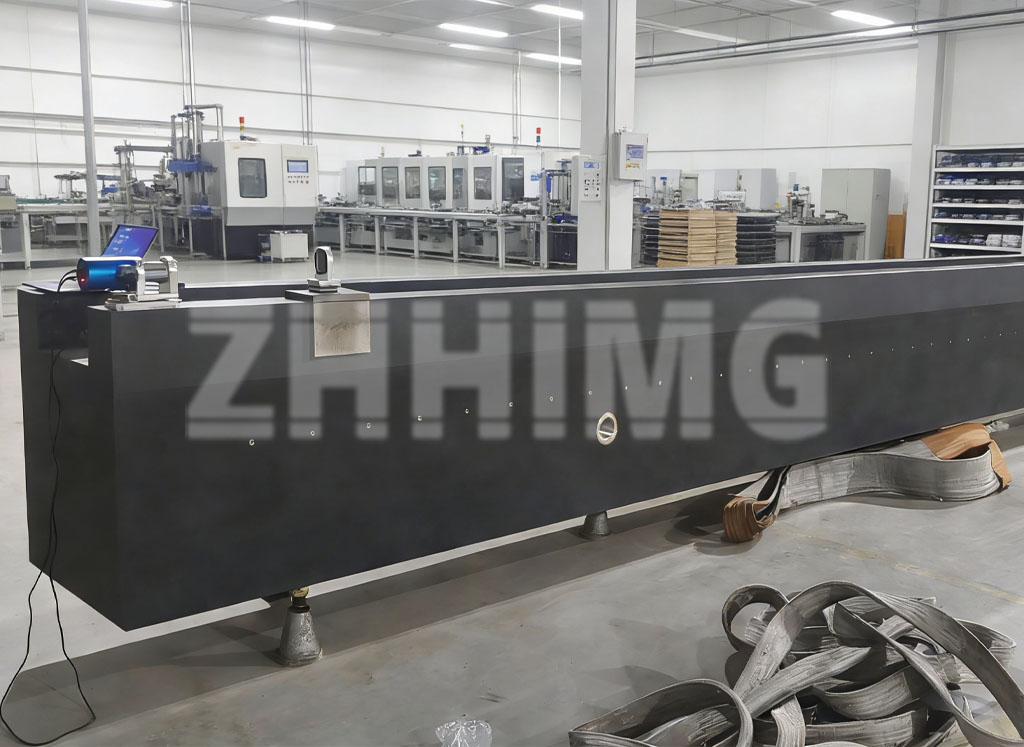
Limitations of Ceramics
The primary barrier to the widespread adoption of ceramic measuring tools is their cost. Ceramic is exponentially more expensive to produce than cast iron or granite, especially at large scales . The manufacturing process involves complex sintering and precision grinding, which is highly time-consuming and energy-intensive . For large-format inspection tables, the cost of sintered ceramics is often prohibitive, making granite the more economically viable choice for achieving absolute flatness .
Additionally, while extremely hard, ceramics are the most fragile of the three materials regarding tensile stress and impact . They cannot withstand shock loading or bending forces well and are susceptible to catastrophic fracture if dropped or mishandled. Consequently, ceramic is rarely used for general-purpose shop floor surface plates, being reserved instead for specialized applications where sub-micron accuracy is an absolute requirement and the budget permits .
Comparative Analysis and Selection Criteria
When selecting the optimal material for precision measuring tools, engineers must carefully balance performance requirements, environmental conditions, and budget constraints.
When to Choose Cast Iron
Cast iron remains a viable and cost-effective choice for general manufacturing, heavy fabrication, and shop floor inspection where extreme precision is not the primary driver . Its ability to withstand the rigors of a harsh production environment, combined with its excellent vibration damping and high load-bearing capacity, makes it suitable for heavy-duty applications . It is particularly appropriate when the budget is constrained, and the facility can manage the necessary maintenance to prevent rust and the environmental controls to mitigate thermal expansion.
When to Choose Granite
Granite is the undisputed champion for the vast majority of high-precision metrology applications. For quality control laboratories, CMM bases, and high-precision surface plates, granite offers the best “sweet spot” between high performance and operational ease . Its superior thermal stability, immunity to rust, and favorable impact behavior (chipping rather than burring) make it the industry standard . Granite provides a reliable, low-maintenance reference plane that ensures accuracy without the astronomical costs associated with advanced ceramics.
When to Choose Ceramic
Advanced ceramics are the material of choice for ultra-high-tech sectors where the highest possible speed, stiffness, and thermal stability are non-negotiable . Applications such as semiconductor lithography equipment, aerospace turbine blade inspection, and ultra-high-precision CMM moving components benefit immensely from the lightweight rigidity and near-zero thermal expansion of ceramics . Ceramics should be selected when the application demands sub-micron accuracy in dynamic environments, and the significant investment can be justified by the required performance gains.
Conclusion
The selection of a material for precision metrology—whether cast iron, granite, or ceramic—is not a matter of identifying a universally superior option, but rather matching the material’s specific physical properties to the demands of the application. Cast iron offers rugged durability and vibration damping for heavy industry; granite provides the essential thermal stability and low maintenance required for standard high-precision metrology; and advanced ceramics push the boundaries of speed and accuracy for the most extreme technological applications. By understanding the nuanced advantages and limitations of each material, manufacturers and metrologists can make informed decisions that ensure the integrity of their measurements, optimize their investments, and maintain the highest standards of quality in an increasingly precise industrial landscape.
Post time: May-15-2026