
In the realm of high-precision manufacturing and metrology, the choice of material for measuring instruments is paramount. The accuracy, reliability, and longevity of critical measurements often hinge on the fundamental properties of the tools themselves. Among the most widely utilized materials for precision instruments are granite and advanced ceramics. Both offer distinct advantages and disadvantages, making the selection process a nuanced decision influenced by specific application requirements, environmental conditions, and budgetary considerations. This article aims to provide a comprehensive comparison between ceramic and granite measuring tools, delving into their inherent material properties, performance characteristics, typical applications, and key factors to consider when making an informed choice for ultra-precision inspection and calibration.
Fundamental Material Properties: A Comparative Analysis
Understanding the intrinsic properties of granite and ceramics is crucial for appreciating their respective roles in precision metrology. While both are chosen for their stability, their underlying characteristics lead to different performance profiles.
Hardness and Wear Resistance
Granite: Precision granite, typically sourced from dense black granite (such as Jinan Black), possesses a Mohs hardness of 6-7 . This high hardness contributes to its strong wear resistance, making it durable against long-term pressure and friction. Granite measuring tools are less prone to scratching or deformation, making them suitable for high-frequency, heavy-load precision measurement scenarios . However, granite surfaces can be susceptible to wear in environments with high tool usage or heavy loads, potentially affecting flatness over extended periods .
Ceramics: Advanced technical ceramics, particularly alumina (Al₂O₃) ceramics, exhibit significantly higher hardness, often ranging from 1200–1400 HV, which is 3–4 times that of granite . This extreme hardness translates into exceptional wear and scratch resistance. Ceramic tools are highly resistant to micro-deformations caused by repeated contact with metal parts or precision instruments, ensuring superior long-term geometric integrity. This makes them particularly advantageous for laboratories measuring aerospace components, engine parts, or semiconductor substrates where maintaining surface integrity is critical .
Thermal Stability and Coefficient of Thermal Expansion (CTE)
Granite: Granite boasts an exceptionally low coefficient of linear thermal expansion (CTE), typically around 5 × 10⁻⁶/K, which is approximately half that of steel . This property means that granite’s dimensions change minimally with temperature fluctuations, reducing thermal expansion-induced errors. Furthermore, granite has low thermal conductivity, giving it excellent thermal inertia and a slow response to ambient temperature changes. This makes granite measuring tools highly stable in environments with controlled temperatures, such as constant temperature workshops and precision laboratories .
Ceramics: Alumina ceramics exhibit an even lower CTE, generally in the range of 4–6 × 10⁻⁶/°C . This makes ceramics exceptionally dimensionally stable across varying temperatures. The lower thermal expansion in alumina ceramics ensures sub-micron repeatability, which is particularly crucial when measuring high-precision components where even minor thermal shifts can compromise tolerances. While both materials offer superior thermal stability compared to metals, ceramics generally provide a slight edge in minimizing measurement error due to thermal expansion, especially in temperature-sensitive applications .
Vibration Damping Capabilities
Granite: Granite’s unique crystalline structure provides excellent natural vibration damping capabilities. It can effectively absorb and dissipate vibrational energy, isolating sensitive components from external disturbances . This characteristic is vital for maintaining stability during dynamic operations, enabling sub-micron or nanometer-level precision. In applications like CMMs or precision machine bases, granite’s damping properties help ensure measurement accuracy by quickly attenuating vibrations .
Ceramics: While ceramics also possess good stiffness, their vibration damping capabilities are generally considered moderate compared to granite . The high stiffness of ceramics can sometimes lead to a higher natural frequency, which might require additional damping solutions in extremely vibration-sensitive environments. However, for many precision applications, the inherent stiffness of ceramics is sufficient to mitigate common vibrational issues.
Non-Magnetic and Corrosion Resistance
Granite: Granite is a naturally non-magnetic material, which is a significant advantage in environments where electromagnetic interference must be strictly controlled, such as in semiconductor manufacturing or where sensitive electronic probes are used . It is also generally resistant to acid and alkali corrosion, though its resistance can be less robust than ceramics when exposed to highly corrosive chemicals . Granite does not rust and does not require lubrication, making it suitable for cleanroom environments as it avoids potential contamination sources .
Ceramics: Alumina ceramics are chemically inert and exhibit superior corrosion resistance, making them unaffected by coolants, oils, laboratory cleaning agents, humidity, and airborne contaminants . They are immune to oxidation and can resist erosion by a wide range of chemical reagents, making them ideal for measurement work in harsh chemical environments . This chemical inertness also contributes to their suitability for cleanroom applications, as they do not shed particles or generate static electricity .
Weight and Portability
Granite: Due to its high density, granite is a heavy material. This weight contributes to its inherent stability but makes granite measuring tools less portable. They are typically suited for fixed-station measurements, such as workshop platforms and laboratory calibration setups, often requiring specialized equipment for movement .
Ceramics: Ceramics are significantly lighter than granite. This lighter texture makes ceramic measuring tools easier to carry and operate on-site, making them particularly suitable for outdoor inspections or applications requiring frequent movement . This portability can be a decisive factor in field metrology or flexible manufacturing environments.
Cost Implications
Granite: The raw material mining and processing technology for high-precision granite can be complex, contributing to its cost. While generally more affordable than advanced ceramics for large-scale applications like surface plates, high-end granite components for ultra-precision machines can still represent a significant investment. They are suitable for scenarios with strict requirements on precision and long-term life where the budget allows .
Ceramics: Advanced technical ceramics often involve more complex manufacturing processes, including sintering at high temperatures, which can lead to higher initial costs compared to standard granite components. However, their exceptional wear resistance and longer service life in abrasive or harsh environments can lead to lower replacement costs and maintenance over time, offering a strong cost-benefit ratio in specific applications . For smaller, intricate components, ceramics might be more cost-effective due to their superior performance characteristics.
Application Scenarios: Matching Material to Need
The optimal choice between ceramic and granite measuring tools largely depends on the specific demands of the application.
Where Granite Excels
Granite remains the material of choice for a wide array of precision applications, particularly where large, stable reference surfaces are required:
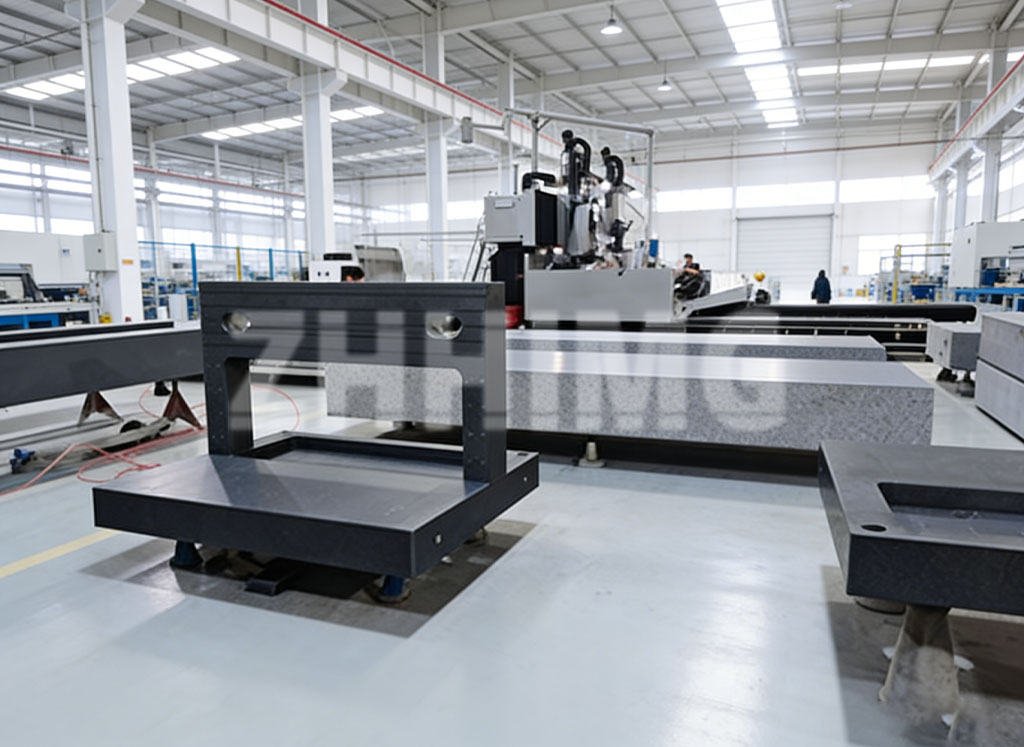
•Coordinate Measuring Machines (CMMs): The base plates and moving bridges of CMMs almost universally utilize granite due to its excellent dimensional stability, vibration damping, and non-magnetic properties, ensuring accurate and repeatable measurements over large volumes .
•Precision Surface Plates: Granite surface plates are the industry standard for providing a flat reference plane for inspection, layout, and calibration tasks. Their inherent stability and ability to be lapped to extremely tight tolerances make them indispensable in metrology labs and quality control departments .
•Machine Tool Bases: For high-precision CNC machines, grinding machines, and other manufacturing equipment, granite bases provide a rigid, vibration-damped foundation that enhances machining accuracy and surface finish .
•General Laboratory Inspection: For standard laboratory inspections and general-purpose precision tool calibration, granite offers a reliable and cost-effective solution, especially for 000-grade precision applications .
Where Ceramics Offer Superiority
Advanced ceramics shine in applications demanding the highest levels of hardness, wear resistance, and thermal stability, often in more extreme or dynamic environments:
•Semiconductor and Photolithography Equipment: For high-speed motion stages and critical components in semiconductor manufacturing, the high stiffness-to-weight ratio, ultra-low CTE, and vacuum compatibility of technical ceramics are non-negotiable. They are crucial for achieving the nanometer-scale precision required in lithography and wafer inspection .
•Aerospace Component Inspection: Measuring complex aerospace components often involves contact with hard, abrasive materials. Ceramic tools’ superior hardness and wear resistance ensure long-term geometric integrity and accuracy in such demanding inspection environments .
•High-Contact and Abrasive Environments: In scenarios where measuring tools are subjected to frequent contact or abrasive conditions, ceramics maintain their precision for longer periods, reducing the need for frequent recalibration or replacement .
•Temperature-Sensitive Measurements: For applications where ambient temperature fluctuations are unavoidable or where the highest thermal stability is paramount, the even lower CTE of ceramics provides a distinct advantage in minimizing measurement errors .
•Chemical and Cleanroom Environments: Ceramics’ chemical inertness and non-shedding properties make them ideal for use in harsh chemical environments or ultra-clean facilities where contamination is a critical concern .
Choosing the Right Instrument: Key Considerations
Making the optimal choice between ceramic and granite measuring tools requires a careful evaluation of several factors:
1.Required Precision Level: For ultra-precision applications (e.g., 000-grade and beyond), especially those sensitive to thermal shifts or wear, ceramics often offer a performance edge. For slightly less stringent but still high-precision needs, granite remains an excellent and often more economical choice.
2.Environmental Conditions: Consider the operating temperature range, presence of corrosive chemicals, and cleanliness requirements. Ceramics generally perform better in extreme chemical environments and offer superior compatibility with stringent cleanroom standards. Granite is excellent in temperature-controlled environments but less resistant to strong chemicals.
3.Dynamic vs. Static Applications: For static reference surfaces or bases requiring excellent vibration damping, granite is often preferred. For dynamic components requiring high stiffness-to-weight ratios and extreme wear resistance, ceramics may be more suitable.
4.Budget and Lifecycle Cost: While ceramics might have a higher initial cost, their extended lifespan and reduced maintenance in demanding applications can lead to a lower total cost of ownership. Granite often presents a more cost-effective solution for larger, less dynamic components.
5.Size and Weight Constraints: If portability or weight reduction is a critical factor, ceramics are the clear winner. For large, fixed installations where mass contributes to stability, granite is typically chosen.
6.Specific Material Interactions: Consider what materials the measuring tool will come into contact with. If abrasive materials are frequently measured, the superior hardness of ceramics will be beneficial.
Conclusion
Both ceramic and granite measuring tools are indispensable in the pursuit of precision in modern manufacturing. Granite, with its excellent vibration damping, thermal stability, and cost-effectiveness for large components, continues to be a benchmark material for many metrology applications. Advanced ceramics, on the other hand, push the boundaries of precision with their superior hardness, ultra-low thermal expansion, and chemical inertness, making them ideal for the most demanding and extreme environments in industries like semiconductor and aerospace.
The decision between these two formidable materials is not about identifying a universally
superior material, but rather about making an informed choice that aligns perfectly with the specific requirements of the application. Engineers and metrologists must carefully weigh the unique properties of each material against their operational needs, environmental conditions, and long-term strategic goals to select the instrument that will deliver the most accurate, reliable, and cost-effective precision measurements.
Post time: May-15-2026