
In the rapidly evolving landscape of high-tech manufacturing, the pursuit of absolute precision is a relentless endeavor. From the microscopic intricacies of semiconductor fabrication to the macroscopic demands of aerospace engineering, every stage of production requires unparalleled dimensional stability, vibration suppression, and thermal management. Against this backdrop, precision granite components have emerged as a foundational element, providing the critical stability required for ultra-precise equipment. Despite being a natural material that has been utilized for centuries, granite’s unique physical properties make it an indispensable asset in modern high-tech industries. This article delves into the critical role of precision granite components in advanced manufacturing, exploring their inherent advantages, key applications, the engineering processes involved in their creation, and the future trends that will continue to shape their utilization.
The Inherent Advantages of Granite: Why Choose an Ancient Material?
The prominence of precision granite in high-tech manufacturing is not a matter of tradition but a direct result of its exceptional physical characteristics. These properties allow granite to outperform many synthetic materials when subjected to the rigorous demands of modern industrial applications, where precision, stability, and reliability are paramount.
Exceptional Vibration Damping Capabilities
Vibration is arguably the most significant adversary in precision manufacturing. Even the slightest external disturbance or internal mechanical movement can cause micro-displacements in equipment components, leading to critical errors in machining or measurement. Granite possesses a unique internal crystalline structure that endows it with outstanding vibration damping capabilities. Compared to traditional metallic materials such as steel or cast iron, granite can absorb and dissipate vibrational energy much more rapidly and effectively . This natural damping characteristic ensures that granite bases can isolate sensitive components from external vibrations, maintaining extreme stability during dynamic operations. This capability is essential for achieving sub-micron or even nanometer-level operational precision. For instance, in high-speed precision machine tools, a granite base can quickly attenuate vibrations generated by moving parts, thereby safeguarding the surface finish and dimensional accuracy of the machined components.
Superior Thermal Stability and Low Coefficient of Thermal Expansion
Temperature fluctuations are a primary cause of dimensional changes and performance drift in precision equipment. In manufacturing environments, even minor temperature variations can lead to material expansion or contraction, compromising the geometric accuracy of the equipment and the quality of the final product. Granite exhibits an exceptionally low coefficient of linear thermal expansion, which is approximately half that of steel and significantly lower than that of aluminum . This means that under identical temperature changes, the dimensional variation of granite is minimal, thereby maximizing the reduction of dimensional errors caused by thermal fluctuations. Furthermore, granite has a low thermal conductivity, which results in a very slow response to changes in ambient temperature, demonstrating excellent thermal inertia. This characteristic is crucial for manufacturing processes that require extremely high repeatability and alignment accuracy, such as the layer-to-layer alignment in semiconductor lithography. Even if the ambient temperature experiences minor fluctuations, a granite base can maintain its geometric stability, ensuring the precision of the lithography process and thereby securing the yield and performance of semiconductor chips .
Inherent Stress-Free Characteristics
Unlike metallic materials, which can develop and retain internal residual stresses during casting or welding processes, granite is a geological material that has formed naturally over millions of years. These residual stresses in metals can lead to gradual deformation over time, compromising the long-term stability of the equipment. Granite, on the other hand, is essentially “pre-aged.” Once it has undergone precision machining and stress relief processes, a granite base will not experience creep or deformation over time . This long-term dimensional stability is invaluable for high-tech equipment, as it ensures that the machinery can maintain its initial geometric accuracy throughout its entire lifecycle. This reliability reduces the frequency of maintenance and calibration, thereby lowering operational costs and enhancing overall production efficiency.
Non-Magnetic and Corrosion-Resistant Properties
In fields such as semiconductor manufacturing and precision measurement, electromagnetic interference is a critical factor that must be strictly controlled. Such interference can adversely affect the performance of sensitive electronic components or the accuracy of measurement probes. Granite is a non-magnetic material, meaning it will not generate magnetic fields that could interfere with sensitive electronics or measurement devices . This property gives granite a significant advantage in equipment that requires a highly precise electromagnetic environment. Additionally, granite boasts excellent corrosion resistance. It does not rust and does not require anti-rust treatments or lubrication like metals do. This characteristic makes granite particularly well-suited for cleanroom environments, as it eliminates potential sources of contamination, such as metal oxide particles or volatile organic compounds from lubricants. This ensures compliance with the stringent requirements of cleanrooms, which is essential for the production of high-purity, high-reliability products.
Key Applications in High-Tech Manufacturing
The application of precision granite components extends far beyond simple support platforms. They are deeply integrated into the most critical subsystems of high-tech manufacturing, serving as the cornerstone for ultra-precise operations and supporting numerous cutting-edge technologies in modern industry.
Semiconductor Manufacturing
The semiconductor industry is the most critical application area for precision granite components. The continuous advancement of Moore’s Law demands that chip feature sizes reach the nanometer scale, which in turn requires manufacturing platforms to achieve unprecedented levels of stability. Granite structures provide an unshakable foundation for several key processes in semiconductor fabrication.
Lithography and Steppers: Lithography machines are the most critical and expensive equipment in semiconductor manufacturing. They use light to print circuit patterns onto silicon wafers. During the exposure process, the reticle and the wafer must be perfectly aligned and remain absolutely stationary. Any minute displacement can lead to pattern distortion. Granite stages and bases provide the rigid, vibration-free platforms necessary to achieve this process. In Extreme Ultraviolet (EUV) lithography, granite’s ability to suppress micro-vibrations makes it the material of choice for the main bodies of these multi-million-dollar machines, ensuring the precise transfer of nanometer-scale patterns .
Wafer Inspection and Metrology: Before chips are packaged, they must undergo rigorous defect inspection and dimensional metrology to ensure product quality. High-speed optical inspection systems require extreme stability when scanning wafers to prevent image blurring or measurement errors caused by vibration. Granite structures, with their high stiffness-to-weight ratio and damping characteristics, can instantaneously absorb inertial forces. This allows inspection cameras to stabilize and focus within milliseconds, thereby increasing the throughput of the equipment without sacrificing resolution .
Wire Bonding and Die Attach: During the packaging phase, ultra-fine gold wires are precisely bonded to chip pads, or chips are accurately attached to substrates. This process requires sub-micron precision at high speeds, placing immense demands on the stability of the equipment. Granite bases provide the necessary rigidity to support these highly dynamic movements while maintaining the stability of the work area, preventing bonding failures or attachment deviations caused by micro-vibrations .
Coordinate Measuring Machines (CMMs) for Wafers: Quality control in the semiconductor industry relies heavily on CMMs to verify the dimensional accuracy of wafers and packages. These machines almost universally employ granite for their moving bridges and base plates. Granite’s non-magnetic properties also play a crucial role here, ensuring that the sensitive electronic probes used to measure wafers are not affected by magnetic interference .
Precision Measurement and Calibration
In metrology laboratories and quality control departments, precision granite surface plates and measuring tools are standard equipment. They provide an ideal reference plane for various measurement tasks, ensuring the accuracy and repeatability of measurement results. Granite’s dimensional stability, low thermal expansion, and exceptional flatness make it the foundational material for calibrating other measuring tools and equipment .
Laser Processing and Optical Systems
Laser processing techniques, such as laser cutting, welding, marking, and micro-drilling, require extremely high positioning accuracy and stability. Granite bases can effectively suppress the vibrations generated when the laser head moves at high speeds and provide a stable optical platform. This ensures the precise focusing and path control of the laser beam, thereby achieving high-precision processing results. In precision optical systems, granite is used to support delicate optical components, such as lenses, mirrors, and prisms, preventing alignment deviations caused by vibration or thermal deformation .
High-Precision CNC Machine Tools and Robotics
Modern high-precision CNC machine tools and robotic systems, particularly in the fields of micro-machining and ultra-precision machining, are increasingly adopting granite as a key structural component. The rigidity and damping characteristics of granite help improve the dynamic performance and machining accuracy of the machine tools, reduce tool vibration, extend tool life, and ultimately enhance the surface quality and dimensional accuracy of the workpieces.
The Engineering of the “Perfect” Stone
Transforming natural granite into precision components that meet the demands of high-tech manufacturing is a complex engineering process that involves meticulous material selection, precision machining, and advanced integration technologies.
Material Selection and Pre-Processing
Not all granite is suitable for precision applications. The industry typically selects “black granite” (such as diabase or basalt) with a fine-grained structure and high density. These materials are favored for their superior physical properties, which ensure the stability and reliability of the final product. Before machining, the raw stone undergoes a natural aging process to further release internal stresses, ensuring the long-term stability of the final product.
Precision Machining and Lapping
Processing raw stone blocks into semiconductor-grade components is a feat of precision engineering. The surfaces must undergo multiple grinding and polishing processes to achieve extremely tight flatness tolerances, often reaching the micron or even sub-micron level over several meters. This requires a combination of advanced CNC machining technologies and traditional hand-scraping techniques. The surface finish must be smooth enough to support the operation of air bearings without generating friction or turbulence .
Inserts and Functional Integration
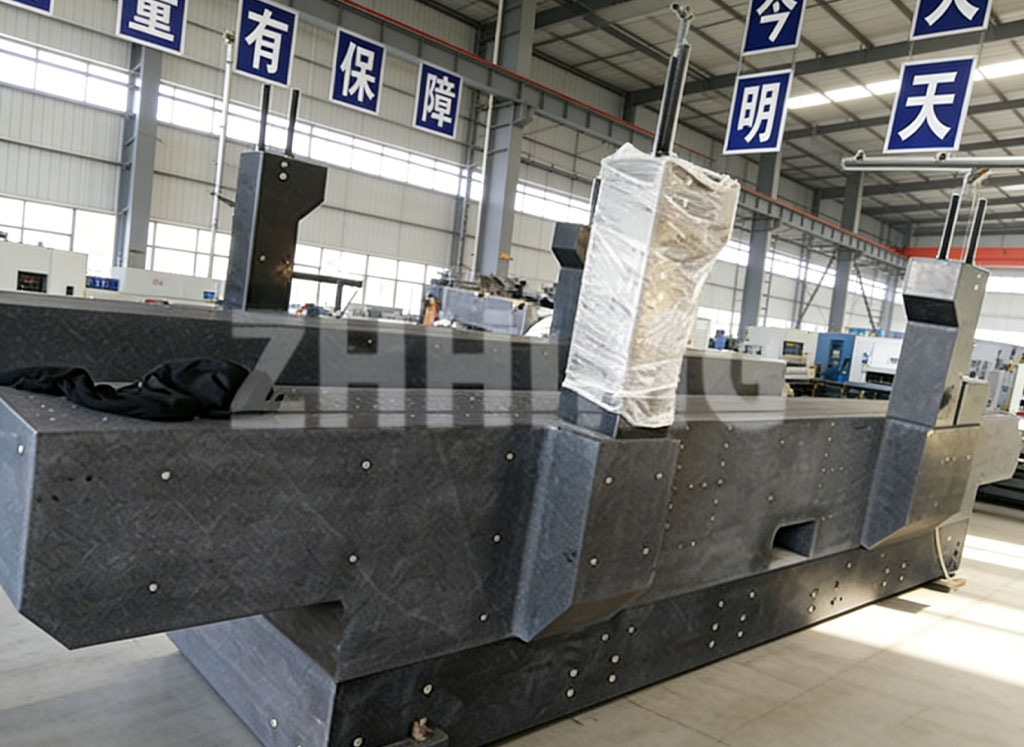
Modern precision granite components are not simple flat plates; they are complex integrated structures. Manufacturers securely bond stainless steel threaded inserts into the granite for mounting motors, sensors, and optical components. Advanced epoxy resin technologies ensure that these metal inserts form a strong and dimensionally stable connection with the granite, creating a “hybrid” structure that combines the stability of stone with the mounting convenience of metal. Furthermore, complex grooves, holes, and guideways can be precisely machined into the granite according to design requirements .
Cleanroom Compatibility
Semiconductor fabrication facilities are strictly controlled environments. Granite possesses natural chemical inertness; it does not rust, does not require oiling, and does not shed particles or generate static electricity. This makes it an ideal choice for ISO Class 1 cleanrooms, avoiding potential sources of contamination .
Future Outlook
As the industry advances toward 2-nanometer and even 1-nanometer process nodes, the requirements for stability will become even more stringent, further highlighting the importance of precision granite components. Natural granite, with its proven long-term reliability, remains the industry benchmark. Additionally, the trend toward larger wafer sizes (450mm and above) necessitates larger and more rigid structures. Granite can be manufactured into massive sizes several meters long without losing its structural integrity, giving it a distinct advantage over materials like cast iron .
In the future, precision granite components will continue to deeply integrate with advanced sensing technologies, active vibration control systems, and AI-driven manufacturing processes. For example, by integrating sensor networks into granite bases, it will be possible to monitor temperature, vibration, and stress in real-time, and use intelligent algorithms for predictive maintenance and dynamic compensation, further enhancing the overall precision and reliability of the systems. In emerging fields such as nanomanufacturing, quantum computing, biotechnology, and space exploration, the demand for extreme stability and ultra-high precision will make the role of precision granite even more irreplaceable.
Conclusion
In the rapidly changing world of high-tech manufacturing, it is easy to overlook the elements that form its foundation. However, without the “silent” stability of precision granite components, the miracles of modern computing—smartphones, AI processors, and cloud computing servers—would simply be impossible to realize. By providing an indestructible platform capable of resisting heat, vibration, and the ravages of time, granite ensures that the microscopic world of silicon can be manipulated with absolute precision. As we continue to push the boundaries of physics, this ancient stone will continue to serve as the cornerstone of the digital age, supporting future innovation and development, and its value will only increase as technology advances.
Post time: May-15-2026