
In the world of industrial metrology, granite surface plates often steal the spotlight for their exceptional flatness and thermal stability in controlled laboratory settings. However, when we step out of the pristine environment of a quality control lab and onto the rugged, dynamic floor of a heavy manufacturing plant, the requirements for a precision reference tool change dramatically. This is where cast iron surface plates (often referred to as cast iron inspection or test platforms) prove their worth. While they may not always match the ultra-fine tolerances of laboratory-grade granite, their unique combination of toughness, vibration damping, and load-bearing capacity makes them the superior choice for heavy-duty industrial inspection.
Unmatched Vibration Damping for Dynamic Environments
One of the most compelling reasons to choose a cast iron surface plate in an industrial setting is its outstanding vibration damping capability. In a busy workshop filled with forklifts, stamping presses, and CNC machines, ambient vibration is a constant reality that can wreak havoc on sensitive measurements.
Cast iron, specifically high-strength gray cast iron (typically grades HT200 to HT300), possesses a unique microstructure containing flake graphite. This internal structure gives cast iron a damping coefficient that is 6 to 10 times greater than that of steel. Essentially, the material acts as a natural shock absorber, rapidly dissipating the energy from external vibrations or internal impacts. For inspectors measuring large, heavy components or operating dynamic testing equipment, a cast iron plate provides a “quiet,” stable baseline that ensures measurement readings remain accurate even in a noisy workshop environment.
Superior Load-Bearing Capacity and Toughness
Heavy-duty inspection often involves placing massive workpieces—such as engine blocks, turbine housings, or large welded frames—onto the reference surface. This is where the mechanical properties of cast iron truly shine.
Cast iron surface plates are engineered for immense strength. With compressive strengths reaching 200-300 MPa and surface hardness typically between HB170 and HB240, they can easily support loads ranging from several tons to dozens of tons without deforming. Manufacturers often enhance this capability by designing the plates with a box-type structure reinforced by a grid of internal ribs (often optimized using finite element analysis). This design maximizes rigidity while keeping the weight manageable, ensuring the surface remains flat even under extreme, concentrated pressure.
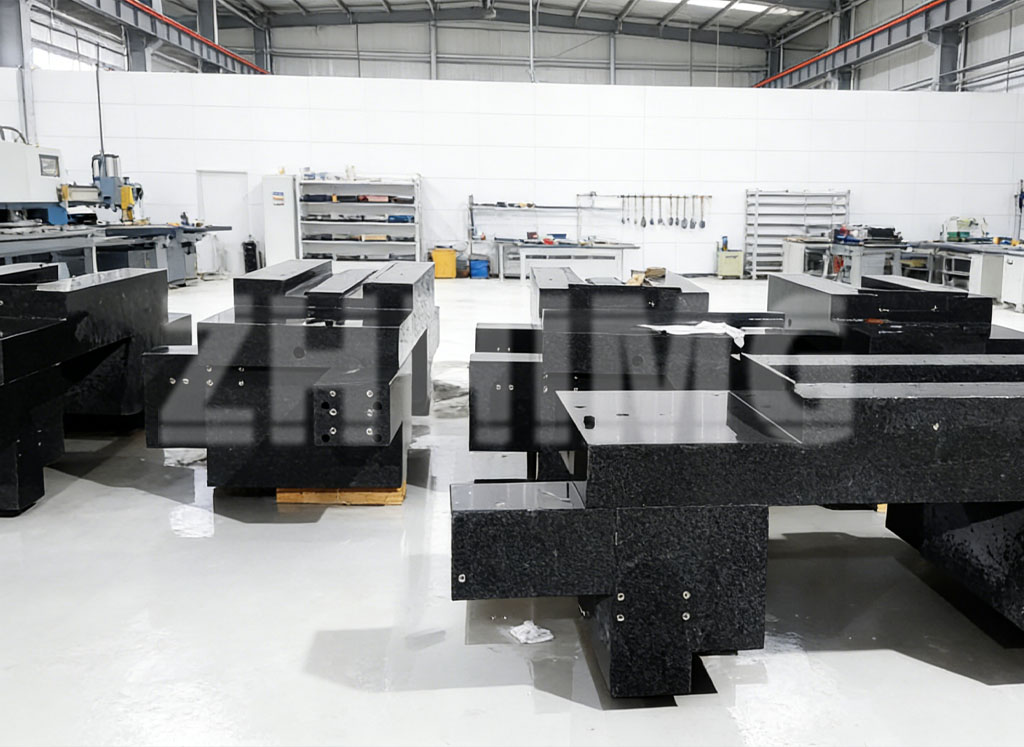
Furthermore, unlike granite, which can be brittle and prone to chipping or cracking if struck by a heavy metal part, cast iron is incredibly tough and impact-resistant. It can withstand the inevitable bumps, drops, and shocks of a production floor without suffering catastrophic damage. Additionally, cast iron is highly wear-resistant. The manual scraping process used to finish high-precision cast iron plates creates microscopic pockets on the surface that can hold trace amounts of oil, providing natural lubrication and ensuring the plate maintains its accuracy over years of sliding heavy parts across it.
Versatility in Fixturing and Assembly
In heavy industry, inspection is rarely just about laying a part on a flat table. It often involves complex setups, clamping, and assembly verification. Cast iron surface plates offer a level of functional versatility that solid stone or steel plates cannot match.
The surface of a cast iron plate can be easily machined to include T-slots, U-slots, or threaded holes. These features allow inspectors and assembly technicians to use T-bolts and clamps to securely fasten workpieces, fixtures, or even testing equipment directly to the plate. This “datum plus fixation” capability is invaluable. It prevents heavy or awkwardly shaped parts from shifting during measurement, drastically improving both safety and efficiency. Whether it is for aligning a large gearbox, setting up an engine for performance testing, or serving as a stable welding fixture, the cast iron plate transforms from a simple measuring tool into a multi-functional industrial workbench.
Long-Term Stability Through Rigorous Manufacturing
A common misconception is that cast iron is prone to warping. However, high-quality industrial cast iron plates undergo rigorous manufacturing processes specifically designed to eliminate this risk.
To ensure long-term geometric stability, reputable manufacturers subject the castings to strict aging treatments. This usually involves a combination of artificial aging (annealing at temperatures between 600°C and 700°C) and natural aging (allowing the casting to rest outdoors for 2 to 3 years). These processes relieve over 90% of the internal stresses generated during the casting process. As a result, a properly treated cast iron plate is incredibly resistant to deformation over time, maintaining its precision for decades.
Another distinct economic advantage of cast iron is its repairability. If a granite plate becomes damaged, it is often difficult or impossible to fix. In contrast, a worn or slightly damaged cast iron surface can be restored to its original factory precision through a process called re-scraping. This ability to refurbish the surface significantly extends the equipment’s lifecycle, making it a highly cost-effective investment for any industrial facility.
Conclusion: Matching the Tool to the Task
Choosing the right surface plate is about matching the material’s properties to your specific operational environment. If your work is confined to a temperature-controlled metrology lab requiring sub-micron accuracy for delicate parts, granite remains an excellent choice.
However, when your inspection tasks move to the heavy-duty industrial floor—where vibration is constant, workpieces weigh tons, impacts are likely, and complex fixturing is required—cast iron surface plates are the undisputed champions. Their robust load-bearing capacity, exceptional vibration damping, versatile T-slot configurations, and remarkable durability make them the ideal “iron shoulder” for heavy industry. By investing in a high-quality cast iron inspection platform, you are securing a stable, reliable, and long-lasting foundation for your most demanding manufacturing and testing challenges.
Post time: May-14-2026