
In the relentless pursuit of nanometer-scale accuracy, the manufacturing and semiconductor industries have increasingly turned away from traditional mechanical bearings toward a more sophisticated solution: precision granite air bearing ways. As machines become faster and requirements for precision become more stringent, the limitations of contact-based motion systems—such as friction, wear, and heat generation—have become significant bottlenecks. Custom-engineered granite air bearings represent a paradigm shift, combining the geological stability of natural stone with the frictionless efficiency of pressurized air film technology to redefine the boundaries of motion control performance.
The Synergy of Natural Material and Fluid Dynamics
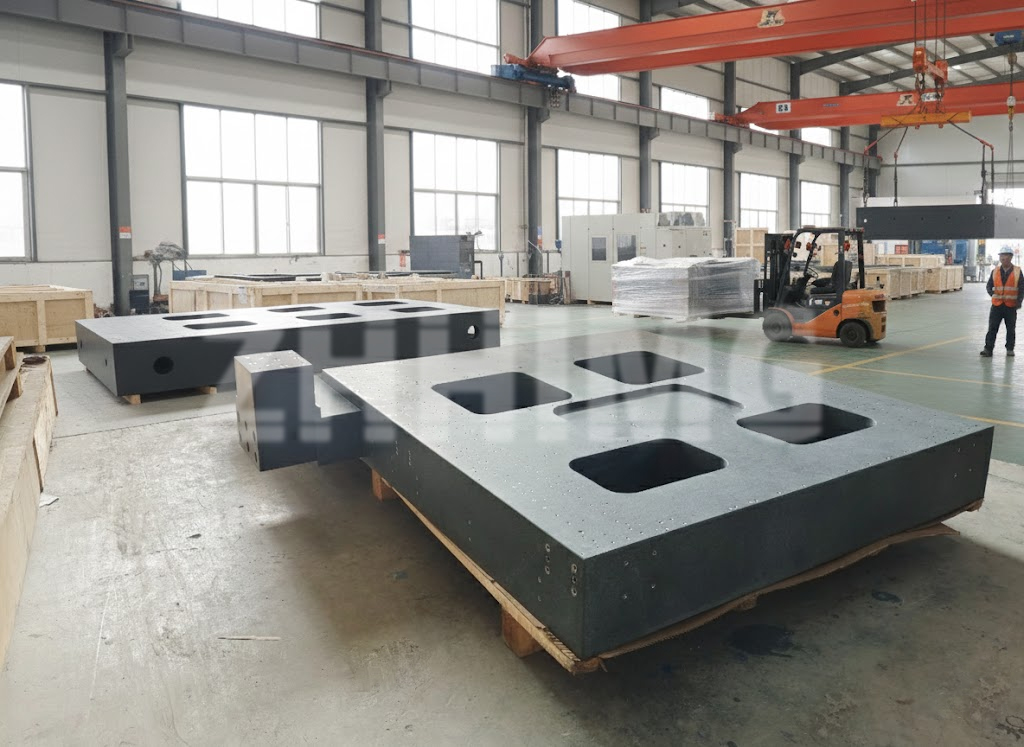
At the heart of these high-performance systems is the pairing of black granite and aerostatic bearings. Granite is the preferred substrate for precision ways because of its extraordinary physical properties. Unlike metals, granite is naturally aged over millions of years, resulting in a material that is virtually free of internal stresses. It possesses a low coefficient of thermal expansion and high vibration damping capabilities. When this stable base is lapped to extreme flatness—often measured in fractions of a micrometer—it becomes the perfect runway for an air bearing.
An air bearing way operates by supporting a load on a thin film of pressurized air, typically ranging from 5 to 10 micrometers thick. Because there is no physical contact between the moving carriage and the granite rail, the friction coefficient is effectively zero at the start of motion. This eliminates the “stick-slip” phenomenon common in mechanical systems, allowing for smooth, instantaneous transitions and ultra-fine positioning that mechanical rollers simply cannot achieve.
Customization: Tailoring Physics to Application
While off-the-shelf components exist, the true power of this technology is realized through custom precision engineering. Every high-end application, whether it is a wafer inspection system or a high-speed laser machining center, has unique requirements for load capacity, stiffness, and travel length. Customizing the geometry of the granite ways allows engineers to optimize the “bearing footprint” to the specific mass of the payload.
Customization also involves the integration of vacuum-preloading. In many high-precision setups, air bearings are designed with internal vacuum ports that pull the carriage toward the granite surface while the air pressure pushes it away. This “opposed force” creates a highly stiff air film that can resist external forces and vibrations, ensuring that the motion remains linear and stable even under varying speeds or directional changes. By tailoring the vacuum and pressure balance, manufacturers can tune the system’s stiffness to match the resonant frequencies of the specific environment.
Overcoming the Challenges of Friction and Heat
In traditional motion systems, friction is the enemy of consistency. Friction generates heat, and heat causes mechanical components to expand, leading to positioning drift. In long-cycle manufacturing processes, even a minor temperature rise can ruin a batch of high-precision parts.
Precision granite air bearing ways solve this by removing the source of the heat. Without rolling elements or sliding friction, there is no thermal buildup within the bearing itself. Furthermore, the constant flow of compressed air through the bearing acts as a localized cooling system, further stabilizing the environment. This thermal neutrality is a cornerstone of why air bearings are the industry standard for coordinate measuring machines (CMMs) and optical lithography stages, where the slightest expansion could result in significant data errors.
Durability and Cleanliness in Controlled Environments
One of the most compelling arguments for adopting granite air bearing ways is their nearly infinite operating life. In a mechanical bearing system, parts eventually fatigue, rollers deform, and lubricants degrade or become contaminated. This necessitates downtime for maintenance and eventual replacement. Because air bearings have no moving parts in contact, there is no wear and tear on the granite surfaces. As long as the air supply remains clean and dry, a granite air bearing system can maintain its factory-spec accuracy for decades.
This lack of wear also makes these systems ideal for cleanroom environments. Traditional bearings require grease or oil, which can outgas or shed particles, contaminating sensitive electronic or optical components. Air bearings are inherently “clean,” exhausting only filtered air. This makes them indispensable in the production of microchips, flat-panel displays, and medical devices where even a single speck of dust can be catastrophic.
The Role of Hand-Lapping in Modern Precision
Despite the advancement of CNC grinding and polishing, the final level of precision for custom granite ways often still requires the human touch. Master technicians use a process called hand-lapping to achieve the final sub-micron flatness. By using diamond abrasives and specialized measuring tools, they can identify and remove microscopic high spots that machines might miss.
This level of craftsmanship ensures that the air film remains consistent across the entire length of travel. If a granite rail is not perfectly flat, the air gap will vary, causing changes in stiffness and potential “grounding” of the bearing. The marriage of traditional hand-finishing and modern fluid dynamics is what allows custom granite air bearing ways to achieve the extreme geometric tolerances required for next-generation motion control.
Integration with Linear Motor Technology
To fully exploit the benefits of a frictionless granite way, these systems are almost always paired with linear motors. Unlike ball screws, which introduce mechanical vibration and backlash, linear motors provide non-contact propulsion. When a non-contact motor is combined with a non-contact air bearing on a stabilized granite base, the result is a motion system with zero mechanical hysteresis.
This combination allows for incredibly high accelerations and short settling times. In industries like electronics assembly, where machines must move, stop, and trigger an action thousands of times per hour, the ability to settle into a target position within nanometers in a few milliseconds is a game-changer for throughput and yield.
Conclusion: Investing in the Future of Motion
The shift toward custom precision granite air bearing ways is not just a trend; it is a necessary evolution for industries that operate at the edge of physical limits. While the initial investment in high-grade granite and precision-lapped air bearings is higher than that of traditional steel rails, the total cost of ownership—considering the lack of wear, reduced maintenance, and superior yield—makes it the more economical choice for high-stakes engineering.
As we move deeper into the era of nanotechnology and ultra-high-speed automation, the stability of granite and the elegance of air-film technology will continue to be the foundation upon which the world’s most precise machines are built. For engineers and system designers, mastering the application of these custom ways is the key to unlocking the next level of motion control performance.
Post time: May-18-2026