
In the world of precision engineering, few combinations have proven as powerful as air bearings paired with precision granite foundations. When motion must be impossibly smooth, friction-free, and accurate to micron or sub-micron levels, this partnership becomes essential. From semiconductor lithography to coordinate measuring machines, from optical grinding to high-precision cutting, air bearing systems riding on granite ways represent the gold standard for applications demanding the ultimate in motion quality. Understanding why precision granite serves as the ideal foundation for these systems reveals much about both the physics of precision motion and the material science that enables it.
This article explores the fundamental principles of air bearing technology, the properties that make granite ideal for this demanding application, and the practical considerations that engineers and equipment designers must address when implementing air bearing systems.
Understanding Air Bearing Fundamentals
Air bearings represent a remarkable achievement in tribology—the study of friction, wear, and lubrication between interacting surfaces. Unlike traditional bearings that rely on rolling elements or fluid films to separate contacting surfaces, air bearings use a thin film of compressed air to create a virtually friction-free gap between the moving and stationary components.
The principle underlying air bearing operation is elegantly simple. Compressed air, typically supplied at pressures ranging from 60 to 100 pounds per square inch, flows through precisely engineered orifices in the bearing surface. This air escapes through the small gap between the bearing and its way, creating a pressure field that supports the load. As long as sufficient air flow maintains this pressure distribution, the bearing floats on a cushion of air with no physical contact between moving and stationary parts.
This near-zero friction condition delivers extraordinary benefits. There is no rolling resistance, no stick-slip behavior, no metal-to-metal contact, and no wear between the bearing surfaces. Motion smoothness is limited only by the quality of the air supply and the precision of the bearing manufacturing. Acceleration and velocity can be precisely controlled without the mechanical hysteresis that affects other bearing technologies.
However, these benefits come with significant requirements. Air bearings demand extreme geometric precision in both the bearing and the way surfaces. The clearance gap between bearing and way—often measured in microns—must be maintained with extraordinary consistency across the entire travel length. Any geometric error in the way surface translates directly into motion error. This is where precision granite enters the picture as the ideal supporting structure.
Why Granite Provides the Ideal Air Bearing Foundation
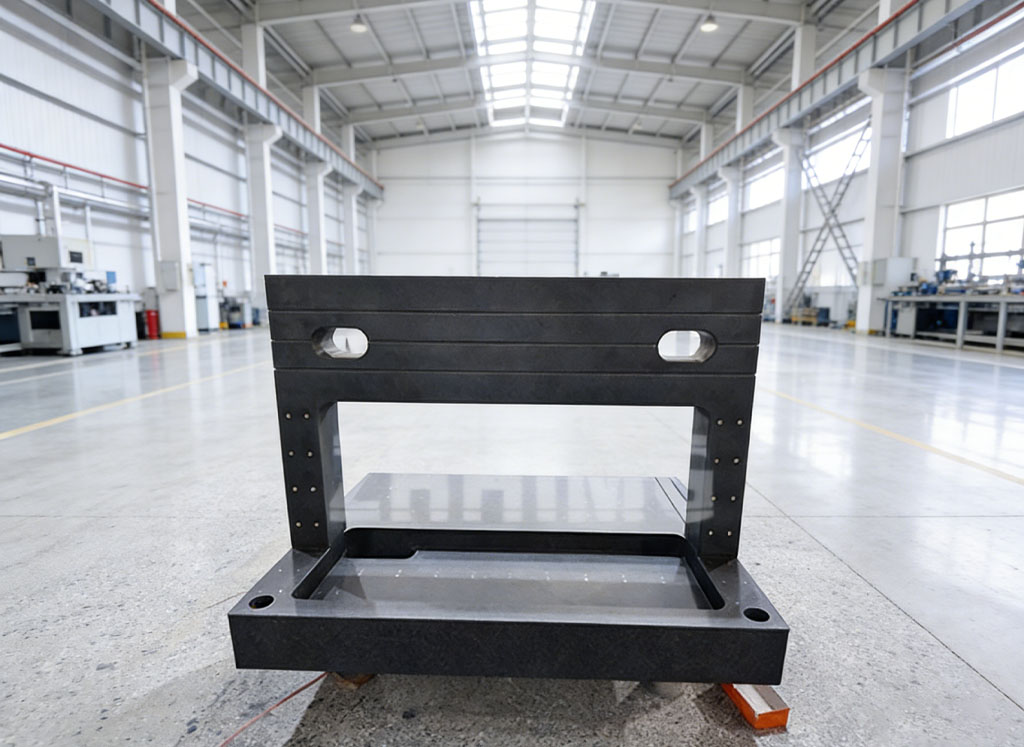
Precision granite offers a unique combination of properties that make it exceptionally well-suited for air bearing way applications. Understanding these properties explains why granite has remained the material of choice for the most demanding motion systems despite advances in alternative materials and manufacturing techniques.
Thermal stability ranks among granite’s most critical advantages for air bearing applications. Air bearing clearances are so small that thermal expansion can significantly affect performance. A steel or aluminum way structure subjected to temperature variations experiences dimensional changes that directly alter the bearing clearance, potentially causing binding, excessive leakage, or compromised load capacity. Granite’s exceptionally low coefficient of thermal expansion, combined with its thermal mass and slow heat conduction, minimizes these effects. Temperature changes produce much smaller dimensional variations in granite than in metals, and those changes occur gradually rather than creating thermal gradients across the structure.
Dimensional stability over time represents another crucial advantage. Air bearing systems are expected to maintain their precision over years or decades of service. Materials that creep, stress-relieve, or undergo microstructural changes introduce drift and error over time. Granite, having formed over millions of years under extreme pressure, exhibits no creep and maintains its dimensions indefinitely under normal operating conditions. Once precision-ground to specification, a granite way retains its geometry essentially forever.
The vibration damping characteristics of granite, while sometimes cited as inferior to cast iron for other applications, prove beneficial for air bearing systems. Air bearings, lacking the friction of mechanical contacts, are sensitive to external vibrations that can affect measurement and positioning tasks. Granite’s ability to absorb and dampen vibrations from the environment helps maintain motion quality even in challenging facility conditions.
Surface texture achievable on precision granite provides the exceptionally smooth, consistent bearing way surface that air bearings require. The fine grain structure of metrology-grade granite, combined with modern precision grinding and lapping techniques, can produce surface finishes measured in microinches with flatness maintained to fractions of a micron across entire travel lengths. This surface quality ensures uniform bearing clearance and consistent air flow across the entire stroke.
The Manufacturing Process: Achieving Air Bearing Precision
Creating granite air bearing ways capable of meeting micron and sub-micron motion requirements demands extraordinary manufacturing precision. The process begins with careful material selection and extends through multiple stages of machining, measurement, and verification.
Material selection for air bearing granite ways focuses on mineral uniformity, fine grain structure, and freedom from internal flaws. Not all granite is suitable for this demanding application. Sources known for consistent mineral composition and fine grain provide the raw material quality that precision finishing requires. Each block is evaluated for internal consistency and freedom from veining, inclusions, or other features that might compromise finished surface quality.
Rough machining establishes the basic geometry while leaving material for precision finishing. Modern CNC grinding techniques remove material efficiently while establishing the foundational geometry that final processes will refine to final tolerance.
Precision grinding represents the heart of achieving air bearing quality surfaces. This operation uses carefully selected abrasives and controlled processes to remove the final amounts of material while creating the flatness and surface texture required. Multiple grinding passes with progressively finer abrasives progressively refine the surface toward the target geometry. Throughout this process, in-process metrology verifies that the surface meets specifications before proceeding to the next stage.
Lapping may follow grinding for the most demanding applications. This process uses abrasive slurries to create an exceptionally fine surface finish while maintaining the geometric accuracy established during grinding. The combination of grinding and lapping can achieve flatness measured in fractions of a micron and surface finishes measured in microinches.
Final verification uses interferometric measurement techniques capable of resolving surface deviations at nanometer levels. Laser interferometers map the surface topography, identifying any remaining errors that might affect air bearing performance. This measurement data both verifies conformance to specifications and guides any final correction operations.
Applications Where Granite Air Bearing Systems Excel
The combination of air bearings and precision granite ways appears across numerous industries and applications where the ultimate in motion quality is required.
Semiconductor manufacturing relies heavily on air bearing systems for lithography, inspection, and wafer handling equipment. As feature sizes in integrated circuits continue shrinking, positioning tolerances shrink correspondingly. Air bearing systems on granite foundations provide the motion smoothness and positional accuracy that patterning and inspection processes demand. The thermal stability of granite becomes particularly critical in semiconductor fabs where temperature control is paramount for both process control and measurement accuracy.
Coordinate measuring machines represent another major application domain. The moving axes of high-precision CMMs often use air bearings on granite ways to achieve the probing accuracy and repeatability that quality assurance requires. The inherent smoothness of air bearing motion eliminates the vibration and jerk that could compromise measurement uncertainty.
Optical manufacturing, including lens grinding and polishing equipment, benefits from the vibration-free motion that air bearing systems provide. Any vibration during optical fabrication can introduce surface errors that degrade optical performance. Granite’s vibration damping combined with air bearing smoothness creates the quiet motion environment that precision optics require.
Precision machine tools, including jig boring machines, precision grinders, and diamond turning equipment, employ granite air bearing ways to achieve the geometric accuracies these machines must deliver. The combination enables machining and measurement accuracies measured in microns or better.
Scientific instruments and research equipment frequently use air bearing systems on granite for similar reasons. Metrology instruments, scanning systems, and research apparatus demand motion qualities that only this combination can provide reliably.
Design Considerations for Granite Air Bearing Systems
Implementing air bearings on granite ways requires attention to several design considerations that differ from conventional bearing systems.
Air supply quality directly affects system performance. Compressed air must be clean, dry, and at consistent pressure. Particulates can plug the small orifices that supply air to the bearing, creating local failures. Moisture can corrode internal passages or affect pressure control. Oil contamination can clog filters and affect sealing. Typically, air bearing systems require multi-stage filtration, drying, and pressure regulation to deliver the air quality these systems demand.
Structural mounting must provide rigid support without inducing stress into the granite way structure. Granite, while extremely stiff, can develop stress if mounting points create constraint against thermal expansion or if mounting forces create internal loading. Careful design of mounting provisions and thermal expansion accommodation preserves the geometric integrity of the way structure.
Protection against contamination becomes more critical than with conventional bearings. Since air bearings operate with no physical contact, any contamination entering the bearing gap can directly damage the bearing or way surfaces. Enclosures, seals, and air pressure differentials that exclude particles from the bearing area help protect these sensitive systems.
Thermal isolation may be necessary in environments with significant temperature variations or heat sources. The granite structure’s thermal stability provides benefit only if the granite can reach equilibrium without being continuously perturbed by external temperature influences. Strategic placement, insulation, and thermal barriers help maintain the stable conditions that precision requires.
Maintenance Philosophy for Air Bearing Systems
Air bearing systems on granite ways require a different maintenance approach than conventional mechanical systems. The absence of wear between bearing and way means that properly implemented systems can operate for decades without replacement of the bearing surfaces themselves.
However, the air supply system requires regular attention. Filters need periodic replacement, dryers need servicing, and pressure regulators need calibration to maintain the air quality that consistent bearing performance requires. Establishing and following a preventive maintenance schedule for the air supply system protects the investment in the air bearing system proper.
Periodic verification of motion quality provides early warning of any developing problems. Laser interferometer measurements of motion accuracy, conducted annually or semi-annually, can identify drift or degradation before it affects product quality. Keeping records of these measurements enables trend analysis that supports maintenance decisions.
Protection against contamination events, such as damage from tool or workpiece crashes, represents the primary failure mode for air bearing systems. While the air bearing itself is inherently protected during normal operation, accidents can damage the precision surfaces. Training operators in proper system operation and installing guards and interlocks where appropriate prevents most accidental damage.
The Future of Air Bearing Technology on Granite
Air bearing systems on precision granite continue evolving as applications demand ever tighter tolerances and faster motion. New bearing designs improve load capacity and stiffness while maintaining the smoothness that makes this technology valuable. Advanced air supply systems provide more consistent pressure control and better contamination exclusion. Improved manufacturing techniques achieve tighter tolerances and more consistent quality.
Granite itself continues benefiting from improved quarry selection, processing techniques, and quality verification methods. Engineered granite composites offer potential improvements in specific properties while maintaining the core advantages that natural granite provides.
The partnership between air bearing technology and precision granite remains one of the great success stories in precision engineering. From the first applications in aerospace metrology to today’s semiconductor fabrication equipment, this combination has enabled achievements that would otherwise be impossible. For applications demanding the ultimate in motion quality, precision granite remains the foundation upon which smooth motion is built.
Post time: May-20-2026