
The machine tool bed serves as the foundation for equipment load‑bearing and precision retention. Substrate selection directly determines long‑term equipment performance. As high‑end equipment including semiconductors, precision lasers and metrology instruments keep advancing toward nanometer‑level accuracy, the drawbacks of conventional cast‑iron and cast‑stone beds have become increasingly prominent. As a high‑performance natural substrate, granite is more and more widely adopted for developing and manufacturing high‑end machine tool beds. Drawing on ZHHIMG’s practical experience, this article analyzes the unique value of granite substrates for machine tool beds from the dimensions of intrinsic material properties, production implementation, long‑term service and life‑cycle cost, and clarifies the essential differences compared with ordinary stone solutions.
The reason why natural granite can satisfy the demanding working conditions of ultra‑precision machine tool beds lies in its inherent physical properties. Qualified bed‑grade granite has undergone sufficient geological aging, with internal residual stress almost fully released and a dense, uniform structure. The black granite selected by ZHHIMG boasts a high density of 3100 kg/m³ with tightly interlocked internal grains and outstanding deformation resistance, which cannot be matched by loose‑textured marble. Many manufacturers confuse granite with marble and use low‑cost marble as a substitute for bed substrates. Although products may meet standards in the short term, slow deformation will occur after commissioning, triggering equipment precision drift and directly reducing overall equipment yield. Granite substrates can restrain stress creep and maintain stable geometry even under long‑term heavy loads, delivering long‑lasting geometric references for machine tools.
Vibration suppression represents another prominent merit of granite substrates. Continuous vibration is generated during high‑speed movement, cutting and reciprocating motion of machine tools. Such vibration transmits to guide rails and actuators and amplifies machining errors. Cast iron achieves limited vibration damping merely through structural reinforcement. By contrast, the crystalline structure of granite features inherent damping capacity, which dissipates vibration energy rapidly and mitigates interferences from resonance. For vibration‑sensitive scenarios such as femtosecond‑laser processing, coordinate measuring machines and semiconductor inspection, granite beds effectively suppress adverse vibration effects, reduce tool marks and measurement jumps, and deliver more consistent machining and inspection results.
Temperature adaptability is another competitive edge of granite substrates. Workshop temperature and humidity vary with day‑night cycles, seasonal changes and equipment heat generation. Metal beds tend to expand and contract under heat, requiring sophisticated temperature‑compensation algorithms for correction. High‑quality granite exhibits low thermal deformation, with minimal dimensional changes induced by ambient temperature fluctuations, lowering equipment reliance on temperature compensation. Meanwhile, the material is rust‑proof, non‑magnetic and corrosion‑resistant. Cutting fluids and dust in production environments will not erode the substrate. Unlike cast‑iron beds, regular anti‑rust coating maintenance is unnecessary, greatly reducing later‑stage workload.
Nevertheless, raw‑material superiority alone cannot bring granite beds’ full advantages into play. Processing environments, inspection capabilities and process expertise are all indispensable. Even premium granite blanks will fail high‑end equipment requirements if processed under vibration interference and drastic temperature‑humidity fluctuations. ZHHIMG operates constant‑temperature‑and‑humidity workshops equipped with dedicated anti‑vibration trenches and extra‑hard thickened concrete floors to isolate external disturbances and create ideal conditions for finish‑grinding and assembly of granite beds. Supported by a complete set of traceable international metrology instruments and senior grinding technicians proficient in multiple national metrology standards, ZHHIMG converts granite’s material potential into tangible micron‑ and nanometer‑level finished‑product precision. Material advantages are only fundamental; advanced manufacturing conditions translate granite’s innate performance into real‑part accuracy.
The comprehensive competitiveness of granite machine tool beds can also be observed from a full‑life‑cycle perspective. Cast‑iron beds suffer from wear‑out and corrosion‑induced aging. Their precision degrades gradually over service time, calling for frequent rework and calibration. High‑quality granite beds retain precision for a long time as long as heavy‑impact damage is avoided, with low rework frequency. Despite high upfront manufacturing thresholds, granite beds cut equipment downtime for calibration and lower overall operating costs for high‑value production lines such as semiconductors, new‑energy inspection and precision optics. Accordingly, such substrates are extensively deployed in high‑end equipment including linear‑motor stages, perovskite‑coating machines and precision‑inspection machine tools. 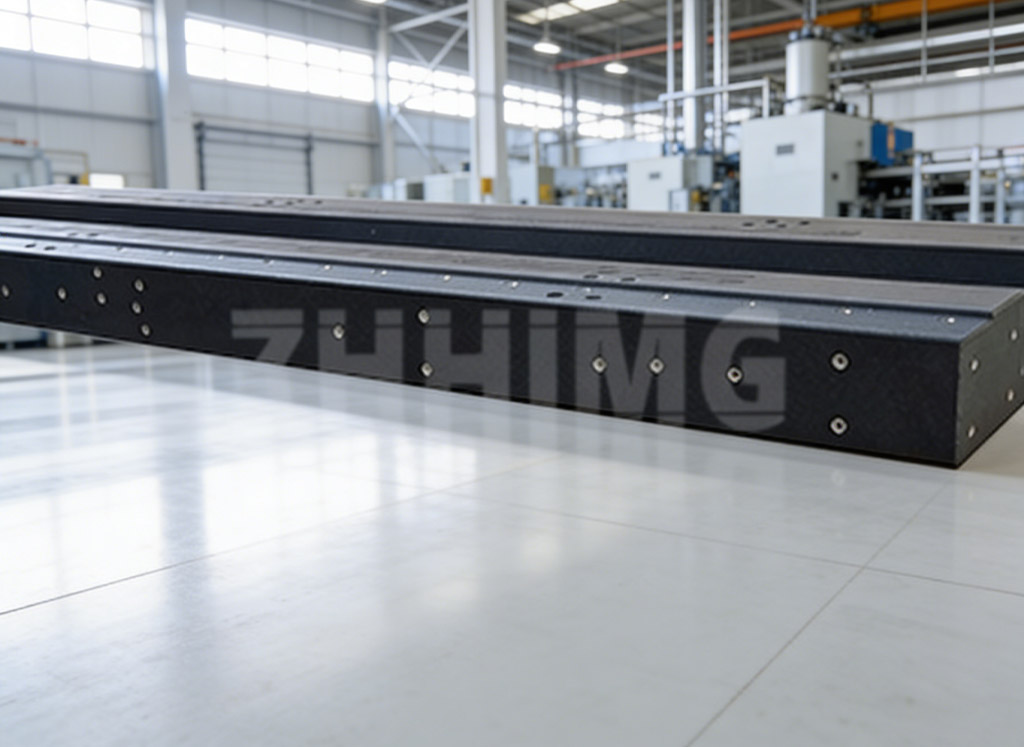
Still, the industry needs to rationally distinguish premium granite solutions from shoddy counterfeit alternatives. Deficiencies in any link, including substrate quality, blank screening, aging treatment, processing environment and inspection verification, will render granite beds merely nominal. Holding complete ISO and CE certifications as well as multiple international trademarks and patents, ZHHIMG adheres to strict raw‑material screening criteria and rejects inferior‑substitution practices. The corporate concepts of openness, innovation and integrity are implemented throughout the whole workflow, from substrate selection to finished‑product delivery.
Looking ahead, high‑end equipment will keep raising requirements for precision and stability. Thanks to its combined strengths of favorable damping performance, low deformation and long service life, granite substrates will occupy an increasingly important position in machine‑tool‑bed manufacturing. Only by controlling raw‑material sources, consolidating manufacturing processes and improving inspection systems can manufacturers fully unlock the core advantages of granite substrates and fuel the development of the global ultra‑precision‑manufacturing industry.
Post time: Sep-03-2026