
1. Superior Physical Properties: Solid Foundation for Precision Manufacturing
The precision foundation of mechanical parts stems from the physical stability of the base material. High-quality black granite undergoes natural aging over hundreds of millions of years, featuring a dense and uniform internal mineral structure with regular grain arrangement. It fundamentally avoids residual internal stress, structural relaxation, dimensional deviation and other defects common in ordinary materials — a natural superiority unmatched by synthetic materials and ordinary stone. With a density up to 3100kg/m³, far exceeding ordinary industry standards, premium customized granite delivers exceptional structural rigidity and compression resistance. It maintains stable performance without plastic deformation under heavy-load working conditions, thoroughly solving the long-term fatigue deformation pain point of metal parts.
In terms of thermal stability, granite has an extremely low linear expansion coefficient, approximately one-twentieth of that of traditional cast iron. It produces negligible dimensional changes under conventional industrial temperature fluctuations, sustaining consistent part precision permanently. Meanwhile, granite features high hardness, low water absorption, acid and alkali resistance, and oxidation resistance. Its Mohs hardness is significantly higher than conventional metal substrates. It only sheds tiny stone particles during long-term friction and impact, without burrs or surface deformation found in metal components. Requiring no rust-proof or anti-corrosion maintenance, it perfectly adapts to high-precision, dust-free and diverse industrial working scenarios. In contrast, ordinary marble adopted by low-end manufacturers has a loose structure, uneven density and poor thermal stability, prone to precision drift, and is completely incapable of meeting the standards of ultra-precision mechanical parts manufacturing.
2. Ultra-high Precision Machinability: Unlocking Nano-level Precision Limit
The core demand for ultra-precision mechanical parts lies in micro and nano-level dimensional and flatness control. The unique texture and mechanical properties of granite make ultra-high precision manufacturing achievable. With uniform hardness and fine texture, granite can be processed via ultra-large precision grinder finishing and nano-level manual lapping, delivering finished parts with ultra-high surface smoothness. Core precision indicators including flatness, straightness and perpendicularity stably reach the nano level, far exceeding the precision threshold of conventional metal processing.
Different from metal materials that suffer from stress rebound and edge deformation during processing, granite maintains stable processing performance. It supports customized production and consistent precision for diverse products, ranging from large integrated machine beds and ultra-long guide bases to miniature precision measuring tools and air-bearing components. Mature precision processing technology enables the integrated forming of granite parts with a single unit length of 20 meters and super-large cross-sectional dimensions, eliminating precision errors and structural risks caused by assembly splicing. This perfectly meets the demand for ultra-large and high-precision substrates of large-scale precision CNC equipment, laser equipment and semiconductor devices. In addition, finely lapped granite parts are non-magnetic and non-conductive, perfectly suitable for special precision scenarios such as optical detection, electromagnetic compatibility and dust-free semiconductor workshops, filling the application gap of traditional mechanical materials.
3. All-weather Operational Stability: Reducing Equipment Operation and Maintenance Costs
High-end precision mechanical equipment is mostly applied in harsh scenarios including constant-temperature laboratories, dust-free semiconductor workshops and high-frequency production workshops. The long-term stability of parts determines equipment service life and production accuracy. Granite features excellent shock resistance and vibration damping performance. Its dense internal mineral structure effectively absorbs vibration frequency generated during equipment operation, reducing precision deviation caused by vibration transmission and improving the overall operational stability of complete equipment. Supported by professional constant-temperature, constant-humidity and shock-proof production systems, granite parts maintain stable dimensional accuracy for a long time with no obvious precision attenuation for years, achieving far better precision retention than cast iron and steel parts.
Furthermore, granite parts are highly durable and maintenance-free. Unlike metal parts that require regular rust prevention, calibration and polishing repair, granite resists aging, weathering and chemical corrosion. It adapts to complex industrial environments with variable temperature, high humidity and slight acid-base erosion, greatly reducing later operation and maintenance costs as well as downtime calibration frequency of high-end precision equipment. It fully meets the long-term high-precision usage requirements of Fortune 500 enterprises, high-end research institutes and national-level metrology institutions. 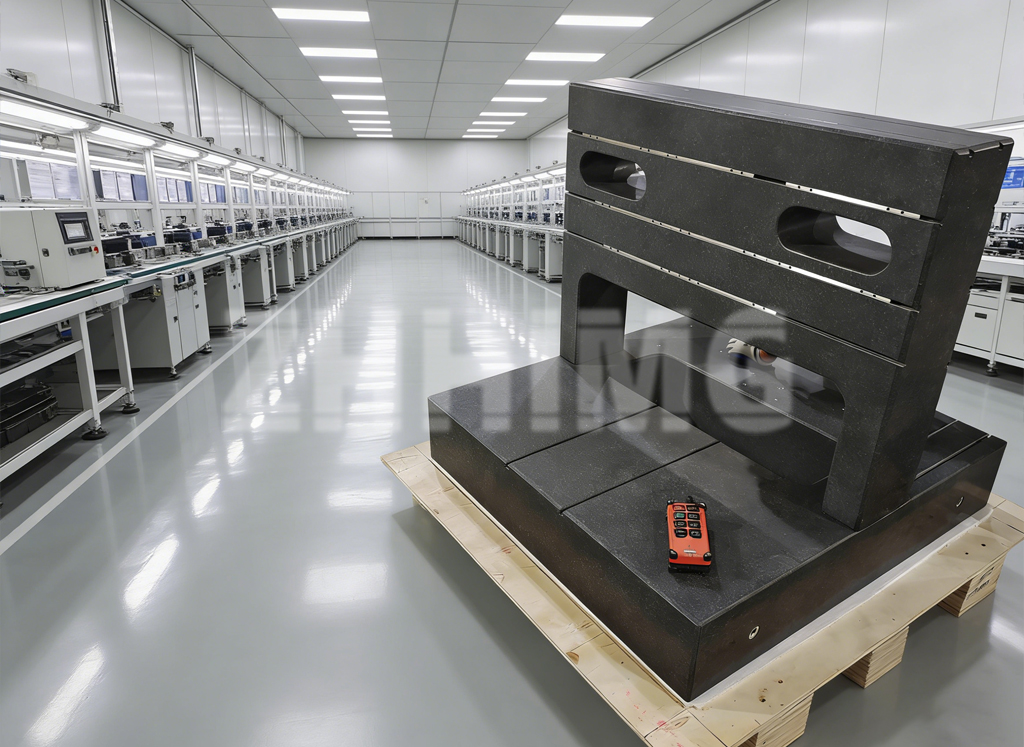
4. Standardization and Compliance: Adapting to the Global High-end Supply Chain
In the globalized precision industrial supply chain, material compliance, process standardization and traceable precision are core entry thresholds. High-quality granite mechanical parts strictly follow mainstream global industrial standards throughout raw material selection, precision processing, precision detection and factory inspection, covering German DIN, American ASME, Japanese JIS, Chinese GB, British BS, Russian GOST and other international metrology standards, realizing mutual recognition of global industrial specifications.
Supported by a complete international certification system and independent intellectual property rights, the precision detection data of high-end granite mechanical parts is fully traceable. Equipped with high-end imported testing equipment and professional metrology teams, the factory achieves accurate micro and nano-level precision control, with all precision indicators certified by national and international authoritative metrology institutions. Meanwhile, standardized and large-scale production lines ensure consistent precision of full-category products including granite structural components, precision measuring tools, air-bearing parts and carbon fiber precision beams, enabling high-efficiency mass production while maintaining ultra-high precision. This makes granite a preferred core substrate in the global high-end precision equipment supply chain.
5. Full-scenario Adaptability: Covering the Entire Ultra-precision Industry Chain
Granite mechanical parts are not limited to measuring tool substrates, but serve as core basic components penetrating the entire ultra-precision industry chain. With diversified performance advantages, they adapt to the manufacturing needs of multiple high-end equipment tracks. In the field of precision metrology, granite surface plates, straight edges and square rulers with nano-level flatness act as benchmark carriers for precision calibration and detection. In high-end equipment manufacturing, granite beds, bases and air-bearing components are widely applied in semiconductor equipment, PCB precision drilling machines, CMM equipment, precision CNC machines, femtosecond/picosecond laser equipment, 2D image measuring instruments, contour detectors, AOI optical inspection equipment, industrial CT and X-ray equipment, linear motor platforms, perovskite coating machines, new energy battery testing equipment and tool detection bases. In scientific research scenarios, they support high-precision experimental research and precision testing projects of global universities and metrology institutes.
From industrial mass-production equipment and high-end scientific research devices to civil precision manufacturing and national-level metrology projects, granite mechanical parts have become indispensable core basic materials in the ultra-precision industry with stable performance, extreme precision and long-term reliability, continuously promoting the precision upgrading and technological iteration of the high-end precision manufacturing industry.
Conclusion
Compared with traditional mechanical manufacturing substrates, granite materials break the precision and performance bottlenecks of conventional precision parts by virtue of superior natural physical properties, ultra-high precision machinability, long-term operational stability, global standard compliance and full-industry-chain adaptability. As the ultra-precision industry develops toward nano-level precision, intellectualization and long-term steady performance, high-quality granite precision parts will gradually replace traditional metal and low-end stone components. They will serve as the core cornerstone of high-end equipment manufacturing, semiconductors, precision metrology and cutting-edge scientific research, leading the high-quality development of the global precision basic component industry.
Post time: Aug-28-2026