
Black Granite vs. Marble for Precision Components: How to Spot the Difference Before You Buy
When buyers search for black granite vs marble precision differences, they are usually trying to answer a much more practical question: is the material in front of me actually what the quotation promised? Black granite and black marble can look almost identical on a polished surface, yet only one of them belongs in a precision application. Confusing the two is one of the most common and most expensive mistakes in component sourcing, because the error is usually discovered after machining, when the part no longer holds its geometry.
This article explains how the two materials differ in measurable terms, what those measurements mean for a precision component, and how to verify the material yourself before accepting delivery. It also states the values we publish for our own granite, together with their source, so that you can check rather than trust. We do not present our material as better than anyone else’s; we present the numbers and the test method, and let the data speak.
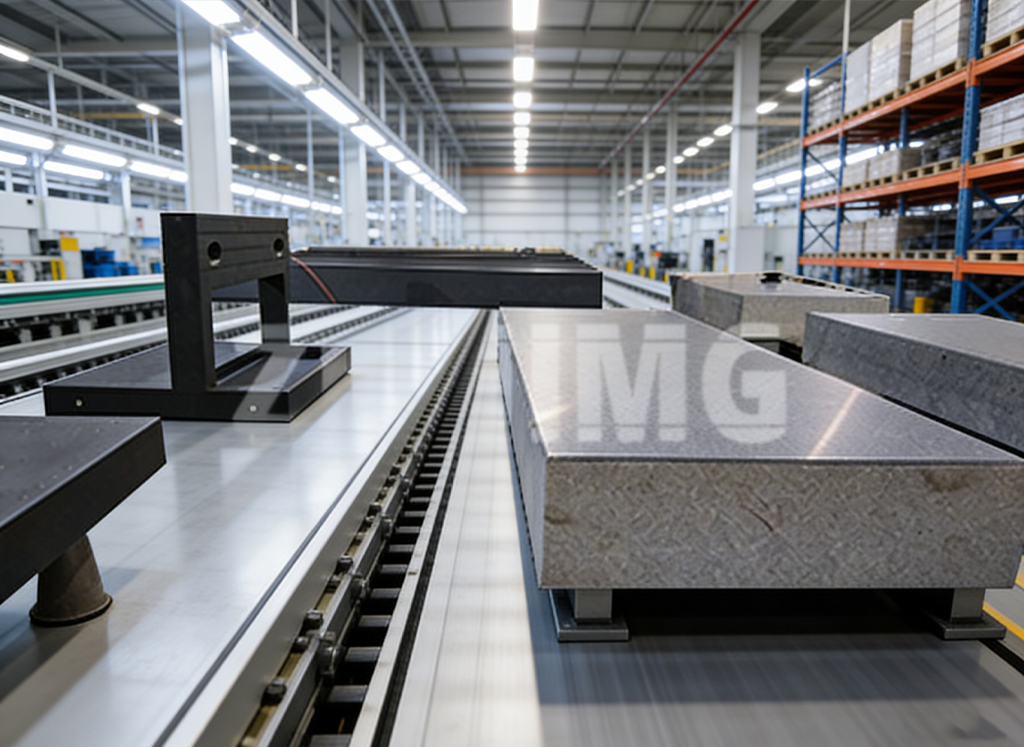
Two different rocks, not two grades of one material
Granite is an igneous rock. It formed from molten material that cooled slowly underground, which gave its minerals time to crystallise into an interlocking structure of quartz, feldspar and mica. That interlocking crystal structure is why granite is hard, dense and mechanically stable over long periods.
Marble is a metamorphic rock. It formed when limestone was subjected to heat and pressure, which recrystallised the calcite into larger, softer grains. Calcite is dramatically softer than quartz, and it reacts with acids. Some black “marbles” sold in building materials are in fact polished limestone or dolomite, which are softer still.
The practical consequences follow directly: granite resists abrasion and keeps its shape; marble scratches easily, wears quickly under sliding contact, and dissolves slowly in acidic environments. A marble surface plate would lose flatness in normal use and would be attacked by common workshop fluids.
Measurable differences: density, porosity, modulus, hardness
Below is a comparison of the properties that matter for precision work, with the typical ranges you would see in a material report. The “How to verify” column describes what a buyer can actually request and check.
| Property | Precision black granite | Black marble (calcite-based) | How to verify |
|---|---|---|---|
| Density | Typically about 2,970–3,100 kg/m³ for dense black granite | Typically about 2,600–2,750 kg/m³ | Weigh a known-volume sample, or ask for a density test on a cut cube; density below ~2,900 kg/m³ is not dense granite |
| Water absorption | Very low — typically below 0.1% by mass for a sound precision granite | Higher — commonly 0.2–0.5%, and higher still in porous varieties | Request absorption data, or perform a simple immersion test on a dry weighed sample; a drop of water should not darken the surface |
| Elastic modulus | Roughly 40–60 GPa in compression, depending on the stone | Roughly 30–50 GPa, with greater variation between deposits | Ask the supplier to quote a modulus test; modulus is also inferred from ultrasonic velocity measurements |
| Hardness (Mohs) | Quartz content gives about 6–7 at grain level | Calcite is about 3 | Skip the scratch test on finished parts; instead ask for mineralogical composition |
| Acid resistance | Effectively unaffected by weak acids | Visible etching with dilute acid | A single drop of dilute acid on an inconspicuous area: granite shows no reaction, marble effervesces and marks |
| Thermal expansion | Roughly 5–8 µm/m·K | Roughly 6–10 µm/m·K with greater anisotropy | Part of the material data sheet; relevant to your thermal error budget |
| Appearance under magnification | Interlocking crystals, speckled texture, no visible sedimentary banding | Uniform sugary grains, often with veining and banding | A 10× loupe on a cut edge distinguishes the two in most cases without damaging the part |
| Suitability for lapping to µm flatness | Yes — the standard material for precision surfaces | No — too soft, will not hold flatness | Ask for the flatness grade and the method used to achieve it |
For our own precision granite components we publish the material data sheet rather than marketing superlatives. Where a figure depends on the specific deposit or component, we state it as a tested value for that component, not as a universal property of “our granite”. A measurement that comes from a test report is useful to you; an adjective is not.
The practical test in the workshop
If you have an unmachined sample and no laboratory nearby, three quick checks separate the two materials in a few minutes.
Weigh it. Take a rectangular offcut, measure its dimensions accurately, weigh it, and calculate the density. A cube of 100 × 100 × 100 mm of true dense granite weighs roughly 3.0 kg; the same cube in black marble weighs around 2.7 kg. The difference is around ten per cent, which is easily resolved on an ordinary workshop scale.
Wet it. Place a single drop of water on a fresh, unpolished surface and wait a minute. Dense precision granite barely absorbs it and the spot stays bright. Marble, especially unpolished marble, darkens as the water soaks into the pores.
Test it with dilute acid. A drop of dilute hydrochloric acid on marble produces visible effervescence because calcium carbonate reacts with acid. Granite does not react. On a finished component, use an inconspicuous face or an offcut, and rinse afterwards.
These three checks cost nothing, damage nothing if done carefully, and catch the majority of substitutions before the material is cut.
Why the difference matters for a precision component
A precision component has to do three things simultaneously: stay in place geometrically, resist wear from contact and cleaning, and behave predictably as the temperature changes. Marble fails at least two of the three.
Lower hardness means it wears. Every time a workpiece, a gauge or a cleaning cloth moves across the surface, marble loses a little material, and the flatness that was lapped in disappears. Lower density and higher porosity mean the material is less homogeneous, so a component machined from marble will show greater local variation in stiffness and thermal response. Higher absorption makes it vulnerable to fluids — coolant, cleaning agents and even condensation — which can stain it, swell it locally and alter its dimensions over time.
There is also a maintenance dimension. Precision granite can be cleaned, inspected and, if necessary, re-lapped to restore flatness. Marble’s softness means it cannot be reconditioned to a precision standard; by the time flatness has drifted, the material is no longer suitable for the application. The argument for granite is not that it is an exotic material but that it is the material whose measured properties match the demands of the job.
A verification checklist for buyers
The strongest protection is not a test you run yourself, but documentation you request before the order is placed. Ask for the following and read the answers carefully.
Request the material specification sheet, with composition and the testing standard cited. A sheet that states density, absorption and modulus with the test method is worth far more than a page of claims. Ask for the density test result for the specific block or batch, not a generic figure for the stone type. Ask for water absorption data measured on the same material. Ask for the mineralogical composition, which is what distinguishes granite from marble definitively, rather than appearance. Ask which reference surfaces will be lapped to which grade, and how that flatness will be verified. Ask for the calibration or inspection report that will accompany the finished component, and confirm which standard it follows.
Finally, ask whether the supplier will accept a third-party test. A supplier confident in the material will not object. If any of these questions produces vague answers, that is itself the most useful data point you will get before ordering. Our own precision black granite products are supplied with material and inspection documentation as a matter of routine, and we welcome customers who ask for it.
Choosing a material is choosing a supplier
For a buyer, the honest position is that material data must be verifiable and that a supplier should be willing to be checked. A density figure that comes with a test report you can inspect is a fact; the same figure stated in a brochure is a claim. Our policy is simply to give you the report and let you decide. If a quote seems unusually low for a precision component, the useful response is not to accept it, and not to reject it either, but to ask what the material is and how that was established.
Questions about grading, tolerances, cleaning and re-lapping are covered in detail in our granite FAQ, and specific material questions are welcome by email. Send the application, the required tolerances and the environment the component will work in, and we will return a material recommendation supported by data rather than adjectives.
Frequently asked questions
Can I tell black granite from black marble by looking at it?
Not reliably on a polished surface — both can look uniformly black. A 10× loupe on a cut or unpolished edge usually reveals interlocking crystals in granite versus a more uniform, sugary texture in marble, sometimes with veining. For certainty, use density measurement, a water drop test or a mineralogical report.
What density should I expect from precision black granite?
Dense black granite used for precision components typically falls around 2,970–3,100 kg/m³. A density materially below that range suggests either a different stone type or a porous, less suitable variety. Ask for the density measured on your specific block, not a general figure.
Is a water absorption test reliable?
As a screening test, yes. Dense precision granite has very low absorption, typically under 0.1% by mass, and a water drop on a dry surface will not darken it. Marble commonly absorbs 0.2–0.5% and shows visible darkening, especially on unpolished faces. For records, request a measured absorption value with the test method.
Why can marble not be used for a surface plate even if it looks flat?
Because flatness is only useful if it survives use. Marble’s hardness is around Mohs 3, far below granite’s quartz grains at 6–7, so it wears under normal contact and cleaning. It also cannot be re-lapped to a precision grade. A marble plate may measure flat when new and lose that flatness quickly in service.
What documents should accompany a precision granite component?
At minimum, a material specification with density, absorption and modulus plus the test methods used, the flatness grade and the standard it follows, and an inspection or calibration report for the finished component. If the application is critical, a mineralogical composition report removes any remaining ambiguity about the stone type.
Post time: Oct-15-2026