
Granite vs. Mineral Casting vs. Steel Weldment: Choosing the Best Machine Base for Precision Equipment
Choosing a granite machine base over a mineral casting or a steel weldment is one of the most consequential decisions in precision equipment design, because the base sets the ceiling for everything mounted on it. No amount of good engineering in the axes, the control system or the metrology can fully compensate for a base that drifts thermally, rings after every motion, or relaxes its internal stresses over the first months of service.
This comparison is written for engineers working on semiconductor metrology and inspection tools, laser processing systems and coordinate measuring machines. It compares the three most common base materials — plus ultra-high performance concrete (UHPC), which sits closer to mineral casting than many buyers expect — across stiffness, damping, thermal stability, achievable machining accuracy, lead time and cost. The aim is objectivity rather than advocacy: each material wins in a specific window of requirements, and pretending otherwise leads to over-specification on one project and under-performance on the next.
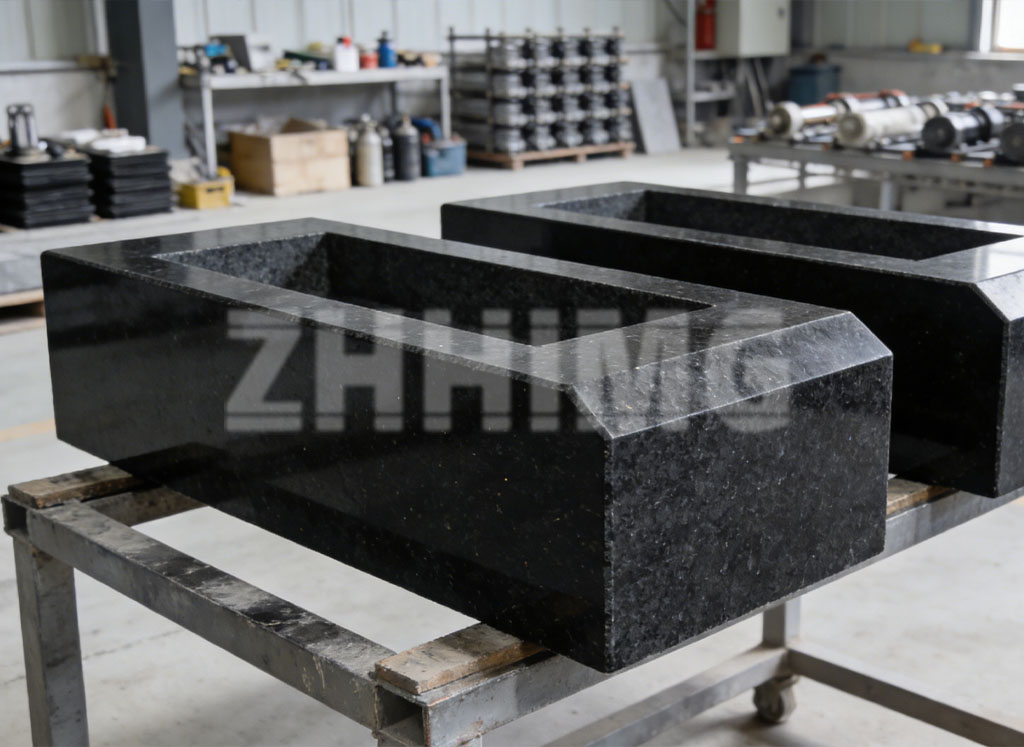
The four candidates in brief
Natural granite is a quarried, fine-grained igneous stone, machined by milling and grinding and finished by lapping. It is used where geometric accuracy and long-term stability are the primary requirements — metrology frames, air-bearing guides, CMM bases and semiconductor stage structures. A typical custom granite machine base carries machined pockets, threaded inserts and rail seats integrated directly into the stone.
Mineral casting — often called epoxy granite or polymer concrete — is a mixture of graded mineral aggregates bound in an epoxy resin, cast into a mould at room temperature. Its strengths are vibration damping, design freedom for complex internal geometry, and the ability to embed inserts, conduits and cooling channels during casting. Mineral casting machine bases are common on grinding machines, measuring machines and automation platforms.
UHPC (ultra-high performance concrete) is a cement-based composite with very high compressive strength and low porosity, reinforced with fibres. It is cast like mineral casting but uses cement chemistry instead of epoxy. Our tailor-made UHPC and RPC components serve applications that need cast-part design freedom and good damping with a lower binder cost than epoxy systems, typically at larger dimensions.
Steel weldment is fabricated from rolled sections and plate, welded, then stress-relieved and machined. It is the default where the structure must be light, hollow for services, impact-resistant, or cheap and fast to iterate. Its weaknesses are well known in precision equipment: lower damping and long-term stress relaxation that can move geometry after machining.
Side-by-side comparison
The table summarises the properties that drive base selection. Statements about material behaviour come from published material data and standard engineering knowledge; statements about cost and lead time reflect general market position and will vary with size, complexity and supplier.
| Property | Natural granite | Mineral casting | UHPC | Steel weldment |
|---|---|---|---|---|
| Static stiffness (E) | High — typically 40–60 GPa in compression along the grain structure | Moderate — typically 30–45 GPa depending on formulation | Moderate to high — typically 35–50 GPa | Highest per mass in thin sections — steel E ≈ 210 GPa |
| Vibration damping | Moderate — good but not the best | Excellent — roughly 6–10× better internal damping than cast iron or steel | Very good — fibre-reinforced cement matrix damps well | Low — welded steel rings audibly; needs added damping treatment |
| Thermal conductivity | Low (~2–3.5 W/m·K) — slow to react, slow to recover | Low (~1–2.5 W/m·K) — thermally sluggish in a good way | Low to moderate (~1.5–2.5 W/m·K) | High (~50 W/m·K) — fast response both directions |
| Thermal expansion | Low — roughly 5–8 µm/m·K | Low — formulation-dependent, commonly 12–20 µm/m·K | Moderate — typically 10–13 µm/m·K | High — ~12 µm/m·K but very uniform and predictable |
| Achievable surface accuracy | Highest — lapped flatness at µm and sub-µm level over large areas; the only choice for air-bearing surfaces | Good after machining/grinding of local seats; full-face lapping not practical | Good after local machining; surfaces usually need coating or plates | Good after machining; surfaces typically scraped or ground locally |
| Long-term stability | Excellent — hundreds of millions of years of stress relief; geometry is essentially frozen | Very good after full cure; slight post-cure movement possible in the first months if curing is rushed | Very good; curing behaviour must be managed like any concrete | Depends entirely on stress relief quality; relaxation can shift geometry over months |
| Design freedom and integration | Limited to machinable geometry; inserts and pockets are machined in | Highest — complex hollows, conduits, cooling channels and inserts cast in one piece | Highest among cast materials at large scale; same mould-based freedom | High — welded fabrication, easily revised; hollow sections for services |
| Damage behaviour | Brittle — edge chips possible; a local impact removes material rather than raising a burr | Tougher than granite but still crack-sensitive at thin sections | Tough with fibre reinforcement; better impact behaviour than granite | Most forgiving — dents, welds and repairs are routine |
| Typical lead time | Moderate — machining and lapping are sequential and labour-intensive | Moderate — mould making adds time up front, then casting cures in parallel batches | Moderate — similar casting workflow, curing is the pacing step | Shortest for simple frames — cutting and welding start immediately |
| Cost position | Highest per kilogram for precision-machined parts; material cost scales with size | Moderate; attractive for complex, heavily integrated bases | Moderate to low at large sizes — a key advantage over epoxy systems | Lowest for simple structures; cost rises quickly with machining |
The rows are not a ranking, and they are not additive. Each material wins a different column, and most real projects are decided by two or three columns — usually damping, thermal stability and one economic factor.
What this means for semiconductor equipment
Semiconductor metrology and inspection tools are the most demanding application for bases, because they combine air bearings, sub-micron measurement and 24/7 operation in a temperature-controlled room. Granite dominates here for concrete reasons: it is the only material that can be lapped to the flatness an air bearing requires across a large area, its low thermal expansion keeps the geometry stable while the room cycles, and its stability is proven over decades of service life.
That said, the honest pattern in the industry is hybrid. Granite carries the reference surfaces — the air-bearing guides, the stage rails, the measurement plane — while a cast mineral structure below carries mass, damping and services. Several of our semiconductor projects combine both: a precision granite frame seated on a mineral-cast support structure, giving each material the job it does best. Pure steel weldment bases appear mainly in wafer handling and pre-alignment modules, where the precision budget lives elsewhere and steel’s speed and reparability matter more.
What this means for laser processing machines
Laser systems stress the base differently. Optical path stability is the critical requirement — a micrometre of drift at the base moves the beam at the workpiece. Granite’s thermal inertia and low expansion protect the optical alignment, which is why laser measurement benches and beam delivery structures so often sit on granite.
But laser cutting and welding cells with motion systems often choose mineral casting instead: the process generates vibration, the motion system adds more, and the outstanding damping of cast mineral keeps the structure quiet without the mass penalty of solid granite at very large dimensions. Steel weldments remain common for the machine enclosure and support frame around the precision core — they absorb impacts, integrate services cheaply, and are easy to modify when the layout changes.
What this means for CMM and metrology platforms
CMMs are the classic granite application. The base defines the datum for all three axes, carries the air bearings on lapped surfaces, and must not drift between calibrations. Here granite is not one option among several — its combination of lappable flatness, low expansion and permanence is effectively required. The supporting table under the CMM base, however, is frequently mineral casting or UHPC, chosen for damping and cost at a size where solid granite would be unnecessarily expensive.
For general metrology platforms that carry instruments rather than define a datum, the choice opens up. A steel weldment table with a granite plate on top is a perfectly legitimate solution; a full mineral-cast base becomes attractive when vibration from the environment, not thermal drift, is the limiting factor.
How to decide: a short checklist
If your application needs lapped reference surfaces, air-bearing seats or the lowest possible thermal drift, start with granite and design the rest of the structure around it. If your application fights vibration — high-acceleration motion, grinding, nearby rotating machinery — mineral casting or UHPC should lead the evaluation, with granite supplying the precision surfaces on top. If your priority is fast iteration, impact resistance, hollow service routing and low cost, and your precision budget is carried by other components, a steel weldment is the rational choice, ideally with attention to stress relief quality.
For most precision equipment, the practical answer is a combination, and the engineering value lies in deciding which material carries which function. Share your load cases, required accuracies, environment and target cost, and we will propose a configuration across our granite, mineral casting and UHPC lines — including hybrid structures where that beats any single material.
Frequently asked questions
Which material is best for vibration damping?
Mineral casting, followed closely by UHPC. The polymer-bound or fibre-reinforced mineral matrix converts vibration energy internally far better than crystalline stone or steel. Granite damps reasonably well, but if damping is the primary requirement, cast mineral materials win. Steel weldments rank last and usually need added damping measures for precision applications.
Why is granite preferred for air bearings?
Air bearings need an extremely flat, smooth, hard surface over their whole pad area to maintain a stable micrometre-scale air film. Lapped granite achieves this flatness across large areas, keeps it for decades, and does not burr when chipped — a raised burr under an air bearing would cause contact and failure. No other base material is routinely finished to this standard.
Is UHPC a substitute for epoxy mineral casting?
Not a substitute — a complement. UHPC offers similar casting freedom and good damping with lower binder cost, which makes it attractive for large structures. Epoxy mineral casting offers a more mature formulation space, higher stiffness in typical formulations, and a longer industrial track record in precision machine tools. The right choice depends on size, budget and the stiffness the design actually needs.
Can a hybrid base combine materials?
Yes, and it is often the best engineering answer. Common combinations include granite reference surfaces mounted on a mineral-cast or UHPC support structure, and granite plates on steel frames. The design work is in the interface: thermal isolation, kinematic or elastic mounting, and making sure vibration does not bypass the damped material through a stiff shortcut.
What should I send to get a base material recommendation?
Your equipment type and envelope, the mass and dynamics of the moving system, the required accuracy at the point of measurement, the environment including temperature stability and vibration sources, and the target cost or lead time constraints. With those inputs we can recommend granite, mineral casting, UHPC or a hybrid — and support the proposal with drawings and verified tolerances.
Post time: Oct-15-2026