
Granite Air Bearings vs. Ceramic Air Bearings: How to Choose for Ultra-Precision Motion Stages
Choosing between a granite air bearing and a ceramic air bearing is a decision that shapes the whole motion architecture of an ultra-precision stage. Both materials produce the same physical effect — a stiff micrometre-scale air film that carries the moving mass without solid contact — but they differ in density, damping, wear behaviour, manufacturable size and cost, and those differences map directly onto different applications.
This article briefly explains how air bearings work, compares granite and ceramic on the properties that matter for stage design, and closes with application-specific guidance for semiconductor inspection, optical platforms and linear motor stages.
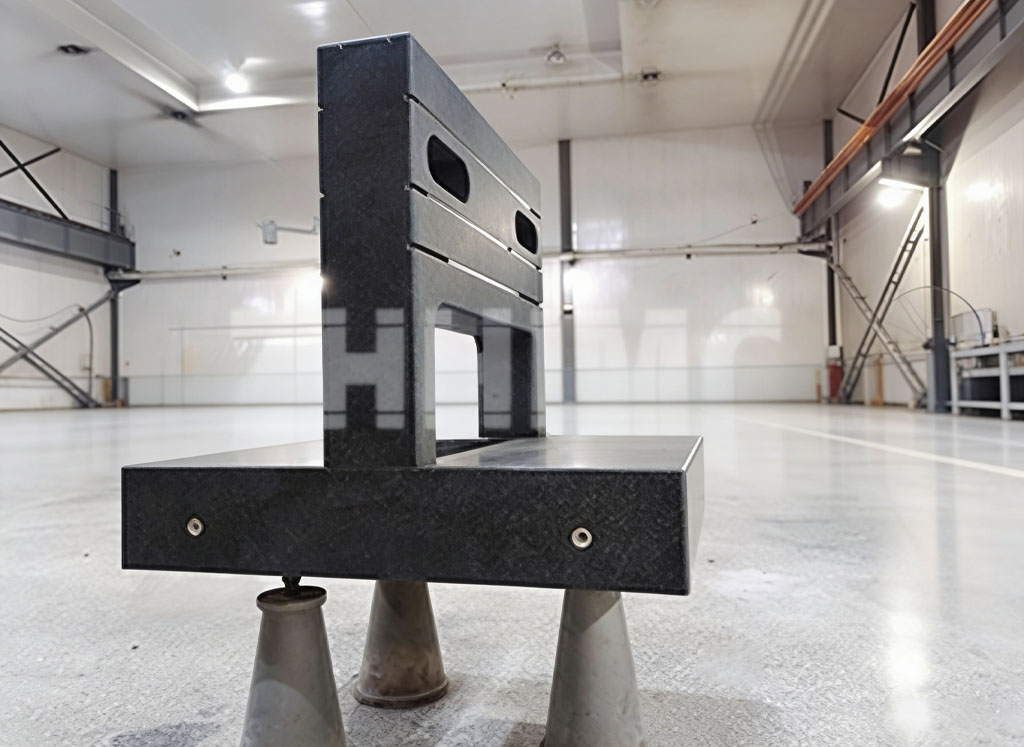
How an air bearing works, in one diagram
Pressurised air enters a pocket inside the bearing, passes through a restriction — either small orifices or a porous material — and fills the gap between the bearing pad and the guideway surface. The escaping air’s flow resistance supports the load, so the pad floats on a film typically a few micrometres to around ten micrometres thick. Because there is no solid contact, there is no stick-slip, no mechanical wear in normal operation, and motion error is governed almost entirely by the geometry of the two surfaces.
Two consequences follow. First, the material is never cosmetic: it is one of the two optical-flat-class surfaces that define the air gap. Second, anything that changes the gap — thermal drift, wear, contamination — changes the stage’s performance directly. That is why the granite-versus-ceramic choice is an engineering decision rather than a preference.
Granite and ceramic compared
The table compares the two materials on the properties that influence stage design. Material behaviour statements come from published material data and standard engineering practice; cost and lead-time positions reflect general market reality and vary with size and supplier.
| Property | Granite air bearing | Ceramic air bearing | Why it matters |
|---|---|---|---|
| Flatness capability | Lapped to sub-µm flatness over very large areas; the established standard for long guideways | Excellent flatness on smaller faces; grinding and lapping of alumina is mature but large one-piece surfaces are harder | Flatness sets gap uniformity, which sets straightness and pitch error of the stage |
| Density | About 3.0 g/cm³ — heavy, which adds inertia to moving granite parts | About 3.5–3.9 g/cm³ for alumina — even heavier per volume, but parts are usually smaller | Moving mass limits acceleration; base mass improves stability |
| Damping and vibration | Good inherent damping from the crystalline structure | Fine-grained alumina offers high stiffness; damping is comparable, film behaviour dominates | The air film provides most of the low-frequency isolation either way |
| Wear and damage behaviour | Extremely long life without contact; a crash chips the stone locally without raising a burr | Harder than granite; very wear-resistant, but brittle — impact can crack rather than chip | Crash recovery differs: granite chips are usually ground or re-lapped; cracked ceramic parts are replaced |
| Thermal behaviour | Low expansion (~5–8 µm/m·K), low conductivity — slow to drift, slow to recover | Alumina expansion (~7–8 µm/m·K) is similar; higher conductivity lets it react and settle faster | Thermal drift moves the gap and the straightness reference directly |
| Manufacturable size | Very large one-piece guideways and bases are routine in granite | Ceramic components are practical at smaller dimensions; sintering limits one-piece size | Long-travel stages usually need granite; compact modules suit ceramic |
| Integration and detail | Pockets, bores and inserts machined into the stone; air channels drilled and plugged | Porous ceramic restrictors and small precision features are natural ceramic strengths | Porous-media bearings are easier to realise in ceramic; large machined structures are easier in granite |
| Typical cost and lead time | Material and lapping cost scale with size; long lead for large pieces | Higher per-volume machining cost, smaller parts; mould and sintering lead time | Budget usually settles which hybrid is affordable, not whether air bearings work |
One honest note: in a well-designed bearing, the air film dominates stiffness and damping, so the material difference between granite and ceramic is smaller than the difference between a good and a poor bearing design. The material decides the ceiling and the failure modes; the design decides most of the everyday performance.
Choosing by application
Semiconductor inspection and metrology stages are the natural home of granite. Travel lengths are long, the reference structure must stay stable for years, air-bearing surfaces need sub-micrometre flatness over large areas, and the moving mass is usually carried by a compact ceramic or steel carriage rather than by moving the granite itself. Granite’s stability and manufacturable size win here; where porous restrictors or very small pads are needed, ceramic elements are integrated into a granite structure.
Optical platforms and measurement benches value thermal stability and clean, non-particulating surfaces above all. Granite remains the default for the base and long guides. Ceramic shows its advantage in the small moving components — probe holders, small carriages, ceramic air floating rulers and similar compact elements — where its hardness, edge quality and smaller size fit the role.
Linear motor stages move fast and often reverse frequently. Here the moving mass matters directly: accelerating granite costs energy and limits throughput, so the guideway is granite while the carriage, and sometimes the intermediate structure, is ceramic or metal. For very high acceleration, all-ceramic compact stages are a serious option, accepting shorter travel. Linear motors also heat the structure; granite’s thermal sluggishness protects the reference geometry from the motor’s heat, which is a practical advantage that is easy to underestimate.
In practice, the highest-performing stages are hybrids: granite where size, stability and lapped area are needed; ceramic where hardness, small precision features or reduced moving mass are needed. Our engineering team regularly builds ceramic air bearing elements into granite structures, and can review which split suits your application.
What to prepare before an inquiry
Because the material choice follows from the application, a useful inquiry includes the travel length and moving mass, the required straightness and positioning accuracy, acceleration and duty cycle, the air supply quality available (pressure, dew point, filtration), the environment’s temperature stability, and any crash-risk factors in the workflow. With those inputs, the granite-versus-ceramic question usually answers itself, and the discussion moves to the details that actually determine performance: restriction design, preload, gap targets and verification method.
Frequently asked questions
Do granite and ceramic air bearings feel different to use?
Not in a correctly designed system. The air film provides the stiffness and the friction-free motion in both cases; the operator or the controller experiences essentially identical behaviour. The material shows up in thermal drift, crash survivability, manufacturable size and long-term gap stability rather than in day-to-day feel.
Which material lasts longer?
Both last effectively indefinitely without contact — that is the point of air bearings. The difference appears after a crash: granite usually chips locally and can be re-lapped or the damaged area reworked, while alumina ceramic tends to crack, and a cracked ceramic part is normally replaced rather than repaired.
Why not use metal air bearings everywhere?
Metal works and is used, but it brings higher thermal expansion, corrosion risk, thermal conductivity that transmits motor heat quickly, and burr-raising deformation on impact. For the guideway reference surfaces in precision stages, granite and ceramic remain preferred because their geometry is more stable over years of service.
Is porous ceramic always better than orifice restrictors?
No. Porous media give excellent gap stability and resistance to clogging sensitivity, but they add cost and are limited by the ceramic element’s size. Orifice designs are simpler, cheaper and fully adequate for many stages. The restriction choice should follow the load, gap and stiffness requirements, not fashion.
Can you build a hybrid granite-and-ceramic stage?
Yes — it is the most common solution for demanding applications. Granite provides the lapped guideway and base structure; ceramic provides small precision pads, porous restrictors or lightweight carriages. Send your travel, mass, accuracy and environment details, and we will propose the material split with supporting calculations.
Post time: Oct-15-2026