
In the world of precision manufacturing and metrology, speed and accuracy are everything. As equipment demands higher acceleration, faster response times, and nanometer-level precision, traditional materials like steel and aluminum are reaching their physical limits.
Carbon fiber precision beams have emerged as the ultimate solution for high-performance bridge structures. Combining an incredibly high strength-to-weight ratio with zero magnetic interference and superior dimensional stability, carbon fiber beams are now the preferred choice for Coordinate Measuring Machines (CMMs), semiconductor inspection equipment, and high-speed optical systems.
Why Carbon Fiber for Precision Bridge Structures?
A “precision bridge” in industrial applications refers to the main horizontal support structure that spans across a machine’s working area (such as the gantry or bridge on a CMM or laser measurement system).
When engineers choose carbon fiber over traditional metals, they gain several distinct advantages:
-
Exceptional Rigidity with Minimal Weight
Carbon fiber is significantly lighter than steel or aluminum while offering much higher stiffness. This drastically reduces the machine’s moving mass, allowing for higher acceleration, faster deceleration, and shorter cycle times without sacrificing geometric stability. -
Near-Zero Thermal Expansion
Temperature fluctuations are the enemy of precision measurement. Carbon fiber composites have an extremely low Coefficient of Thermal Expansion (CTE), meaning the beam’s dimensions remain virtually unchanged in varying temperatures, ensuring consistent accuracy. -
Superior Vibration Damping
Carbon fiber naturally absorbs and dissipates vibrations much faster than metals. This rapid damping ensures that the machine settles faster after movement, allowing for quicker and more reliable high-precision measurements. -
Non-Magnetic and Non-Conductive
In environments like semiconductor manufacturing or specialized optical testing, avoiding magnetic interference and static electricity is critical. Carbon fiber is inherently non-magnetic and can be engineered to prevent electrical conductivity.
Key Industrial Applications
Carbon fiber precision beams are essential in ultra-precision equipment where motion performance is paramount. Common applications include:
- Coordinate Measuring Machines (CMMs): Reducing moving mass for faster, high-accuracy probing.
- Semiconductor Equipment: Providing stable, non-magnetic platforms for wafer inspection and lithography stages.
- Laser and Optical Measurement Systems: Eliminating thermal drift and ensuring perfect beam alignment over long spans.
- High-Speed Automation Gantries: Improving pick-and-place robot speed and accuracy.
- Large-Scale Precision Inspection: Spanning long distances while maintaining flatness and straightness.
Engineering and Manufacturing Challenges
Producing a carbon fiber beam for precision industrial applications is not simply about wrapping fibers around a mold. It requires an intimate understanding of material science and ultra-precision machining.
- Anisotropic Engineering: Unlike isotropic metals, carbon fiber’s strength varies by direction. The fiber layup must be meticulously engineered to handle specific loads and prevent twisting (torsional deflection) along the beam’s span.
- Precision Machining: After curing, the beams require ultra-precise machining to achieve the exact mounting tolerances and flatness required for air bearings or linear guides.
- Stress Relief: Proper manufacturing processes must ensure internal stresses are relieved to prevent long-term warping.
ZHHIMG® Multi-Material Precision Capabilities
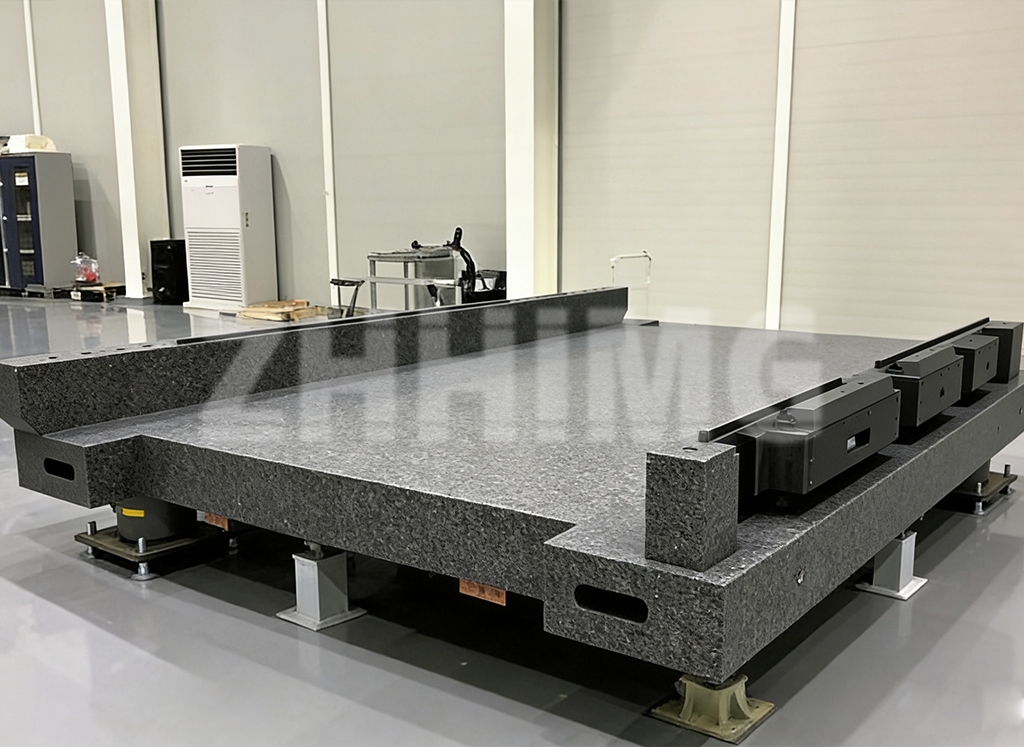
ZHHIMG® understands that modern precision equipment often requires a hybrid approach. While carbon fiber offers unmatched dynamic performance for moving bridges, it is frequently combined with the extreme static stability of our ZHHIMG® black granite (≈3100kg/m³) machine bases.
With extensive experience in precision manufacturing and rigorous quality control backed by ISO 9001, ISO 45001, ISO 14001, and CE certifications, ZHHIMG® supports clients in integrating carbon fiber components into their most demanding systems.
Whether you are designing a next-generation CMM or upgrading a semiconductor inspection platform, selecting the right precision beam is the key to unlocking higher machine performance.
Ready to Evaluate Carbon Fiber for Your Application?
If your current equipment is limited by the weight or thermal instability of metal beams, it is time to explore carbon fiber precision bridges. Share your technical drawings, load requirements, and accuracy targets with the ZHHIMG® engineering team. We can provide expert guidance on material selection and manufacturing solutions tailored to your specific needs.
Visit http://www.zhhimg.com to explore our full range of precision materials and contact us for a technical consultation.
Post time: Nov-09-2026