
Two good tools for two different jobs
Straight edges and square rulers exist in both granite and engineering ceramics, and buyers regularly ask which one is “better”. The honest answer: neither is better in general. Granite and ceramic sit in different places on the trade-off curve of weight, stiffness, thermal behavior, wear life and cost, and the right choice depends on what your application punishes hardest.
This article compares the two materials the way an assembly or calibration engineer would: property by property, including the weaknesses of each.
Comparison at a glance
| Property | Granite straight edge | Ceramic straight edge (Al₂O₃) |
|---|---|---|
| Density / weight in use | approx. 2,600–3,100 kg/m³; long edges are heavy and often need two hands or a crane | Al₂O₃ itself is denser per volume, but ceramic edges use slimmer cross-sections for the same stiffness, so the finished tool is noticeably lighter and easier to handle on site |
| Elastic modulus (rigidity) | typically 50–130 GPa; adequate, but long granite edges deflect more and need proportionally deeper sections | approx. 300–370 GPa; several times stiffer, which allows slim, light sections that still hold straightness under their own weight |
| Thermal expansion | low, roughly 4–6 ×10⁻⁶/K; granite drifts very little with shop temperature changes | approx. 8 ×10⁻⁶/K for alumina; still far better than steel (about 12), but measurably higher than granite |
| Wear resistance | good lapped wear life; surfaces can polish or wear locally with heavy sliding use | Mohs ~9, extremely wear resistant; working surfaces keep their texture for many years |
| Typical accuracy grades | grade 00 / 0 available, flatness and straightness down to about 1 µm class on standard sizes | comparable grades available; our ceramic straight rulers are produced for 1 µm class straightness, and air floating versions go well below that |
| Price range | generally the more economical option in standard sizes | typically a premium over granite of similar size, reflecting raw material and sintering cost |
| Best suited for | metrology rooms, reference checking, larger sizes where thermal stability matters most | on-machine measurement, cleanrooms, corrosive or humid environments, handheld use, semiconductor and optics assembly |
Where granite wins — and where it does not
Granite’s strengths are real: very low thermal expansion, proven behavior over decades in metrology labs, and a favorable price in common sizes. For a master straight edge that lives on a calibration bench and checks other instruments, granite is usually the sensible default.
Its weaknesses are equally real. Weight is the first: beyond roughly 1,000 mm, a granite straight edge becomes a two-person job, and handling risk (both for the tool and for the surface it touches) goes up. Granite is also somewhat porous compared with sintered alumina; on poorly sealed surfaces, coolants and oils can stain or creep into the texture, which matters in wet machining environments.
Where ceramic wins — and where it does not
Ceramics change the trade-off. The high elastic modulus of alumina allows slim sections that stay straight under their own weight, so a ceramic straight edge vs granite straight edge comparison usually ends with the ceramic tool being the lighter and easier one to carry between machines. Alumina is also fully non-magnetic, corrosion proof, does not absorb coolant, generates very little dust when worn, and its extreme hardness keeps the working surfaces accurate for years. These are the reasons ceramic edges dominate in cleanrooms, semiconductor equipment and around precision machine tools.
The weaknesses: alumina is brittle in a different way than granite. Edge chipping is the typical failure mode if the tool is knocked or stored carelessly, so protective handling rules apply. Its thermal expansion, while good, is higher than granite’s, which makes very long ceramic edges slightly more temperature-sensitive than their granite equivalents. And price is genuinely higher — if your application does not need what ceramic offers, paying for it buys nothing.
The special case: ceramic air floating rulers
When the measurement itself must not disturb the surface, a ceramic air floating ruler goes one step further: pressurized air escapes through fine pores or channels on the working face, so the ruler glides on an air film with no physical contact. This eliminates wear during use almost entirely and allows nanometer-class straightness measurements of machine guides and granite surfaces. It is the tool of choice for machine tool builders and metrology institutes — and, being ceramic, it keeps the weight low even in long lengths, which matters when the ruler has to be lifted onto a machine table repeatedly.
How to decide for your application
- Checking masters in a temperature-controlled metrology room, medium to long lengths: granite first, for thermal stability and cost.
- On-machine inspection, frequent carrying, humid or corrosive environment, cleanroom: ceramic.
- Squareness checks at assembly stations with frequent handling: a ceramic square ruler gives you wear life and low weight; granite squares are the economical choice for bench use.
- Nanometer straightness of machine guides, non-contact requirement: ceramic air floating ruler.
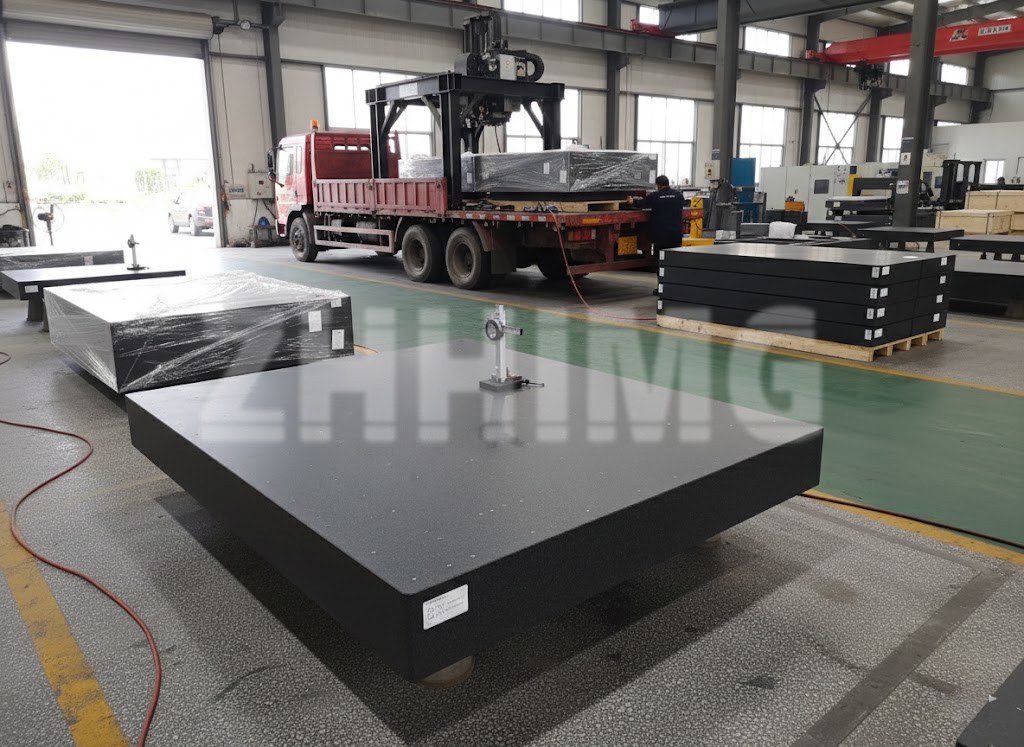
The photo below shows a ceramic straight ruler being verified against a granite master on a calibration bench — in practice the two materials are not competitors but colleagues: granite provides the stable reference, ceramic provides the mobile, wear-free working tool.
Ask us about both
ZHHIMG manufactures both granite and ceramic precision tools, including ceramic straight edges, square rulers and air floating rulers in custom lengths and accuracy grades. Tell us your measurement task, environment and length, and our engineers will recommend the material and grade that fits — including where granite is genuinely the better answer. Contact ZHHIMG for a quotation or material datasheet.
Post time: Oct-10-2026