
Why this matters when you are buying from a distance
Most overseas buyers of precision granite components never visit the factory. They receive a black, polished block that looks exactly like the photos on the quotation, and by the time a problem appears — a surface that will not hold flatness, edges that chip along polishing veins, inserts that loosen — the shipment has long been paid for. The most common substitution in this trade is marble sold as black granite. To the eye, a polished black marble slab and a polished black granite plate can look nearly identical.
The difference is not cosmetic. It is measurable, and it can be verified before you pay.
Black granite vs marble for precision work: the physical reasons
Granite and marble are both natural stones, but they formed differently, and the difference shows up precisely where precision applications need it.
- Stability. Granite is an igneous rock with interlocked quartz and feldspar grains. Marble is metamorphosed limestone, largely calcite, which is softer and more reactive. Calcite responds to temperature swings and humidity more noticeably, and a marble reference drifts more between seasons.
- Water absorption. Marble absorbs more water than granite. In a workshop with coolant mist or humid air, a marble plate gradually takes up moisture, which affects both its mass and its dimensional behavior. Quality granite for metrology typically absorbs well under 0.1 percent.
- Wear resistance. Marble scratches far more easily. On a working surface that gets wiped daily and has parts set on it, a marble plate loses its fine lapped texture quickly, and its accuracy goes with it. This is also why “resurfacing” a marble plate is a losing game: it wears out again much faster than granite does.
- Structure. The fine, uniform grain of suitable black granite laps to a sharp, non-reflective matte finish that holds oil films and supports accurate reading of surfaces. Marble polishes to a gloss and tends to show chatter marks and grain pull-out when lapped.
In short: for black granite vs marble precision applications, the answer is not a matter of taste. Marble simply does not meet the requirements of a metrology reference.
Four properties that identify precision granite, with realistic values
These are the numbers to ask about. Treat any supplier who cannot produce them as a risk.
- Density. Precision granite grades typically sit between 2,600 and 3,100 kg/m³ depending on the quarry. Our own material, used for our machine bases and plates, measures approximately 3,100 kg/m³ in our material test reports — a figure that, to our knowledge, is higher than most European and American black granite grades, and one of the reasons a ZHHIMG base feels noticeably heavier than a same-size plate made from lighter stone. A density well below 2,600 kg/m³ is a warning sign: it suggests porosity, a different stone, or a heavily filled material.
- Water absorption. For metrology-grade granite, expect a value under 0.1 percent. Marble typically measures several times higher. This single number is one of the fastest ways to distinguish the two stones on paper.
- Elastic modulus. Quality granite for machine bases typically shows an elastic modulus on the order of 50 to 130 GPa. Marble, being softer and more deformable, generally sits at the low end of that range or below it. For a machine base, higher modulus means less deflection under moving loads.
- Hardness. Granite’s Mohs hardness is commonly around 6 to 7, driven by its quartz content; marble, made mostly of calcite, is around 3 to 4. A simple scratch test with a steel knife blade will mark marble but barely touch granite — not a precise test, but a useful spot check when a third-party report is not available on site.
How to actually verify: third-party test reports
Words on a datasheet are easy. What you want is a test report from an independent laboratory, issued for the specific stone batch, with the laboratory’s name and the test method visible. Reputable material tests for this industry are traceable to national metrology institutes and cover density, water absorption, compressive strength, elastic modulus and chemical composition.
When you evaluate a supplier, ask for the report — not a screenshot of it, but the document itself, including the sample description and the test date. A serious manufacturer keeps these on file and sends them without argument. A supplier who answers “trust us, it is granite” has already told you something. Note also that chemical composition data supports the granite identification: the mineral content of genuine granite differs clearly from that of marble, and a laboratory can confirm this from the same sample.
A simple on-site check you can do on arrival
Before a third-party test, two quick checks at goods-in give a first indication:
- Weight. Density is mass per volume. Measure the plate, calculate its volume, weigh it, and divide. Genuine precision granite lands near 2,600–3,100 kg/m³; a plate that comes out well below this is either marble, porous stone, or thinner than invoiced.
- Surface finish. Precision-lapped granite is matte and non-reflective. A glossy black surface that behaves like polished decorative stone, especially one that scratches with a steel point, is a red flag.
Neither check replaces a laboratory report, but together they catch the most obvious substitutions in ten minutes.
Document checklist to send your supplier
Copy this list into your RFQ or forward it to a colleague. It is deliberately short enough to be used as-is:
- Material identification report (stone type and origin / quarry), issued by a third-party laboratory
- Physical properties test report: density, water absorption, compressive strength, elastic modulus, hardness
- Chemical composition report for the same batch, confirming the stone is granite and not marble
- Flatness calibration report for the finished plate, stating the standard and grade used (for example DIN 876 or GB/T 20428), with the measured values
- Material traceability: the link between the quarry batch, the test reports and your specific serial number
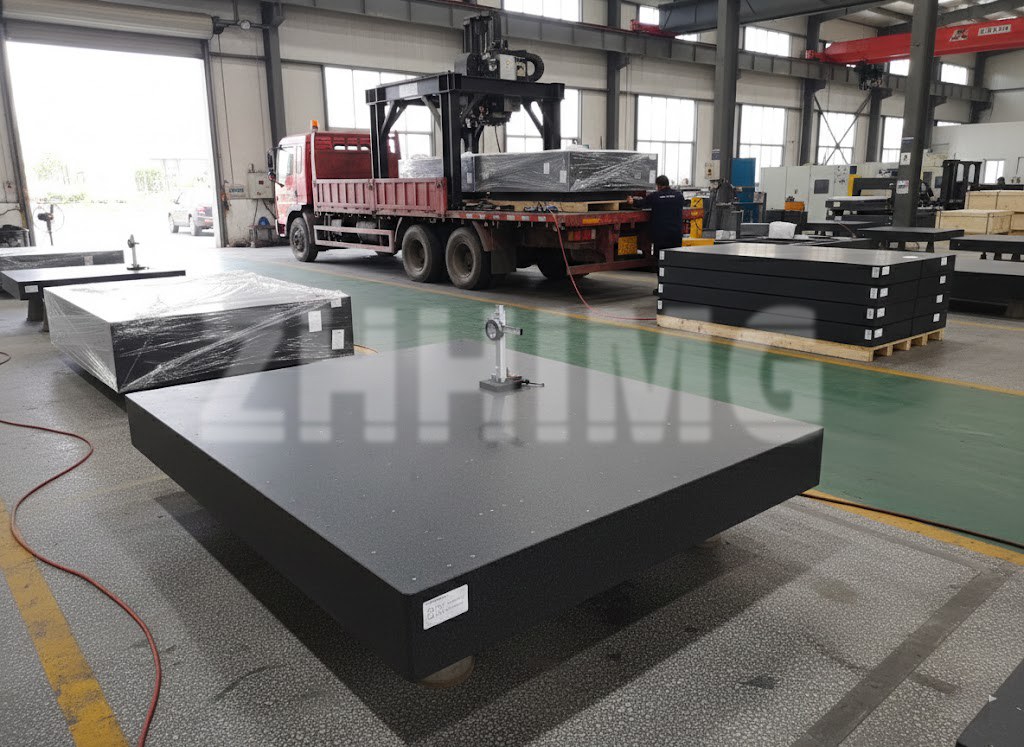
If a supplier cannot provide items 1 to 3 for the batch your parts come from, treat the offer as unverified regardless of the price. The photo below shows finished black granite plates in our works, packed and awaiting shipment with their inspection paperwork — this is what a normal, documented delivery looks like.
Buying precision granite with confidence
How to identify precision granite ultimately comes down to one habit: never accept material claims without a document behind them. We supply third-party material test reports, batch traceability and flatness calibration reports with our precision granite products, and we welcome customers who check. If you would like to see our material reports before specifying, tell us the size and application, and our engineers will send them with the quotation — contact ZHHIMG today.
Post time: Oct-10-2026