
In high-precision manufacturing, “extreme environments” are no longer the exception—they are becoming the standard. Whether it’s the high-vacuum chambers of a semiconductor fab or the temperature-fluctuating floors of an aerospace hangar, the material of your measuring tools dictates the accuracy of your data.
At ZHHIMG, we specialize in both materials. This guide will help you decide between Technical Ceramics and Precision Granite when the conditions get tough.
Defining the “Extreme” in Metrology
Before choosing a material, we must define the stressors your equipment will face:
-
Thermal Instability: Rapid temperature swings or high-heat environments.
-
Corrosive Exposure: Exposure to acidic cooling fluids or harsh cleaning chemicals.
-
Cleanroom Requirements: The need for non-shedding, non-porous surfaces.
-
Electrical/Magnetic Interference: Environments requiring non-conductive or non-magnetic properties.
Technical Ceramics: The Specialist for Harsh Conditions
When precision is non-negotiable in laboratory or semiconductor settings, technical ceramics (Al2O3 or SiC) are the premier choice.
-
Ultra-Low Thermal Expansion: Ceramics offer a CTE significantly lower than most metals and even granite, ensuring $000$ grade precision remains stable during temperature shifts.
-
Chemical Immunity: Highly resistant to oxidation and corrosion from industrial acids or alkalis.
-
Superior Hardness: With extreme wear resistance, ceramic tools maintain their lapped accuracy far longer under high-frequency use.
-
Non-Porous & Insulating: Ideal for cleanrooms and electrical testing where conductivity or “outgassing” is a concern.
Precision Granite: The Bedrock of Stability
For large-scale industrial applications, ZHHIMG® Black Granite remains the global gold standard for a reason.
-
Exceptional Vibration Damping: Granite’s natural internal structure absorbs mechanical noise, making it the best base for high-speed CMMs and heavy machining.
-
Cost-Efficiency at Scale: While ceramics are expensive to produce in large dimensions, granite can be quarried and finished into massive 10-meter surface plates cost-effectively.
-
Natural Aging: Our granite undergoes centuries of natural stress relief, ensuring it won’t warp over time like cast iron or steel.
-
Easily Repairable: If a granite surface is scratched, it can be re-lapped on-site to restore its original micron-level flatness.
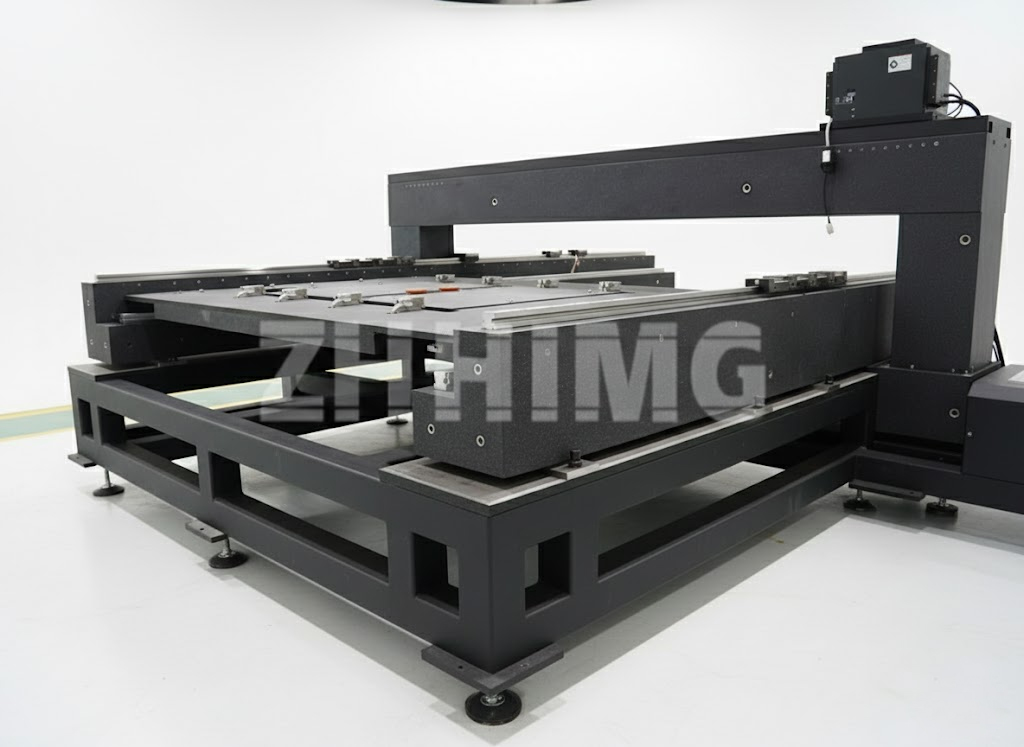
The Decision Tree: Which Should You Choose?
To simplify your procurement, follow this logic based on your specific environmental parameters:
-
Is the tool larger than 2 meters?
-
Yes: Granite (Ceramics become prohibitively expensive and fragile at this size).
-
-
Is the environment a Class 100 Cleanroom or Vacuum?
-
Yes: Ceramics (Zero porosity and no corrosion).
-
-
Are there significant temperature fluctuations (> ±2℃)?
-
Yes: Ceramics (Lowest thermal expansion).
-
-
Is vibration from nearby machinery a concern?
-
Yes: Granite (Superior mass and damping properties).
-
-
Is budget the primary constraint for standard precision?
-
Yes: Granite (Best ROI for Grade 0 and 00 applications).
-
Expert Selection Tool: Get Your Recommendation
Don’t leave your precision to chance. Use our Extreme Environment Selection Tool to find your perfect match.
Step 1: Select your environment (High Temp / Chemical / Cleanroom / Standard).
Step 2: Input your required accuracy grade (000, 00, or 0).
Step 3: Define your required dimensions.
Our engineers will analyze your parameters and provide a formal recommendation and quotation within 24 hours.
Post time: Mar-12-2026