
In high-stakes metrology—whether in a third-party calibration lab, a government quality inspection center, or an aerospace R&D facility—the integrity of a measurement is only as good as the platform it sits on. Even the most advanced sensors cannot compensate for a foundation that drifts, vibrates, or warps.
If your facility is struggling with unstable measurement accuracy, the root cause often lies in the interaction between the equipment and its environment. Below, the engineering team at ZHHIMG® breaks down the most frequent precision issues and provides systematic high-precision detection solutions.
1. Thermal Instability: The “Invisible” Dimensional Shift
Temperature fluctuation is the most common cause of measurement error. Most metals expand or contract significantly with even a 1°C change, leading to “measurement drift.”
-
The Issue: Using steel or cast iron platforms in environments without strict ±0.1°C control.
-
The ZHHIMG Solution: Switch to high-density black granite. Granite has a significantly lower coefficient of thermal expansion than metal. Its high thermal mass means it reacts slowly to ambient changes, providing a “thermal buffer” that maintains geometric integrity during long inspection cycles.
2. Vibration Interference: The Enemy of Sub-Micron Accuracy
In industrial zones, floor vibrations from heavy machinery, HVAC systems, or even nearby traffic can translate through the floor into the measuring platform.
-
The Issue: High-frequency jitter that causes “noise” in sensitive laser or touch-probe readings.
-
The ZHHIMG Solution: Implement passive or active vibration isolation. For precision measuring platforms, we recommend integrated air-flotation isolation mounts. Additionally, the natural internal damping of granite is superior to metal, effectively “soaking up” micro-vibrations before they reach the workpiece.
3. Material Deformation and “Memory”
Over time, synthetic materials and certain metals can suffer from internal stress relief, causing the platform to bow or twist years after installation.
-
The Issue: Traditional cast iron plates require periodic “stress-relieving” and frequent re-scraping to maintain flatness.
-
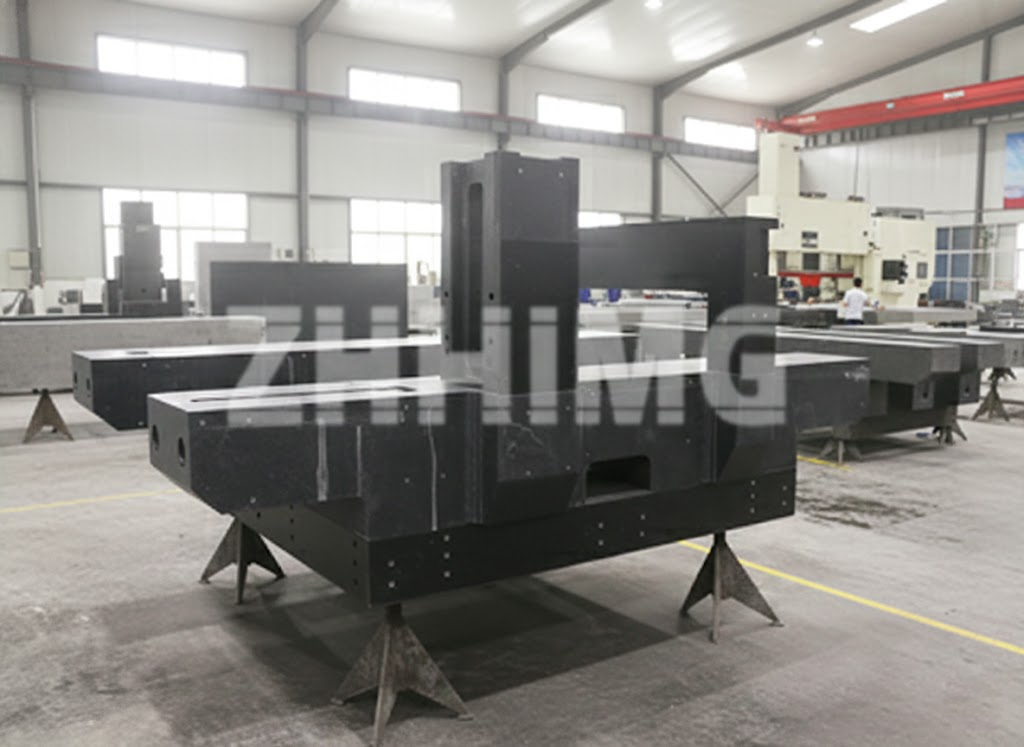
The ZHHIMG Solution: Use naturally aged mineral materials. Our ZHHIMG® granite is aged for millions of years, meaning it has zero internal stress. Once lapped to a specific grade (such as DIN 876 Grade 00), it remains stable for decades.
4. Incorrect Installation and Leveling
Even the best platform will fail if it is not supported correctly. A common mistake is supporting a large surface plate on too many points, which can cause the plate to “follow” the unevenness of the floor.
-
The Issue: Over-determined support leading to structural distortion.
-
The ZHHIMG Solution: Follow the Bessel Point support system. By supporting the platform at specific calculated points, you minimize the deflection caused by the material’s own weight. We provide specialized adjustable mounts that ensure a 3-point primary support for optimal equilibrium.
Comparison: Why Your Platform Material Matters
| Factor | Metal (Steel/Iron) | ZHHIMG® Black Granite |
| Thermal Expansion | High (Unstable) | Very Low (Stable) |
| Corrosion | High (Requires Oil) | Zero (Acid-Resistant) |
| Magnetic Influence | Yes (Attracts Interference) | No (Non-Magnetic) |
| Wear Resistance | Moderate | Extreme (Mohs 6-7) |
| Maintenance | High | Minimal |
Professional Support for Your Lab
At ZHHIMG®, we don’t just sell surface plates; we provide the foundation for your accuracy. Our technicians, with over 30 years of manual grinding experience, can help you diagnose unstable measurement accuracy and design a custom structural solution—from constant-temperature workshop assembly to integrated air-bearing tracks.
Post time: Mar-18-2026