
In precision manufacturing and metrology laboratories, the granite surface plate serves as the ultimate reference surface for dimensional measurements. Its flatness and stability directly influence the accuracy of Coordinate Measuring Machines (CMMs), optical inspection systems, and other precision instruments. However, even the highest-grade granite plate cannot deliver optimal performance without proper installation and calibration.
This guide presents a systematic 7-step approach to granite surface plate installation and calibration, designed to minimize measurement errors and ensure long-term precision for your metrology applications.
Why Proper Installation and Calibration Are Critical
Granite surface plates are precision tools that demand meticulous attention during setup. According to ASME B89.3.7-2013 standards, surface plates must meet strict flatness tolerances—Grade AA plates for calibration laboratories, Grade A for inspection areas, and Grade B for shop floor applications. However, these specifications assume proper installation conditions.
Common installation-related issues include:
- Measurement Errors: Even a deviation of 0.01 mm/m from level can cause significant inaccuracies when inspecting precision components.
- Uneven Load Distribution: Improper support can induce internal stresses, leading to micro-deformation over time.
- Calibration Failures: Many plates fail calibration not due to wear, but due to installation-induced stress that affects flatness measurements.
7 Essential Steps for Installation and Calibration
Step 1: Site Preparation and Environmental Control
Before installation begins, ensure the installation site meets critical environmental requirements:
- Vibration Control: Position the plate away from heavy machinery, compressors, or traffic areas. Vibration is the enemy of precision measurement.
- Temperature Stability: Maintain ambient temperature at 20 ± 2°C with minimal fluctuation. Granite has a low coefficient of thermal expansion (approximately 5.5 × 10⁻⁶/°C), but even small temperature shifts can affect dimensional accuracy.
- Floor Strength: Verify floor load-bearing capacity. For large granite platforms weighing several tons, reinforcement may be necessary.
- Humidity Control: Keep relative humidity between 40-60% to prevent condensation and minimize dimensional changes.
Professional Tip: For ultra-high-precision applications, consider installing the granite platform on an isolated foundation separate from the main building structure to eliminate external vibration transmission.
Step 2: Safe Transportation and Handling
Granite is dense and brittle, requiring specialized handling procedures:
- Use Proper Lifting Equipment: Never lift the plate by its edges. Use spreader bars with wide, durable straps designed for the plate’s exact dimensions to distribute weight evenly.
- Avoid Impact: Granite can withstand compressive forces but is vulnerable to tensile stress. Dropping or sudden impacts can cause fractures or micro-cracks that compromise flatness.
- Temperature Acclimatization: After transport, allow the plate to rest for 24-48 hours in the installation environment. This permits the granite to reach thermal equilibrium and relieves stress from transportation.
Safety Note: For plates exceeding 2 tons, always engage professional rigging teams with experience handling precision stone components.
Step 3: Foundation and Stand Setup
The foundation beneath the granite plate is as critical as the plate itself:
- Three-Point Support Principle: Most stands feature 5 support points—3 primary points forming a stable triangle and 2 secondary points for auxiliary support. This geometry prevents over-constraint and minimizes internal stress.
- Primary Support Configuration: Select the middle point of the 3-point side plus the two end points of the 2-point side. Lower the secondary points initially so they do not contact the plate.
- Stand Stabilization: Before placing the granite, ensure the stand itself is level and stable. Adjust leveling feet until the stand no longer wobbles or shifts under gentle pressure.
Technical Insight: Supporting the plate at points other than its designated suspension points voids certified accuracy. Always follow manufacturer-specified support layouts.
Step 4: Precision Leveling Procedure
Leveling is the most critical step for achieving optimal measurement accuracy:
Equipment Required:
- Electronic precision level (accuracy ≥ 0.005 mm/m for Grade 00 plates)
- Torque wrench (5-10 N·m for secondary support adjustment)
Procedure:
- Place the electronic level on the working surface along the X-axis (lengthwise). Record the reading (N1).
- Rotate the level 90° to align with the Y-axis (widthwise). Record the reading (N2).
- Adjust primary support points based on readings:
- If N1 (X-axis) is positive (left side higher) and N2 (Y-axis) is negative (rear side higher): Lower the middle primary point clockwise and raise the rear primary point counter-clockwise.
- If N1 is negative (right side higher) and N2 is positive (front side higher): Raise the middle point and lower the front primary point.
- Repeat measurements until both N1 and N2 are within ±0.005 mm/m for Grade 00 plates or ±0.01 mm/m for Grade 0 plates.
- Critical Step: Slowly raise secondary support points until they just make contact with the plate bottom. Do not over-tighten—overtightening disrupts the level achieved with primary points.
Step 5: Static Stabilization Period
After initial leveling, allow the granite plate to stabilize:
- 24-Hour Rest Period: Let the plate remain undisturbed for at least 24 hours. This allows residual stress in the granite and stand to release naturally.
- Re-Verification: After stabilization, re-measure X and Y axes with the electronic level. If deviations exceed acceptable ranges, repeat Step 4.
- Document Readings: Record all leveling data in a maintenance log for future reference and trend analysis.
Why This Matters: Rushing into operation without proper stabilization can result in gradual settling and shifting, leading to calibration drift over weeks or months.
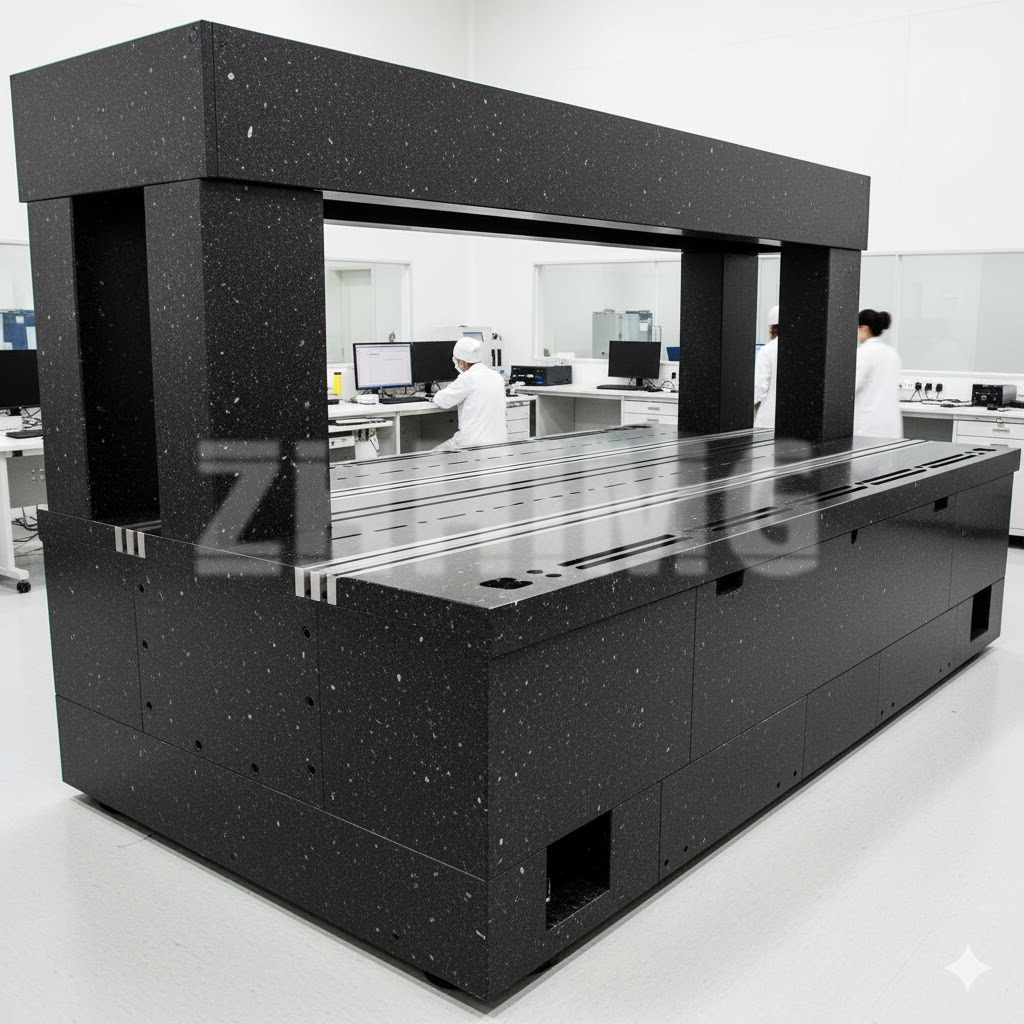
Step 6: Calibration and Accuracy Verification
Calibration confirms that the granite plate meets its specified flatness tolerances:
Calibration Standards:
- Follow ASME B89.3.7-2013 (Granite Surface Plates) or equivalent international standards
- Grade AA: Highest accuracy for calibration laboratories
- Grade A: Inspection areas
- Grade B: General shop floor applications
Calibration Methods:
- Overall Flatness Measurement: Use laser interferometers, auto-collimators, or electronic levels to measure points across the surface in a grid pattern. Combine measurement lines into a 3D analysis of overall flatness.
- Local Variation (Repeat Reading): Use a repeat reading gauge with a three-point base and fourth contact point. Manually sweep the gauge across the surface to measure local flatness variations.
- Decision Rule: Simple acceptance with test uncertainty ratio (TUR) ≥ 4 for Grade A and B plates, TUR ≥ 2 for Grade AA plates.
Calibration Frequency:
- Heavy/Critical Use (Grade AA/0): Every 6 months
- Moderate Use (Grade 1): Every 12 months
- Low/Reference Use: Every 24 months
Professional Calibration Services: For certified compliance, engage accredited calibration laboratories with traceable measurement standards.
Step 7: Long-Term Maintenance and Care
Proper maintenance extends service life and preserves calibration accuracy:
Daily Maintenance:
- Clean the working surface with a lint-free cloth and neutral granite cleaner
- Avoid abrasive materials, bleach-containing cleaners, or harsh scrubbing
- Remove spills promptly—oil stains can be treated with absorbent powder, food stains with hydrogen peroxide (carefully applied)
Periodic Maintenance:
- Inspect support structures for corrosion or wear; replace aged components promptly
- Check leveling quarterly for heavily used plates, semi-annually for moderate use
- Verify calibration compliance according to recommended schedules
Environmental Monitoring:
- Continuously monitor temperature and humidity in the measurement area
- Document environmental conditions alongside calibration data
- Investigate any significant deviations promptly
Handling Guidelines:
- Never exceed maximum load capacity
- Avoid heavy impacts between workpieces and the granite surface
- Use protective pads when placing heavy components on the plate
Why Choose ZHHIMG® Granite Surface Plates
At ZHHIMG®, we combine premium materials with precision engineering to deliver granite surface plates that exceed international standards:
Superior Material Selection
- ZHHIMG® Black Granite: Premium-grade granite with density ≈3100 kg/m³, exceptional hardness (Mohs 6-7), and minimal thermal expansion
- Natural Aging: Granite formed over millions of years, ensuring zero internal stress and long-term dimensional stability
Precision Manufacturing
- CNC Grinding + Hand Lapping: Combined machining processes achieve tolerance ±0.5 μm with surface roughness Ra ≤ 0.2 μm
- Temperature-Controlled Environment: All finishing performed in cleanroom conditions to ensure consistency
- Third-Party Verification: Every plate undergoes independent metrological verification with traceable certification
Customization Capabilities
- Non-standard sizes from 300×300 mm to 3000×2000 mm
- Specialized designs including T-slot grooves, threaded holes, and integrated reference marks
- Tailored support structures for specific CMM models and applications
Comprehensive Support
- On-Site Installation Services: Professional teams with decades of experience handling ultra-heavy structures (up to 100 tons)
- Global Coverage: Service across Europe, North America, and Asia
- ISO Certification: ISO 9001, ISO 14001, and ISO 45001 certified processes
- 2-Year Warranty: Extended coverage with free annual precision re-calibration
Conclusion: Precision Is a Process, Not a Product
Installing and calibrating a granite surface plate is not a one-time task—it is an ongoing process that combines meticulous setup, regular verification, and proactive maintenance. By following these 7 essential steps, precision instrument manufacturers and metrology laboratories can:
- Minimize measurement errors and improve CMM accuracy
- Extend the service life of granite surface plates beyond 10 years
- Maintain calibration compliance with international standards
- Ensure reliable, repeatable measurements for critical quality control applications
Remember, the accuracy of your entire measurement system depends on the foundation beneath it. A properly installed and calibrated granite surface plate is not just an accessory—it is the bedrock of metrological confidence.
About ZHHIMG®
ZHHIMG® is a leading global manufacturer of precision granite components for metrology, semiconductor, and advanced manufacturing industries. With over 20 international patents and full ISO/CE certifications, we deliver uncompromising quality and precision to customers worldwide. Our mission is simple: ”The precision business can never be too demanding.”
For technical consultation, installation services, or product inquiries, contact the ZHHIMG® team today.
Post time: Mar-26-2026