
The Natural Damping of Crystalline Network Structures
Although metallic materials possess good machining performance, when facing complex dynamic disturbances, the attenuation speed of their internal elastic waves is often unsatisfactory, making them prone to continuous resonance tails. In contrast, naturally formed dark rock structures exhibit a completely different physical talent.
Taking the high-quality black granite long selected by ZHHIMG Group (ZHHIMG®) as an example, its density performance breaks the upper limit of conventional stones (reaching approximately $3100\,\text{kg/m}^3$). This extremely dense mineral crystal matrix constitutes a natural energy dissipation field at the microscopic level. When external high-frequency or low-frequency vibration waves attempt to penetrate the base, the densely distributed grain boundaries and multi-phase mineral intersection points act like countless miniature dampers, rapidly converting kinetic energy into micro-amounts of heat and dissipating it. This outstanding intrinsic internal damping enables the granite base to achieve an “emergency brake” the moment a disturbance occurs, suppressing the amplitude to the nanoscale.
The Geometric Code Against Time and Thermal Flow
Dynamic vibration resistance is only the first step to ensuring the stability of the optical path, and long-term structural static stability is another severe test. Any minor “creep” or stress release will ruin the meticulously calibrated optical path coaxiality.
High-quality granite has completed sufficient internal stress release during its long geological evolution. Its chemical properties are extremely stable; it is rust-free, acid-alkali resistant, and possesses an extremely low coefficient of thermal expansion. To perfectly activate this physical gene, modern ultra-precision manufacturing achieves ultimate upgrades through a dual closed-loop of software and hardware. For example, placing ultra-large-scale granite bases in constant-temperature, constant-humidity, and dust-free workshops built with ultra-hard concrete pouring and surrounded by anti-vibration trenches, and cooperating with expensive high-precision CNC grinders and veteran master craftsmen with over thirty years of manual experience for nanoscale finishing. This process chain—integrating “top-tier native material + ultimate digital-intelligent processing + nanoscale tactile finishing”—ensures that the base can still maintain a perfect geometric datum after years of high-intensity, variable-environment heavy-duty service. 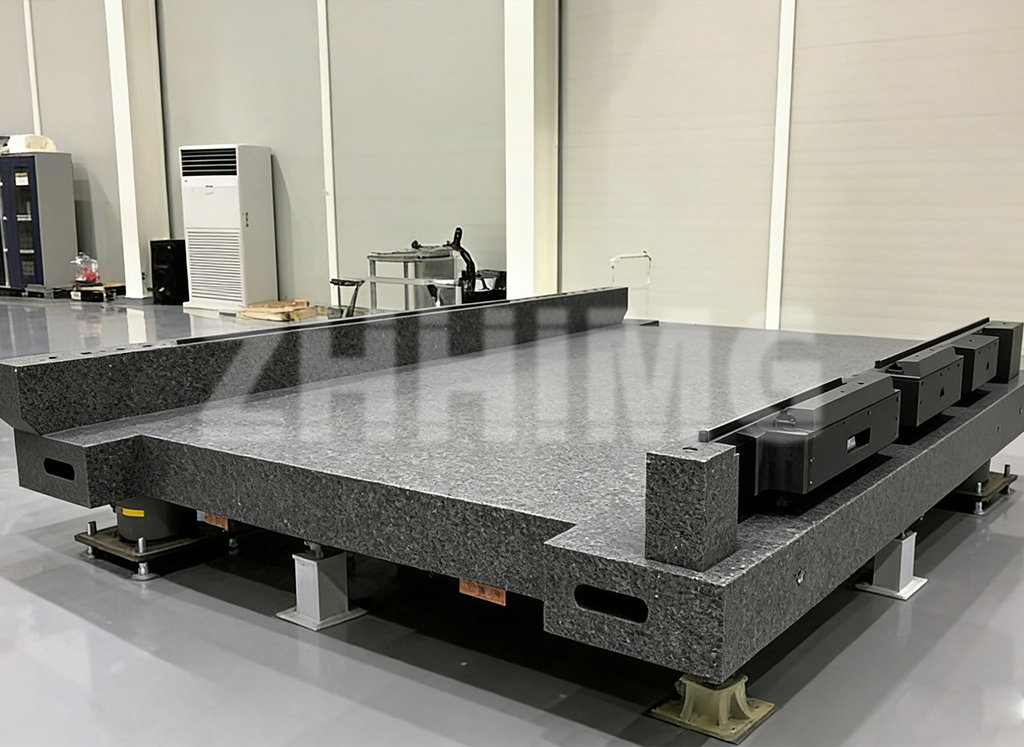
The Physical Endgame of Protecting Optical Paths
In the practice of optical engineering, an excellent granite bench base has long surpassed the traditional definition of a “bearing flat plate.” It swallows up the complex vibration noises from the outside world through the natural high-damping characteristics brought by high density; it locks down the boundaries of spatial geometry through strict international metrology standards (such as DIN, ASME, and other systems) and traceable calibration means. It is precisely because of this solid skeleton that deeply combines physical properties with peak manufacturing craftsmanship that humanity’s path to exploring the speed of light and microscopic limits can remain rock-solid amidst the storms.
Post time: Sep-24-2026