
Air bearings achieve what no contact bearing can: motion without wear, without stick-slip and without lubrication, at sub-micron straightness levels. But an air bearing is only as good as the surface it floats on. This article explains the physics of air films, why fine-grained natural granite is the ideal mating material, what surface accuracy the guideway demands, and where granite air bearing stages deliver the most value — from linear motor platforms to optical inspection systems.
1. How Air Bearings Work: Riding on a Microscopic Film of Air
An air bearing supports its load on a thin pressurized film, typically 3–15 µm thick. Two supply principles dominate:
- Orifice compensation. Air flows through precisely sized holes into a shallow pocket or groove; the pressure self-adjusts as the gap changes. Simple and robust, but load capacity is moderate and the film is sensitive to local surface errors.
- Porous compensation. Air bleeds uniformly through a porous material (often carbon), producing an exceptionally stable and tilt-tolerant film with higher damping.
Either way, the governing physics is the same: the film stiffness depends on the square of the gap uniformity. If the guideway surface has waviness comparable to the film thickness, the stage experiences pressure modulation — visible as straightness error, roll, or worse, pneumatic hammer (self-excited oscillation). The guideway, not the bearing, sets the quality ceiling of the system.
2. Why Granite Is the Ideal Guideway Material
Engineers sometimes ask why air bearing stages so overwhelmingly run on granite rather than steel or ceramic rails. The reasons are material-physics, not tradition:
- Fine, uniform grain structure. Igneous black granite solidifies from a single melt; there is no dendritic segregation, inclusions or soft matrix as in cast iron. Lapping exposes a homogeneous surface, so the air gap stays uniform along the whole travel — the single most important factor for film stability.
- Low thermal expansion (≈5–8 µm/m·°C). Air gaps are only a few microns; half a degree of temperature change can shift a steel rail more than an air gap. Granite’s stability keeps the film geometry intact through day–night cycles.
- No corrosion, no oil. Bare granite needs no coatings and no lubricant — critical in cleanrooms, where outgassing and particle generation disqualify greased rails.
- High damping. Granite’s internal damping suppresses vibration transmission from floor and drives, improving the dynamic behavior of the floating stage.
- Lappable to micron-level flatness over meters. Long granite rails can be hand-lapped and verified to a few microns over several meters — something machining alone cannot achieve.
3. What Surface Accuracy Does an Air Bearing Guideway Need?
Specification depends on the bearing type and the target motion quality, but typical requirements for a precision granite air bearing system are:
| Parameter | Typical Requirement | Why It Matters |
|---|---|---|
| Overall flatness of bearing face | 1–5 µm over the travel length | Baseline film gap uniformity |
| Local flatness / waviness | ≤ 0.5–1 µm per 25 mm | Short-wavelength errors modulate pressure directly |
| Straightness over full travel | 0.5–2 µm (horizontal & vertical) | Directly becomes stage straightness error |
| Surface finish | Lapped, Ra ≤ 0.4 µm typically | Finish affects gap leakage and flow stability |
| Parallelism of opposing rails | 1–3 µm over length | Controls roll and yaw of the carriage |
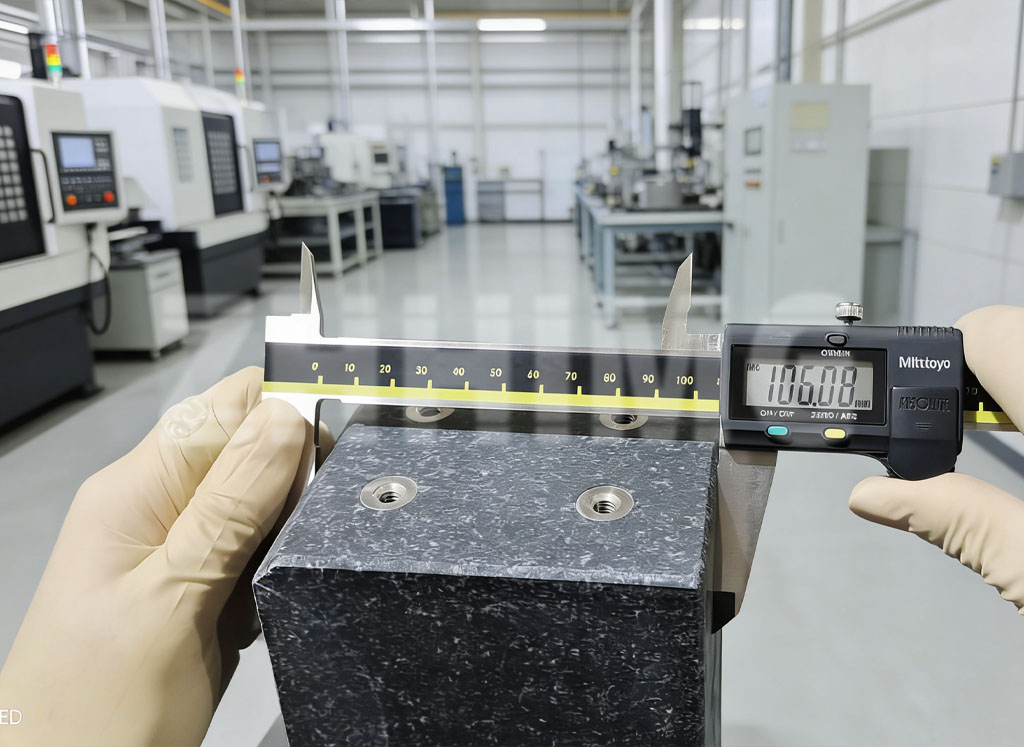
Verification is inseparable from these numbers: measuring straightness over a 2 m rail with sub-micron uncertainty requires electronic levels, autocollimators or laser interferometry in a temperature-controlled room. This is why the guideway supplier’s measurement capability matters as much as their lapping benches — we describe our approach in our granite inspection and calibration process.
4. Typical Applications
- Linear motor platforms. Ironless linear motors deliver smooth force with no cogging; combined with granite air guideways, stages reach sub-micron straightness at speeds of 1–2 m/s — the standard architecture for wafer inspection and laser scanning.
- XY precision stages. Stacked or planar air bearing stages on a granite base achieve nanometer-level repeatability for lithography-adjacent metrology, probe cards and display inspection.
- Optical inspection systems. Confocal, interferometric and chromatic sensor systems need vibration-free, wear-free scan motion; the non-contact film adds no particles and no hysteresis.
- Mass comparators and metrology labs. Air bearing carriages on granite rails serve where both cleanliness and geometric perfection are mandatory.
In all these cases the granite plays two roles at once: structural base and precision guideway. Integrating both in one material — one lapping process, one thermal behavior, one certification — removes interfaces that would otherwise inject error. More application detail is available in our semiconductor equipment solutions.
5. Design Notes Before You Specify
- Define travel, payload and center of gravity — film stiffness and bearing pre-load are sized around them.
- Specify air quality — typically clean, dry air with filtration to 0.01 µm; the film is only as clean as the supply.
- Decide the measurement datum — who owns the straightness reference: the bearing maker, the base maker, or the assembled system?
- Plan the environment — 20 ± 0.5 °C and a vibration-isolated foundation preserve the certified geometry.
- Request the inspection report with the part — measured straightness/flatness values with instrument identification and traceability, not just a grade letter.
Conclusion
Air bearings and granite are a matched pair: the bearing provides frictionless motion, and granite provides the geometrically stable, thermally quiet, particle-free surface that makes the film work. When both are engineered and verified together, the result is motion quality that contact systems cannot reach.
Developing an air bearing stage or motion platform? Send us the travel range, payload, required straightness and interface drawing — ZHHIMG® will engineer and certify the granite guideway components for your system, with a traceable inspection report included.
Post time: Sep-24-2026