
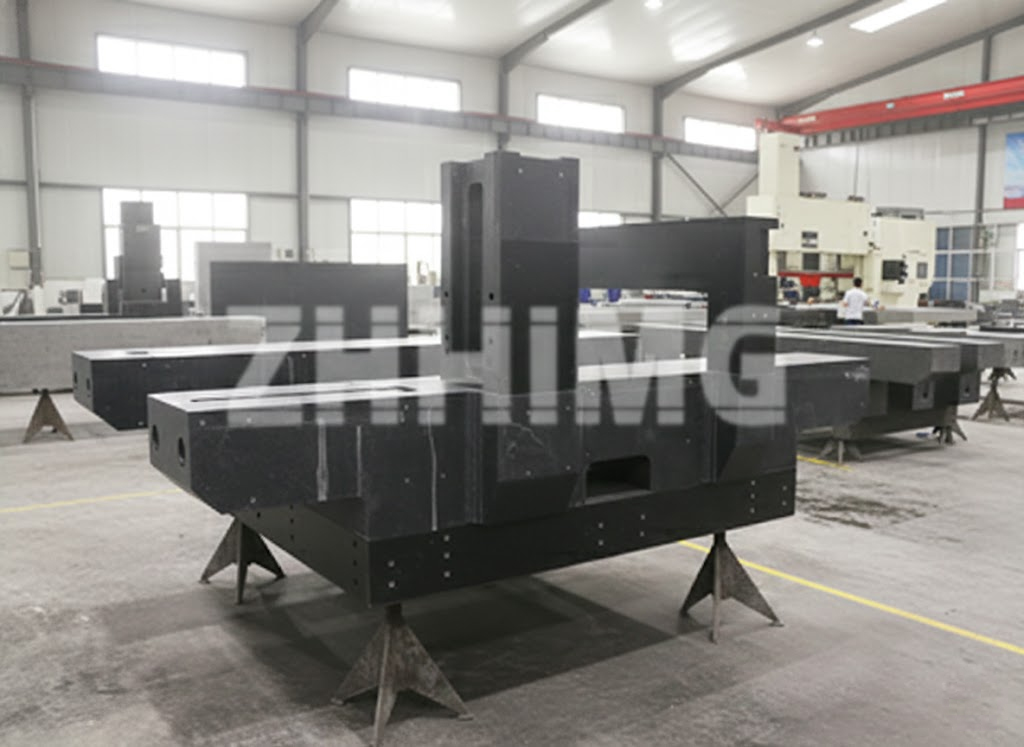
Choosing the base material is one of the most consequential decisions in precision machine design. The base carries the guideways, the drive system and the workpiece, and it quietly determines thermal drift, vibration behavior and how long the machine holds its accuracy. The four dominant candidates — natural granite, cast iron, engineered ceramics and mineral casting — each have distinct physics behind them, and none is universally “best”. Because ZHHIMG® manufactures and assembles all of these material families, this comparison is written to be objective: the goal is to help design engineers match material to application, not to sell one of them.
1. Natural Granite: The Dimensional Reference
Fine-grained black granite has been the reference material for metrology equipment for decades, and for good reasons:
- Very low thermal expansion — roughly 5–8 µm/m·°C, about half that of steel. A temperature change causes far less geometric distortion than in a metal base of the same size.
- Excellent long-term stability — granite is geologically ancient material with no residual casting or machining stresses to relax. Properly supported, it holds geometry for decades.
- Good damping — noticeably better than steel, which is why CMM structures rely on it.
- Rust-free, non-magnetic, electrically insulating — useful in semiconductor and cleanroom environments.
Its limitations are equally real: it is brittle (edge chipping must be designed around), it cannot be welded, and complex internal geometry requires drilling, milling and inserts. Fabrication of large shapes also takes time — see how we manage this in our granite manufacturing process.
2. Cast Iron: The Proven Workhorse
Cast iron remains the default for general machine tools, and it deserves its reputation:
- Highest structural stiffness per cost — with an elastic modulus around 100–120 GPa and dense wall sections, iron bases resist cutting forces effectively.
- Fast, mature supply chain — foundries and machining partners exist everywhere; lead times are typically the shortest of the four.
- Design freedom — complex cores, internal ribs and mounting bosses are cast directly.
- Reasonable damping — flake graphite structures absorb vibration better than welded steel, though clearly less than granite or mineral casting.
The trade-offs: thermal expansion is roughly double that of granite (~10–12 µm/m·°C), castings carry residual stresses that must be relieved through aging or heat treatment, and corrosion protection is required in humid environments.
3. Engineered Ceramics: When Stiffness Meets Extreme Environments
Materials such as silicon carbide (SiC) and alumina occupy the high end of the performance spectrum:
- Outstanding specific stiffness — SiC combines high elastic modulus (350–420 GPa) with low density (~3.1 g/cm³), giving the best stiffness-to-weight ratio of the four.
- Very low thermal expansion — SiC is around 4 µm/m·°C; some ceramics are even lower.
- Extreme hardness and wear life — surfaces essentially do not wear in normal use; ideal for optics, wafer handling and laser systems.
The constraints are brittleness, sensitivity to impact and tensile loading, expensive and slow processing (sintering, CVD or reaction bonding), and size limits — very large monolithic ceramic bases are difficult and costly. Ceramic is usually chosen where weight, dynamics or thermal performance justify the budget, not as a default.
4. Mineral Casting: Damping Champion with Fast Prototyping
Mineral casting (epoxy granite) is a composite of mineral aggregates in an epoxy matrix, cast at room temperature into molds:
- Best vibration damping — typically 6–10 times better than cast iron, which directly improves surface finish and settling time in dynamic machines.
- Near-net-shape freedom — cable channels, conduit openings and complex contours are molded in; no welding or heavy fabrication.
- Fast iteration — once the mold exists, parts replicate quickly; ideal for mid-volume equipment where a casting pattern would be expensive.
- Thermal behavior close to steel (~12–16 µm/m·°C) — this can be an advantage when bonding to metal components, reducing interfacial stress.
On the other hand, its elastic modulus (30–45 GPa) is the lowest of the four, so sections must be generous; creep behavior and epoxy aging should be considered for ultra-high stability requirements; and it is not suitable for very hot environments.
Side-by-Side Comparison
| Property | Granite | Cast Iron | Ceramic (SiC/Al₂O₃) | Mineral Casting |
|---|---|---|---|---|
| Thermal expansion (µm/m·°C) | 5–8 | 10–12 | 2–4 (SiC ≈ 4) | 12–16 |
| Damping capacity | Good | Moderate | Moderate–low | Excellent (6–10× iron) |
| Elastic modulus (GPa) | 50–80 | 100–120 | 350–420 | 30–45 |
| Long-term stability | Excellent | Good (after stress relief) | Excellent | Good |
| Relative cost | Moderate | Low | High | Low–moderate |
| Typical lead time | Moderate–long (large shapes) | Short | Long | Short (with mold) |
| Design freedom | Moderate (drill/mill/inserts) | High (cast features) | Low–moderate | High (molded features) |
| Typical applications | CMMs, metrology frames, semiconductor stages | Machine tools, general production equipment | Optics, wafer handling, laser systems | Dynamic machines, printing, medical, mid-volume equipment |
Values are indicative ranges for common commercial grades; project-specific data should be confirmed with the manufacturer.
How to Choose: Questions That Decide the Material
- What dominates the error budget — thermal drift or vibration? Thermal drift points toward granite or ceramic; vibration and dynamic settling point toward mineral casting or granite.
- How large is the structure? Granite and iron scale well to multi-meter bases; ceramic does not.
- What environment does the machine live in? Cleanrooms and humidity favor granite (rust-free, outgassing-free); hot workshops favor metals or mineral casting with the right resin.
- What is the production volume? One-off and low volume favor granite fabrication; high volume favors cast iron patterns or mineral casting molds.
- How will it be joined? Hybrid designs — for example a granite base with a metal column, or a mineral casting body with granite guideway rails — often beat any single material.
Conclusion: The Right Base Is the One Matched to Your Error Budget
Granite wins on thermal stability and metrological credibility, cast iron on cost and supply speed, ceramic on stiffness-to-weight and wear life, mineral casting on damping and shape freedom. Most precision machines do not need a philosophical winner — they need a considered combination of properties, interfaces and budget.
Planning a new machine base or motion platform? Send us your layout, payload, accuracy targets and environment — ZHHIMG® engineers will recommend the optimal material combination, provide a manufacturability review of your drawing, and quote with certified inspection data. Explore our precision granite components and ultra-precision granite solutions to see what we build.
Post time: Sep-24-2026