
In ultra-precision equipment projects such as semiconductor inspection, laser machining and coordinate measuring machines, the granite machine base serves as the reference carrier for the whole machine. Custom machining is only one part of the project. Many projects suffer from precision drift, vibration interference and assembly difficulties after commissioning. The root cause is often not poor stone quality, but incomplete verification of on-site installation conditions in the early phase. To ensure the granite base delivers micron and even nanometer-level reference performance after installation, four major dimensions including on-site foundation, environmental parameters, assembly interfaces, transportation and hoisting must be verified one by one before drawing finalization and production.
The foundation for equipment installation is the primary prerequisite for stable operation of the granite base. The granite base features heavy self-weight and high rigidity, yet it is highly sensitive to uneven foundation settlement. In the early stage, it is necessary to confirm the structural type, pouring thickness and bearing load of the floor at the installation area, to check whether the ground can bear the combined static load of the base and the complete machine. Meanwhile, survey vibration sources in the surrounding area, such as stamping equipment, air compressors and conveyor lines inside the workshop, and evaluate the amplitude of low-frequency vibration transmitted through the ground. If on-site vibration exceeds the limit, anti-vibration trenches, vibration isolators or independent foundations shall be planned in advance to prevent external vibration from transferring to the granite base via the ground and continuously disturbing the motion precision of the equipment. Ordinary factory concrete floors often fail to meet the requirements of ultra-precision equipment. A separate thickened independent foundation may need to be poured when necessary to avoid base plane deformation caused by foundation settlement.
Temperature and humidity environmental conditions cannot be ignored. Although granite has a far lower thermal expansion coefficient than metals, sustained temperature gradients and day-night temperature differences can still induce tiny deformation, directly affecting the repeat positioning accuracy of equipment. Before customizing the base, confirm whether the installation workshop is equipped with a constant temperature and humidity system, together with the temperature control range and temperature fluctuation value, as well as the air flow condition in the area. Direct air blowing from air conditioning outlets onto the base will create local temperature differences and result in one-way deformation of the base. Such layout problems need to be identified and adjusted in advance. Environmental humidity also needs to be confirmed. High humidity will affect supporting air bearing assemblies, guide rails and sensors. Granite itself is not afraid of moisture, yet supporting components of the whole machine will be affected by the environment. It is required to synchronize environmental parameters in advance and decide whether the base needs to reserve dust-proof and protective structures. For semiconductor-type equipment, confirm the on-site cleanliness level to determine if the base needs to adopt dust-free assembly processes.
Mechanical assembly interfaces between the base and the host are the core confirmation items during customization. It is required to collect the load distribution and center of gravity of the whole machine, distinguish concentrated loads from distributed loads, so as to design the internal reinforcement structure of the base, anchor layout and support points. Improper support point layout will cause stress deformation of the granite base, and even well-finished grinding accuracy cannot be retained. Meanwhile, confirm installation benchmark requirements: position, tolerance and depth of threaded holes, counterbore holes and locating pin holes, specifications and orientation of T-slots, as well as benchmark areas on the plane. Also confirm whether cable chases, pipeline holes and cable avoidance positions for air bearing modules need to be reserved. All interface dimensions and geometric tolerances must be locked before material cutting and machining. Granite is brittle stone. Modifying hole positions or cutting grooves after finishing is extremely difficult and may easily cause component scrap. In addition, confirm the host assembly sequence to judge whether reserved operating space for assembly is needed on the base. 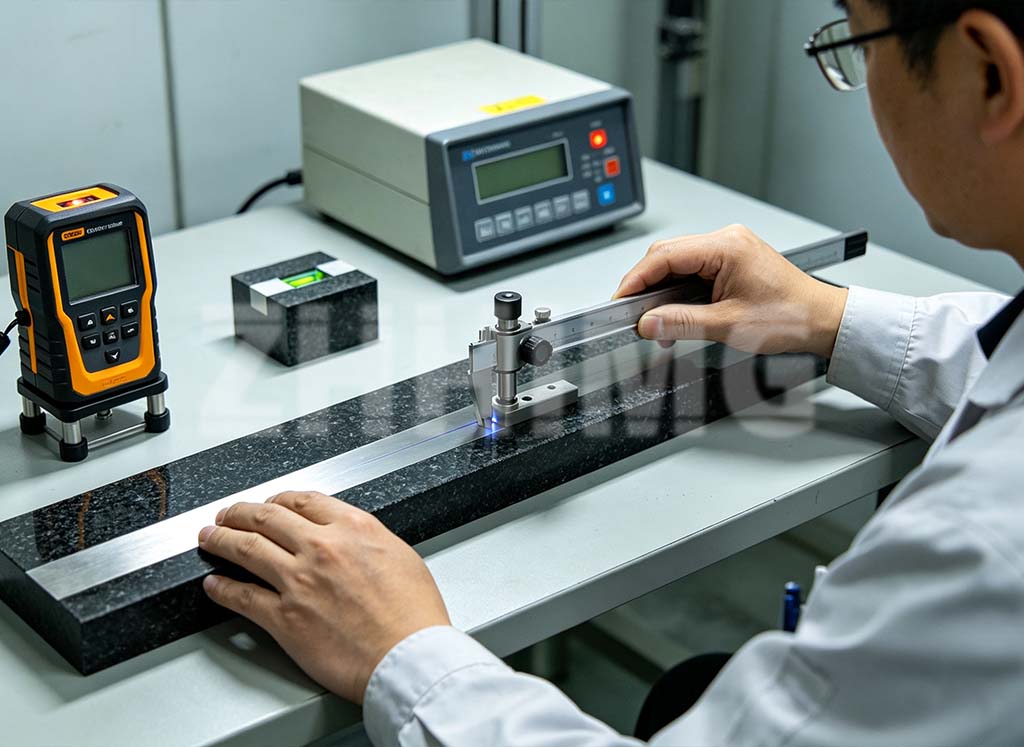
Hoisting, transportation and positioning conditions also need to be assessed in the early customization stage. Granite machine bases are heavy components. Their monolithic size and weight determine packaging schemes, transport vehicles and on-site crane selection. It is necessary to confirm the width and height of workshop doors and passages, rated lifting capacity of elevators or overhead cranes, and load capacity of floor passages, to judge whether the base can be integrally processed and delivered as a single piece, or fabricated in segmented parts for splicing. If the on-site overhead crane has insufficient tonnage or narrow passages, the base segmentation scheme must be adjusted in advance to prevent finished components from being unable to enter the workshop. Besides, confirm the leveling space after positioning, the travel range of base anchor leveling feet, and operating space for level gauges, reserving measurement positions for later precision re-inspection with laser interferometers and electronic levels.
Apart from the above hardware conditions, metrology acceptance conditions should also be confirmed beforehand. After the granite base is in place, flatness, straightness and other precision indicators need to be rechecked on site. In the early phase, the standing time required for temperature stabilization after the granite base is transported from the machining workshop to the site should be agreed. The granite base cannot undergo precision measurement immediately after arrival; sufficient time is required for it to reach thermal equilibrium with the ambient temperature, otherwise measurement data will deviate. Confirm available on-site testing instruments and metrology standards in advance, and clarify acceptance benchmarks to avoid disputes between the supplier and the buyer regarding on-site acceptance criteria.
Customizing a granite machine base is more than simply machining stone according to drawings. The on-site foundation, environment, assembly interfaces, hoisting and positioning conditions jointly determine whether the base can finally achieve ultra-precision reference performance. Only by confirming all installation conditions in the early project stage can risks such as rework and precision failure be avoided from the source, allowing the granite base to support stable operation of the complete machine for a long time.
Post time: Sep-15-2026