
When you specify a machine base for a semiconductor lithography tool or a coordinate measuring machine, you are essentially defining the thermal and vibrational ceiling that your equipment can never exceed. The material choice you make in those early design stages propagates through every subsequent engineering decision. Polymer concrete and cast iron have served the industry for decades, but as tolerances tighten toward the nanometer scale, the fundamental physical properties of natural granite increasingly become the only viable foundation material.
For equipment manufacturers navigating the pressures of shorter product cycles and global competition, sourcing a custom granite machine base from an experienced OEM/ODM partner has become a strategic decision rather than a commodity procurement task. This article explores the engineering rationale behind granite machine bases, the case for customization, and what to look for in a manufacturing partner who can deliver from design collaboration through to high-volume shipment.
The Machine Base as a Performance Determinant
Many engineers spend considerable effort optimizing motion control systems, encoder resolution, and environmental isolation, yet treat the machine base as a passive structural element. This perspective underestimates how actively the base material participates in your system’s error budget.
Consider thermal drift alone. A steel machine base expands approximately 12 micrometers per meter for every degree Celsius change. Over a 3-meter-long precision platform operating in a semiconductor fab where temperature gradients can exceed 0.5°C between morning and afternoon cycles, that translates to nearly 20 micrometers of positional error accumulating daily. No matter how sophisticated your feedback system, you cannot correct an error that originates in your foundation before it reaches your sensor.
The same principle applies to vibration. Equipment bays in modern manufacturing facilities share floor space with HVAC systems, material handling equipment, and other machinery. Vibration transmission through conventional bases can corrupt measurements or introduce errors in high-speed positioning systems within milliseconds. Your machine base either attenuates these disturbances or amplifies them.
Engineering Properties That Make Granite Irreplaceable
Thermal stability represents granite’s most compelling advantage for precision applications. With a coefficient of thermal expansion ranging from 0.6 to 1.2 × 10⁻⁶ per degree Celsius, granite exhibits roughly one-tenth the thermal expansion of carbon steel. When properly specified and mounted, a granite machine bed in a temperature-controlled environment contributes thermal drift errors measured in nanometers rather than micrometers. This characteristic alone explains why virtually all semiconductor lithography tools, coordinate measuring machines, and optical inspection platforms rely on granite foundations.
The damping capacity of granite further distinguishes it from alternative materials. Natural granite exhibits a logarithmic decrement of 0.012 to 0.015, compared with approximately 0.001 for gray cast iron. This means granite dissipates vibrational energy roughly ten times more effectively. In practical terms, a well-designed granite base attenuates vibrations in the critical 50 to 500 Hz frequency range by approximately 95 percent, protecting sensitive instrumentation from ambient disturbances that would otherwise compromise measurement accuracy or processing quality.
Equipment operating in semiconductor fabrication facilities and research laboratories demands corrosion resistance and non-magnetic behavior that polymer concrete and many engineered composites cannot reliably provide. Granite demonstrates exceptional chemical inertness, resisting attack from coolants, cleaning agents, and atmospheric contaminants. Its non-magnetic nature eliminates a potential interference pathway for electron beam systems, scanning probe instruments, and magnetic encoder systems.
The material also offers practical advantages during the equipment lifecycle. Unlike ferrous materials, granite does not rust. Unlike polymer composites, it does not outgas or undergo creep over decades of service. A properly specified granite machine base can maintain its geometric integrity for fifteen years or longer without intervention, which explains why CMM manufacturers routinely guarantee long-term stability specifications predicated on granite table performance.
Beyond Standard Sizes: The Customization Imperative
Standard catalog granite plates serve many applications adequately, but advanced equipment increasingly requires solutions that standard dimensions cannot provide. When designing a semiconductor wafer inspection platform, you might need internal passages for vacuum distribution, embedded stainless steel inserts positioned to tolerances tighter than 20 micrometers, or cable routing channels that maintain minimum distances from precision surfaces. These requirements cannot be satisfied by selecting from a range of standard thicknesses and planar dimensions.
Custom internal geometries allow equipment designers to reduce mass without sacrificing stiffness. Strategic lightening pockets, honeycomb reinforcement patterns, and optimized rib structures can decrease base weight by 30 to 40 percent compared with solid construction. This becomes critical for equipment that must meet strict floor loading requirements or for applications requiring rapid traverse rates where base mass directly impacts acceleration limits.
Precision-machined mounting interfaces represent another dimension of customization that affects overall system performance. Your motion guides, actuators, and instrument packages require mounting surfaces with specific flatness, parallelism, and positional relationships to reference datums. Pre-machined tapped holes, precision bushings, and integrated clamping features positioned according to your CAD model eliminate the need for field machining and ensure that critical alignments are established during initial assembly rather than adjusted iteratively.
Consider the requirements of a custom granite base for a coordinate measuring machine manufacturer. The probe head mounting interface requires perpendicularity to the measuring plane within 2 arc seconds. The air bearing reference surfaces demand flatness tolerances approaching 0.5 micrometers per square meter. The temperature compensation system needs integral channels for sensor cables. These specifications vary by machine model, by measurement volume, and by the manufacturer’s proprietary design philosophy. No standard product line can accommodate this diversity.
Building the OEM/ODM Partnership
Effective collaboration between equipment manufacturer and machine base supplier begins long before the first purchase order. In the design phase, an experienced granite base manufacturer can contribute value beyond simple production. Engineering consultation regarding material selection, rib design optimization, and interface geometry often reveals opportunities to improve performance or reduce cost that might not be apparent to engineers without specialized granite fabrication experience.
When evaluating a potential OEM/ODM partner, ask specifically about their quality management system certifications. ISO 9001 certification indicates a structured approach to quality, but forward-thinking precision manufacturers typically pursue integrated management system certification covering occupational health and safety (ISO 45001) and environmental management (ISO 14001) as well. These certifications signal organizational maturity and commitment to sustainable business practices that increasingly matter to multinational equipment manufacturers.
Examine the supplier’s traceability capabilities. For semiconductor and medical device applications, you may need to demonstrate that material certificates, inspection records, and process parameters are documented and retrievable for every production lot. Ask about calibration traceability chains extending to national metrology institutes. Suppliers who calibrate their instruments against standards traceable to NIST, PTB, or equivalent national laboratories provide defensible documentation that simplifies your compliance burden.
Prototyping and production transition represent a critical phase where many supplier relationships encounter friction. The ideal partner demonstrates the ability to produce initial prototypes rapidly for design validation, then scales to production volumes while maintaining identical process controls and inspection regimes. Inconsistency between prototype and production parts has derailed numerous equipment development programs.
Delivery reliability matters enormously in equipment manufacturing contexts where line stoppages due to delayed components can cost thousands of dollars per hour. Evaluate the supplier’s manufacturing capacity against your demand projections, but also probe their subcomponent supply chains and logistics capabilities. Partners offering multiple incoterms options (EXW, FOB, CIF, DAP, CPT) demonstrate flexibility in accommodating varied shipping arrangements preferred by global customers.
Applications Where Custom Granite Bases Deliver Measurable Value
The semiconductor industry illustrates the demanding requirements that drive custom granite base specifications. EUV lithography systems require vibration isolation achieving sub-nanometer displacement at frequencies extending into the kilohertz range. Supporting structures must accommodate extremely tight flatness specifications while providing thermal mass that moderates transient temperature fluctuations. Vacuum-compatible designs eliminate outgassing pathways that could contaminate the optical path. These requirements converge on custom granite solutions designed in close collaboration with the equipment manufacturer.
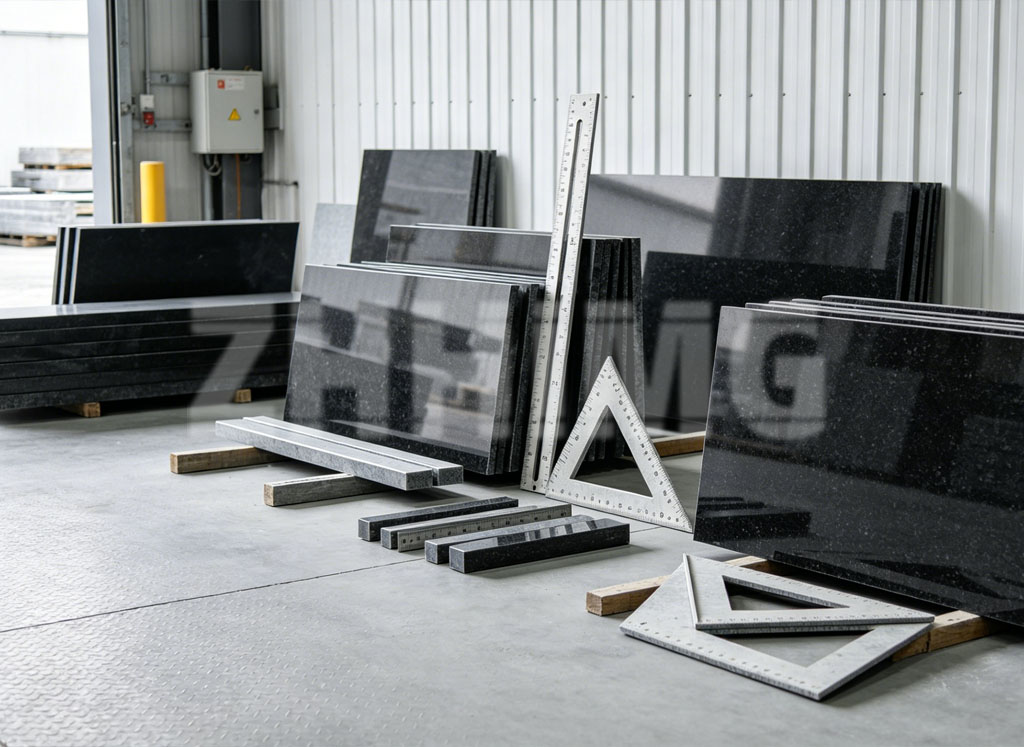
Coordinate measuring machine manufacturers rely on granite bases to anchor their systems’ geometric stability over years of continuous operation. The granite table provides the reference plane against which all dimensional measurements are ultimately traced. Maintaining plane parallelism and flatness specifications over measurement volumes exceeding several cubic meters demands both exceptional raw material properties and manufacturing processes that preserve those properties throughout production.
Laser processing systems, whether configured for cutting, welding, or additive manufacturing, require vibration-damped foundations that isolate the optical delivery system from facility disturbances. The high frequencies generated by servo systems and linear motors during rapid positioning can couple into insufficiently massive or rigid bases, creating beam pointing errors that degrade processing quality.
PCB drilling and routing equipment, AOI (automated optical inspection) systems, industrial CT scanners, and precision CNC machining centers all present distinct base requirements that standard products cannot efficiently address. The common thread across these applications is the need for a foundation material that combines thermal stability, damping characteristics, geometric precision, and long-term dimensional integrity in a configuration tailored to the specific machine architecture.
Manufacturing Capabilities That Enable Precision Delivery
Producing custom granite machine bases that consistently meet demanding specifications requires more than good intentions. It requires specialized equipment, disciplined processes, and experienced personnel.
Large-scale capacity matters when your equipment roadmap includes platforms exceeding 5 meters in length. Suppliers operating oversized grinding equipment and lifting infrastructure capable of handling single pieces weighing 100 tons or more can address application requirements that would exceed the practical limits of smaller operations. The ability to produce monolithic granite components up to 20 meters in length with planeness tolerances measured in micrometers separates genuine precision manufacturers from generalist fabricators.
Controlled manufacturing environments play an underappreciated role in achieving precision targets. Grinding operations conducted in temperature-stabilized facilities eliminate thermal gradients that would distort workpieces during machining. Isolated foundations prevent vibration transmission from production equipment into precision Processing surfaces. Some manufacturers maintain dedicated cleanroom facilities for components destined for semiconductor applications, eliminating particle contamination risks that could compromise equipment performance.
Metrology infrastructure determines whether manufactured parts actually meet specifications or merely appear to. Using German manufactured comparators with 0.5 micrometer resolution, Swiss electronic levels, and British laser interferometers for linear calibration provides measurement confidence appropriate for demanding applications. Traceability chains extending to national metrology institutes ensure that your measurement results can be defended to customers and regulators.
The human element remains irreplaceable. Master craftsmen with three decades of manual grinding experience possess intuitive understanding of material behavior that no automated system fully replicates. These skilled technicians can detect subtle anomalies during final finishing operations that might escape automated inspection, ensuring that delivered parts meet the exacting standards that precision equipment demands.
Conclusion
Selecting a custom granite machine base supplier is a decision that shapes your equipment’s performance ceiling and your organization’s competitive position for years to come. The thermal stability, vibration damping, and long-term geometric integrity that natural granite provides cannot be replicated by alternative materials when precision requirements enter the micrometer or nanometer regime.
ZHHIMG® combines manufacturing scale with precision craftsmanship to deliver custom granite machine bases for equipment manufacturers worldwide. Our two production facilities spanning 200,000 square meters, certified to ISO 9001, ISO 45001, and ISO 14001 standards, produce precision granite components used by leading semiconductor, measurement, and advanced manufacturing equipment companies. We invite OEM and ODM partners to discuss their custom requirements.
Visit www.ZHHIMG-group.com to explore our capabilities, request technical consultation, or initiate a custom granite base project. Our engineering team welcomes collaboration from the earliest design stages through production delivery, supporting customers across more than 20 countries with flexible incoterms and responsive logistics. Let us demonstrate how precision granite manufacturing can elevate your equipment’s performance foundation.
Post time: May-12-2026