
The Unyielding Foundation of Modern Precision Manufacturing
In the relentless pursuit of manufacturing excellence, where tolerances are measured in microns and quality is non-negotiable, the foundation of precision often lies in the most fundamental tools. Among these, granite measuring tools have emerged as the bedrock of accuracy, providing a stable, durable, and reliable reference for a vast array of industrial applications. As industries from aerospace to semiconductor manufacturing push the boundaries of what is possible, the demand for high-performance metrology equipment has never been greater. This has propelled the market for customized granite measuring tools to the forefront of industrial innovation, offering tailored solutions that are as unique as the challenges they are designed to solve.
Granite, a natural igneous rock, possesses a unique combination of physical properties that make it an ideal material for precision measurement. Its fine, non-porous crystalline structure ensures exceptional stability, while its inherent hardness provides remarkable resistance to wear and corrosion. Unlike their metallic counterparts, granite tools are non-magnetic, immune to rust, and exhibit a coefficient of thermal expansion that is significantly lower than that of steel or cast iron. This means they maintain their dimensional integrity even in fluctuating workshop environments, ensuring that measurements remain accurate and repeatable over time. For manufacturers, this translates directly into improved product quality, reduced scrap rates, and enhanced operational efficiency.
The versatility of granite extends beyond simple flat surfaces. Through advanced machining and hand-lapping techniques, manufacturers can produce a wide range of precision tools, including granite surface plates, straight edges, angle plates, and complex, custom-designed components. These tools serve as the primary datum for calibrating machinery, inspecting finished parts, and setting up production lines. In an era where “smart manufacturing” and Industry 4.0 are reshaping the industrial landscape, the role of these fundamental precision tools is more critical than ever. They are not just passive instruments; they are the active guardians of quality, ensuring that every component produced meets the stringent specifications demanded by modern engineering.
The Imperative of Customization in a Complex Industrial Landscape
While standard granite tools are sufficient for many general-purpose applications, the complexities of modern manufacturing often require a more bespoke approach. The “one-size-fits-all” model is increasingly inadequate for industries that operate at the cutting edge of technology. This is where the concept of customized granite measuring tools becomes paramount. From the automotive sector, where large-scale components like chassis and battery packs require massive, stable platforms for inspection, to the delicate world of semiconductor fabrication, where even the slightest vibration or thermal shift can ruin a batch of microchips, the need for tailored solutions is evident.
Customization in granite metrology is a multifaceted process that goes far beyond simply cutting a stone to a specific length and width. It involves a deep understanding of the customer’s application, the environmental conditions of the workspace, and the specific accuracy requirements of the task at hand. For instance, a manufacturer of high-speed PCB drilling machines may require a granite base with integrated T-slots and precise mounting holes to ensure perfect alignment of the drilling head. Similarly, an aerospace company might need a large, hollowed-out granite structure to reduce weight while maintaining rigidity for a coordinate measuring machine (CMM).
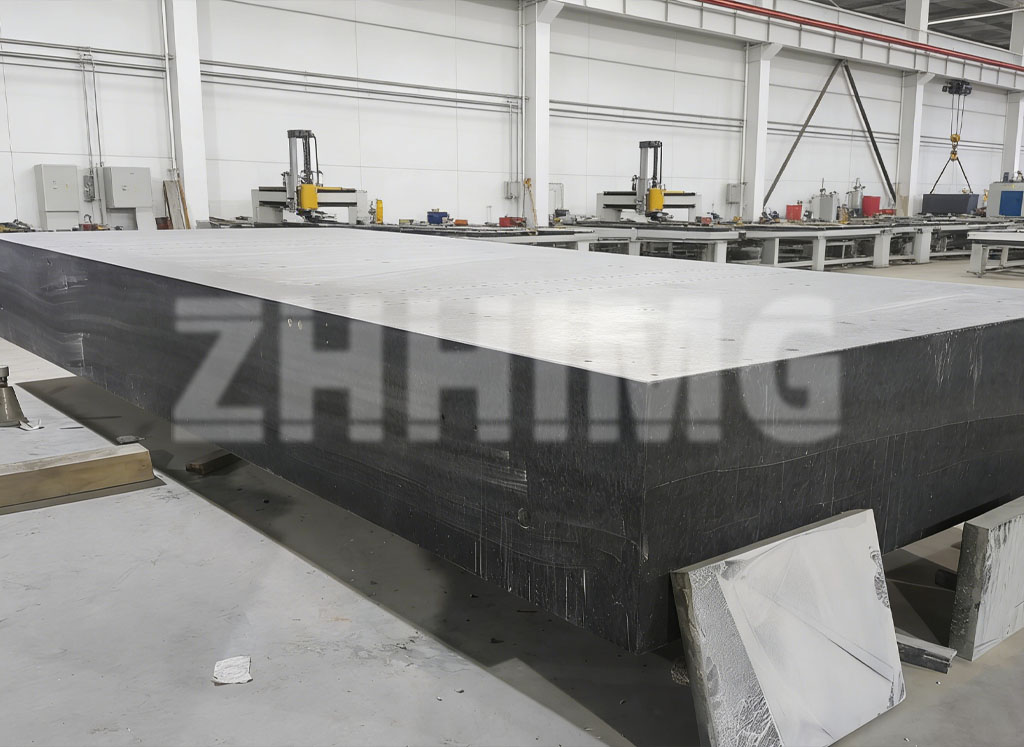
The process of creating these custom tools begins with the meticulous selection of raw material. Not all granite is created equal. High-quality manufacturers source their stone from specific quarries known for producing rock with the ideal density, hardness, and stability. The stone is then subjected to a natural aging process, sometimes for years, to relieve internal stresses and ensure long-term dimensional stability. Once the raw block is prepared, it undergoes a series of precision machining operations, often utilizing state-of-the-art CNC milling centers capable of handling massive workpieces. The final and perhaps most critical stage is the hand-lapping process, where skilled artisans use traditional techniques to achieve surface finishes and flatness tolerances that are measured in fractions of a micron.
This level of customization allows manufacturers to integrate granite components seamlessly into their existing workflows. A custom granite angle plate, for example, can be designed with specific clamping features and relief channels to accommodate a particular family of parts, streamlining the inspection process and reducing setup time. In the realm of industrial automation, granite is increasingly being used to construct the structural frames of robotic arms and gantry systems, where its high stiffness-to-weight ratio and vibration-damping properties contribute to faster, more accurate movements. By tailoring the design and fabrication of these tools to the exact needs of the application, manufacturers can unlock new levels of performance and productivity.
Material Science and the Pursuit of Ultimate Accuracy
The accuracy of a granite measuring tool is intrinsically linked to the quality of the material from which it is made. The pursuit of ultimate accuracy begins at the quarry. Leading manufacturers of precision granite tools invest significant resources in material science, analyzing the physical properties of different rock formations to identify the most suitable candidates for metrological applications. Key parameters such as density, porosity, and the coefficient of thermal expansion are rigorously tested. A high-density, low-porosity granite is less susceptible to moisture absorption, which can cause subtle warping over time. Similarly, a low coefficient of thermal expansion ensures that the tool’s dimensions remain constant despite changes in ambient temperature, a critical factor for maintaining accuracy in non-climate-controlled environments.
Once the ideal material is sourced, the focus shifts to processing and fabrication. The journey from a rough-hewn block to a precision measuring instrument is a testament to the fusion of modern technology and traditional craftsmanship. Advanced CNC machinery is used to rough out the basic shape of the tool, creating complex geometries and features that would be impossible to achieve by hand. However, the final stages of production still rely heavily on the skill and experience of master craftsmen. The process of hand-lapping, where an abrasive slurry is used to polish the granite surface to a mirror-like finish, is an art form that has been perfected over generations. This process not only achieves the required surface flatness but also creates a surface that is free from the micro-fractures and stresses that can lead to long-term instability.
Quality control is an integral part of the manufacturing process. Reputable manufacturers employ a range of sophisticated metrology equipment to verify the accuracy of their products at every stage of production. Laser interferometers, electronic levels, and coordinate measuring machines are used to measure flatness, straightness, and squareness with an uncertainty that is often an order of magnitude smaller than the tolerance of the tool itself. This rigorous approach to quality assurance ensures that every custom granite tool that leaves the factory is not just a piece of stone, but a certified instrument of precision, backed by traceable calibration data. For the end-user, this means confidence in their measurement results, knowing that their tools are built on a foundation of scientific rigor and uncompromising quality.
Real-World Impact: Enhancing Efficiency and Quality Across Industries
The true value of customized granite measuring tools is best understood by examining their impact on real-world manufacturing challenges. In the automotive industry, for example, the shift towards electric vehicles has introduced new complexities in the production of battery packs and electric motors. These components require extremely precise geometries to ensure optimal performance and safety. A major automotive manufacturer recently faced a challenge with the inspection of large battery tray assemblies. Their existing metal fixtures were prone to thermal distortion, leading to inconsistent measurement results and a high rate of false rejections. By partnering with a granite tooling specialist, they developed a custom granite inspection platform that provided a thermally stable and highly accurate reference surface. The result was a dramatic improvement in measurement repeatability, a significant reduction in scrap, and a faster production cycle.
In the semiconductor industry, where the scale of production is microscopic but the stakes are enormous, the stability of the manufacturing environment is paramount. The fabrication of integrated circuits involves a series of complex lithography and etching processes, each of which requires precise alignment. Granite is the material of choice for the stages and platforms that hold the silicon wafers during these processes. Its non-magnetic properties prevent interference with the sensitive electronic components, while its high stiffness ensures that the wafer remains perfectly flat. A leading semiconductor equipment manufacturer required a custom granite base for a new line of wafer inspection tools. The base needed to be not only incredibly flat but also feature a complex network of internal channels for cooling and vacuum lines. Through a collaborative design and manufacturing process, a solution was developed that met all the stringent requirements, enabling the production of next-generation chips with higher yields and greater reliability.
These examples illustrate how customized granite solutions are not merely passive components but active enablers of innovation. They solve specific, high-stakes problems that cannot be addressed with off-the-shelf products. By providing a stable, accurate, and durable foundation, these tools empower manufacturers to push the limits of their processes, improve product quality, and ultimately, gain a competitive edge in the global marketplace. The investment in high-quality, custom granite tooling is an investment in the very heart of the manufacturing process, one that pays dividends in efficiency, reliability, and peace of mind.
Future Trends: The Evolution of Granite Metrology in a Digital Age
As we look to the future of manufacturing, the role of granite measuring tools is poised to evolve in tandem with emerging technologies. The rise of automation, artificial intelligence, and the Industrial Internet of Things (IIoT) is creating new opportunities for integrating these fundamental tools into a connected, intelligent ecosystem. We are beginning to see the development of “smart” granite components, embedded with sensors that can monitor temperature, vibration, and even structural integrity in real-time. This data can be fed into a central control system, allowing for predictive maintenance and ensuring that measurement accuracy is never compromised.
Furthermore, the increasing demand for large-scale additive manufacturing and the production of massive components for the aerospace and energy sectors will drive the need for even larger and more complex granite structures. The ability to machine and assemble these big mac components with micron-level accuracy will be a key differentiator for manufacturers of precision granite tools. At the same time, advancements in material science may lead to the development of new composite materials that combine the best properties of granite with other substances, offering enhanced performance characteristics such as even lower thermal expansion or greater impact resistance.
Sustainability is also becoming an increasingly important consideration. The quarrying and processing of natural stone can have an environmental impact, and forward-thinking manufacturers are exploring ways to minimize their footprint. This includes implementing more efficient water recycling systems in their grinding and polishing operations, as well as finding innovative ways to repurpose granite waste. The goal is to create a circular economy where the precision and durability of granite tools are matched by the sustainability of their production. In this digital and environmentally conscious age, the humble block of granite is set to remain a cornerstone of industrial progress, adapting and evolving to meet the ever-changing demands of the modern world.
Post time: Apr-30-2026