
In the world of high-precision engineering, where the margin for error is measured in microns, granite is not just a stone—it is the bedrock of accuracy. From the bases of Coordinate Measuring Machines (CMM) to the stages of semiconductor lithography systems, custom granite components play a pivotal role in ensuring stability, vibration damping, and thermal resistance.
However, for procurement managers and engineers sourcing these components globally, the manufacturing process often remains a “black box.” How does a raw, jagged block of stone transform into a mirror-finished, nanometer-level precision stage? Understanding this journey is not merely an academic exercise; it is the key to vetting suppliers, ensuring quality, and building trust in a supply chain where physical inspection is not always possible.
This article takes you on a virtual tour of the factory floor, detailing the rigorous transformation from blueprint to reality.
The Genesis: Material Selection and Geological Stability
The manufacturing process begins long before any cutting tools touch the stone. It starts in the quarry. For precision applications, not all granite is suitable. Manufacturers typically source specific types of granite, such as “G603″ (Grey), “G654″ (Black/Gabbro), or “Red” granite, depending on the required hardness and grain structure.
The first critical step is the assessment of the raw block. A high-quality manufacturer does not simply cut what is available; they select blocks based on density and uniformity.
- Grain Structure: The stone must have a fine, consistent grain. Large crystals or fissures can lead to micro-fractures during machining or uneven wear over time.
- Natural Aging: Upon quarrying, the best manufacturers allow the raw blocks to “rest” or age naturally for months. This exposure to the elements helps release the geological stresses trapped within the rock. If this step is skipped, the internal stress will eventually cause the finished component to warp or twist, ruining its precision.
Phase 1: Rough Machining – Shaping the Beast
Once a block is selected and inspected for cracks or inclusions, it is cut to a size slightly larger than the final dimensions specified in the blueprint. This is the “roughing” stage.
- Diamond Wire Sawing: To cut these massive blocks, factories utilize industrial diamond wire saws. Unlike traditional blades, a diamond-impregnated wire allows for precise slicing of hard stone with minimal waste.
- CNC Milling: For components with complex geometries—such as T-slots, threaded inserts, or specific mounting holes—Computer Numerical Control (CNC) milling machines equipped with diamond-tolerant tooling are used. At this stage, the focus is on removing bulk material to get close to the target dimensions, usually leaving a margin of 1-2mm for the finishing processes.
Phase 2: The Science of Stress Relief
This is arguably the most critical, yet invisible, part of the manufacturing process. Granite is a natural material under immense compression. If you machine it to perfect tolerances immediately after quarrying, it will eventually move as the internal stresses equalize.
To prevent this, reputable manufacturers employ Artificial Stress Relief (Kiln Drying).
- The Process: The roughly machined blocks are placed in large, computer-controlled kilns. They are heated to specific temperatures (often between 450°C and 600°C) and then cooled slowly over a period of several days according to a precise curve.
- The Result: This thermal cycling mimics years of natural aging in a matter of days. It relaxes the internal crystal structure of the stone, ensuring that once it is finished, it will remain dimensionally stable for decades.
When sourcing components, asking for a “Stress Relief Certificate” or a “Temperature Curve Report” is a hallmark of a knowledgeable buyer.
Phase 3: Precision Grinding – The Pursuit of Flatness
After stress relief, the component returns to the machining floor for semi-finishing. The goal here is to achieve the general geometric tolerances required by the blueprint.
- Surface Grinding: Large surface grinders are used to flatten the top and bottom surfaces. This process removes the “saw marks” from the initial cutting and establishes the initial parallelism.
- Coolant Management: Grinding granite generates immense heat and silica dust. To combat this, manufacturers use copious amounts of water-based coolant. This not only suppresses dust (a critical safety requirement) but also prevents the stone from expanding due to heat, which could affect the grinding accuracy.
At this stage, the part is dimensionally close to the final spec, but the surface finish is still too rough for precision applications. It typically has a “fine ground” appearance, similar to sandpaper.
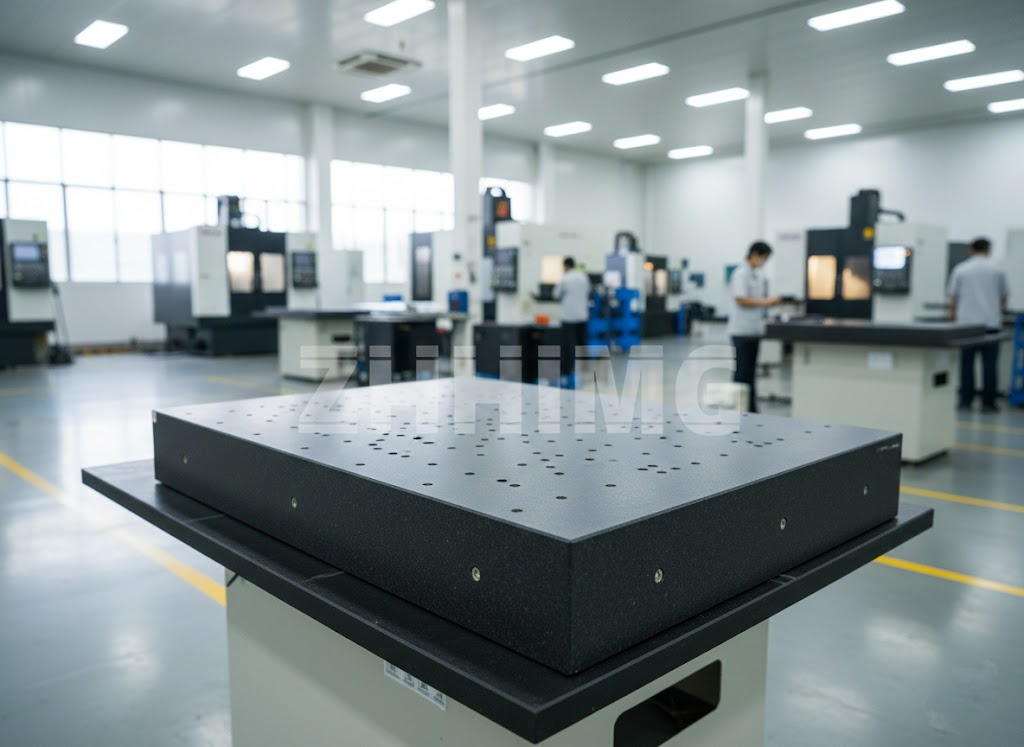
Phase 4: Hand Scraping and Lapping – The Art of Perfection
This is where the “magic” happens. For high-precision grades (such as Grade A or AA), machines alone cannot achieve the required flatness. Human intervention is required.
- Hand Scraping: Skilled craftsmen use hand scrapers to manually remove microscopic layers of stone. By using a reference plate or a laser interferometer as a guide, the worker identifies high spots (often indicated by Prussian Blue dye) and scrapes them down. This creates the distinctive “frosted” or checkered pattern often seen on high-end surface plates. This pattern is not just aesthetic; the pockets help retain oil, reducing friction for sliding components.
- Lapping: For ultra-smooth finishes (required for air bearings or optical mounts), the surface undergoes lapping. A slurry of abrasive powder (often Silicon Carbide or Diamond) is spread over the surface, and a lap tool is moved over it to polish the stone to a mirror finish. This process can achieve surface roughness (Ra) values of less than 0.1 microns.
Phase 5: Assembly and Bonding
Custom granite components are rarely just a block of stone. They often require metal inserts, threaded bushes, or linear guide rails.
- Bonding: Because granite cannot be easily welded or tapped like metal, inserts are usually bonded using high-strength, structural epoxy. The manufacturer must drill the hole, clean it chemically to remove all dust, and inject the adhesive.
- Mechanical Locking: In some high-load applications, the metal inserts are mechanically keyed or dovetailed into the stone to prevent pull-out.
- Curing: The assembly is left to cure for a specific time to ensure the bond is as strong as the stone itself.
Phase 6: Quality Assurance – The Final Verdict
Before a component leaves the factory, it must pass a rigorous Quality Assurance (QA) protocol. This is where the “Blueprint” meets “Reality.”
- Flatness and Parallelism: The component is measured using an Electronic Level or a Laser Interferometer. The laser beam is shot across the surface, and a computer generates a topographical map, showing peaks and valleys in microns.
- Rockwell Hardness Test: Random spots on the component may be tested to ensure the granite meets the required hardness specifications (typically Mohs 6-7).
- Visual Inspection: The surface is inspected under bright light for any scratches, pitting, or “orange peel” texture that indicates poor polishing.
Packaging and Logistics: The Final Mile
The manufacturing process is not complete until the part is safely packed. Granite is heavy but brittle; it has high compressive strength but low tensile strength. It can crack if dropped or if pressure is applied to the wrong point.
- Crating: Components are packed in fumigation-free plywood crates.
- Isolation: The granite never touches the wood directly. It is suspended on high-density foam or rubber pads to absorb shock during ocean freight.
- Moisture Protection: Since granite is porous, it is wrapped in VCI (Volatile Corrosion Inhibitor) paper or heavy-duty plastic with desiccants to prevent moisture absorption during sea transport.
Conclusion: Trust Through Transparency
For international buyers, the distance between the blueprint and the final product can feel vast. However, by understanding these six phases—from geological selection to final laser inspection—you gain the ability to ask the right questions and demand the necessary certifications.
A high-quality custom granite component is a marriage of nature’s stability and human engineering. It requires the raw power of diamond saws, the thermal precision of kilns, and the delicate touch of a master scraper. When you see a finished component, you are looking at the result of a complex, multi-stage journey—one that ensures your machinery rests on a foundation of absolute truth.
Post time: Apr-29-2026