
In the high-stakes world of precision engineering, where nanometer-level accuracy dictates performance, the choice of material is not merely a preference—it is a fundamental necessity. While metals and ceramics have their place, precision granite remains the undisputed king of structural stability. For procurement managers, mechanical engineers, and R&D specialists sourcing from the global market, specifically from manufacturing hubs like China, the challenge often lies not in finding a supplier, but in communicating exactly what is needed.
Misunderstandings in technical specifications can lead to costly delays, rejected shipments, and compromised machine performance. This guide serves as a comprehensive bridge between your engineering requirements and the manufacturing floor. It is designed to eliminate ambiguity, ensuring that when you ask for a specific grade, flatness, or finish, you receive exactly that.
Chapter 1: The Physics of Stability – Why Granite?
Before diving into the “how” of specification, it is crucial to understand the “why.” Precision granite—typically quarried from specific geological formations rich in quartz and feldspar—is chosen for its unique physical properties. When specifying components, you are leveraging three main characteristics:
The Damping Capacity
Granite possesses exceptional vibration damping properties. In high-speed machining or precision measurement, external vibrations are the enemy. Granite absorbs these vibrations rather than transmitting them, ensuring that the “noise” does not affect the accuracy of the measurement or the cut.
Thermal Stability
Unlike steel, which expands and contracts significantly with temperature changes, precision granite has a low coefficient of thermal expansion. More importantly, it has low thermal conductivity. This means it reacts slowly to temperature fluctuations, providing a stable datum reference even in environments where temperature control is not perfect.
Non-Magnetic and Non-Conductive
For industries involving electronics manufacturing or MRI machines, the non-magnetic nature of granite is non-negotiable. It prevents interference with sensitive electromagnetic fields.
Chapter 2: Selecting the Right Material Grade
Not all granite is created equal. In the industry, we generally categorize precision granite into two primary types based on density, hardness, and grain structure. Specifying the wrong type can lead to premature wear or insufficient rigidity.
Black Granite (Gabbro/Granite)
Often referred to as “Black Granite” in the trade, this material is geologically a gabbro. It is characterized by a very fine, uniform grain structure.
- Best For: Ultra-precision applications such as Coordinate Measuring Machine (CMM) tables, high-end lithography machines, and laser interferometry bases.
- Key Advantage: It offers the highest hardness (Mohs 6-7) and the finest surface finish capabilities. It is less porous than grey granite.
Pink Granite
This is the industry workhorse. It has a slightly coarser grain than black granite but offers excellent stability.
- Best For: Surface plates, machine bases, and general precision tooling.
- Key Advantage: It is generally more cost-effective than black granite and easier to machine while still offering superior vibration damping compared to cast iron.
Specification Tip
When drafting your Request for Quotation (RFQ), do not simply write “Granite Base.” Be explicit: “Material: Natural Black Granite (Gabbro), fine-grained, free of fissures, cracks, and inclusions.”
Chapter 3: The Art of Stress Relief
The single most common failure point in precision granite components is not wear, but warping. Granite is a natural stone under immense geological stress. If this internal stress is not managed during the manufacturing process, the stone will move after it has been machined to tolerance, rendering it useless.
Natural Aging
This involves quarrying the block and letting it sit exposed to the elements for months or even years. While effective, it is time-consuming and difficult to verify.
Artificial Stress Relief (Kiln Drying)
This is the industry standard for high-precision parts. The rough block is heated in a specialized kiln to a specific temperature (often around 500°C to 600°C) and then cooled slowly according to a precise curve. This process mimics years of natural aging in a matter of days.
How to Specify
You must demand certification of the stress-relief process. Your specification should read: “Material must be artificially stress-relieved via kiln drying. Supplier must provide a stress-relief curve report or certification of treatment.”
Chapter 4: Defining Geometric Tolerances
When you look at a drawing, “flatness” and “parallelism” are often just numbers. However, in the context of granite metrology, these numbers define the capability of the machine.
Flatness
This is the measure of how smooth a surface is. For granite, this is often defined by grades (e.g., AA, A, B, 00) or by specific microns over a specific area.
- The Nuance: A large surface plate might have a flatness tolerance of ±5 microns, but a small precision stage might require ±0.5 microns.
- Specification: Always specify the measurement method. Will you use an electronic level, a laser interferometer, or a autocollimator? The method of measurement can sometimes influence the result.
Parallelism
This refers to the relationship between the top and bottom surfaces. If the parallelism is off, the component will twist when clamped down, destroying the flatness.
Squareness
For granite bridges or coordinate measuring machine structures, the squareness of the legs to the base is critical. A deviation of even a few arc-seconds can result in significant measurement errors over a long travel distance.
Tip for Sourcing
Avoid “over-tolerancing.” Do not ask for laboratory-grade flatness (Grade 00) on a structural base that will be covered by a sheet metal guard. Tighter tolerances exponentially increase the cost due to the manual labor required for scraping and lapping.
Chapter 5: Machining and Fabrication Techniques
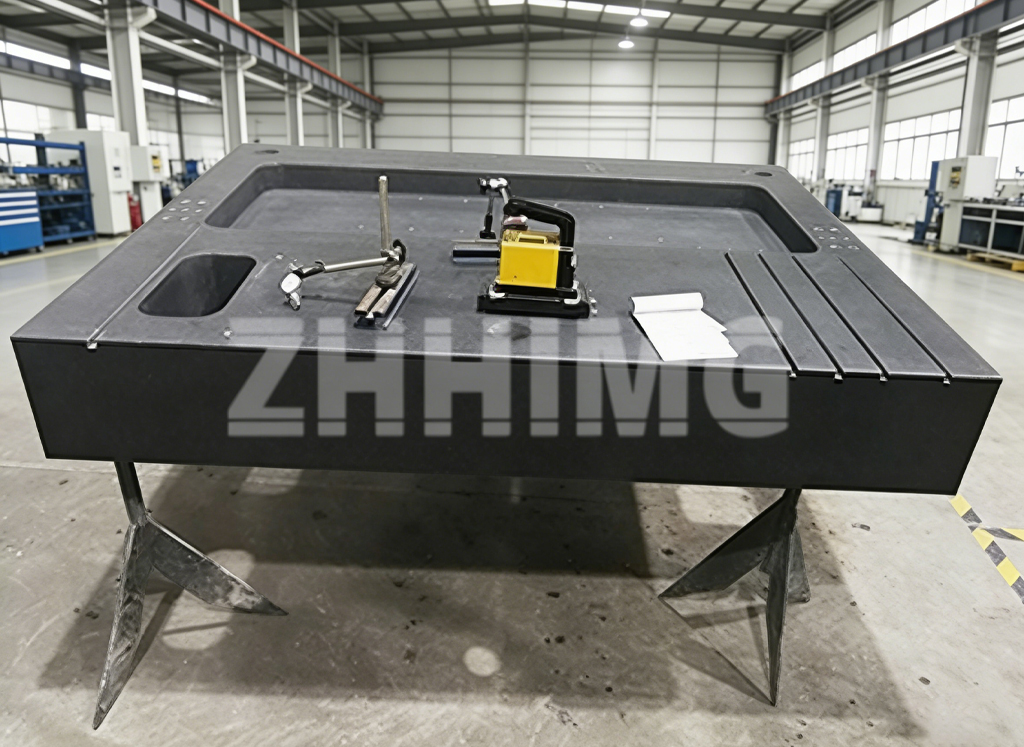
Granite is harder than steel, requiring specialized tooling. Understanding the manufacturing process helps you specify features that are actually manufacturable.
Diamond Tooling
All cutting, drilling, and grinding must be done with diamond-impregnated tools. Standard carbide tools used for metal will be destroyed instantly.
Water Cooling
Machining granite generates immense heat. Water is used not just to cool the tool, but to suppress the silica dust.
- Critical Spec: If your part requires tight tolerances, specify “Temperature Controlled Coolant.” Machining with freezing cold water vs. room temperature water can cause thermal expansion differences that affect the final dimension.
Bonding and Assembly
Often, granite parts are bonded together or to metal inserts using high-strength epoxy.
- The Risk: Epoxy creates a rigid joint, but if the surface preparation is poor, the bond will fail.
- The Spec: ”All bonded surfaces must be mechanically keyed and chemically treated. Use structural grade epoxy with a proven track record in precision metrology.”
Chapter 6: Surface Finishes and Coatings
The surface of the granite dictates its interaction with the environment and the moving parts of the machine.
Lapped and Polished
This is the standard for measuring surfaces. It creates a mirror-like finish that minimizes friction for air bearings or scanning probes.
Fine Ground
A uniform, matte finish. This is often used for sliding surfaces where a tiny amount of oil retention is desired, or for aesthetic surfaces that don’t need to be optical grade.
Coatings
Bare granite is porous. In environments with high humidity or exposure to coolants, the stone can absorb liquids, leading to swelling or staining.
- Impregnation: A clear sealant is applied to fill the microscopic pores without changing the dimensions.
- Hard Coatings: Some advanced applications use thin-film coatings (like DLC – Diamond Like Carbon) to increase surface hardness even further.
Specification Advice
If your machine operates in a humid environment (like a food processing plant or a coastal facility), specify: “Surface must be treated with a hydrophobic impregnation sealer compatible with precision metrology.”
Chapter 7: Packaging and Logistics – The Hidden Danger
You have specified the material, the tolerance, and the finish perfectly. The part is manufactured to perfection. And then, it breaks in transit. Granite is brittle; it has high compressive strength but low tensile strength. It cannot be treated like a steel block.
The Crating Standard
- Material: Use only seasoned hardwood or high-grade plywood.
- Isolation: The granite part must never touch the wood directly. It must be suspended on high-density foam or rubber isolators.
- Blocking: The part must be blocked in such a way that it cannot tip over, but it must also be able to “breathe.”
Moisture Protection
Granite absorbs moisture from the air (hygroscopic). If shipping via sea freight, the humidity inside a container can be extreme.
- Requirement: The part must be wrapped in VCI (Volatile Corrosion Inhibitor) paper or heavy-duty plastic with desiccant packs to prevent “container rain” from affecting the stone’s calibration.
Chapter 8: Quality Assurance and Inspection
Trust, but verify. When sourcing custom components, especially from overseas, you need a robust Quality Assurance (QA) protocol.
The CMM Report
Do not accept a “visual inspection.” Demand a digital CMM report. This report maps the surface of the granite and provides a heat map of deviations.
- Key Data Points: Ask for the “Peak to Valley” (P-V) value and the “Root Mean Square” (RMS) value of the surface flatness.
The Rockwell Hardness Test
To ensure you aren’t receiving a softer, inferior stone, random samples should be tested for hardness.
The Ring Test
For surface plates, a simple “Rocking Test” can be performed. Place the plate on a known flat surface and apply pressure to the corners. If it rocks, the bottom surface is not parallel to the top.
Conclusion: The Specification Checklist
To summarize, specifying custom precision granite is a holistic process. It requires looking beyond the 2D drawing and understanding the lifecycle of the material.
When you approach a supplier, your specification package should include:
- Material Definition: (e.g., Black Gabbro, Fine Grain).
- Stress Relief Certification: Proof of kiln drying.
- Geometric Tolerances: Flatness, Parallelism, and Squareness defined in microns.
- Surface Finish: Lapped, Polished, or Ground, with Ra value.
- Environmental Protection: Sealing or coating requirements.
- Inspection Standards: CMM report format and acceptance criteria.
By mastering these specifications, you transform from a simple buyer into a technical partner. You reduce the risk of errors, ensure the longevity of your machinery, and ultimately, deliver a product that stands the test of time and precision.
Post time: Apr-29-2026