
In the high-stakes world of precision metrology, the foundation of every accurate measurement is the surface plate. It is the silent reference plane upon which the integrity of your entire quality control process rests. When outfitting a metrology lab or an inspection center, the choice between a granite surface plate and a cast iron surface plate is one of the most critical decisions a procurement manager or quality engineer must make. It is not merely a choice between stone and metal; it is a choice between different physical properties, maintenance philosophies, and long-term investment strategies.
Both materials have served the manufacturing industry for over a century, and both have distinct advantages that make them superior in specific applications. While granite is often hailed as the king of stability and precision, cast iron remains the workhorse of the industrial floor. Understanding the nuances of “Granite vs. Cast Iron” is essential for ensuring that your laboratory is equipped with the right tool for the job, balancing the need for nanometer-level accuracy against the rigors of heavy-duty inspection.
The Case for Granite: The Standard of Stability
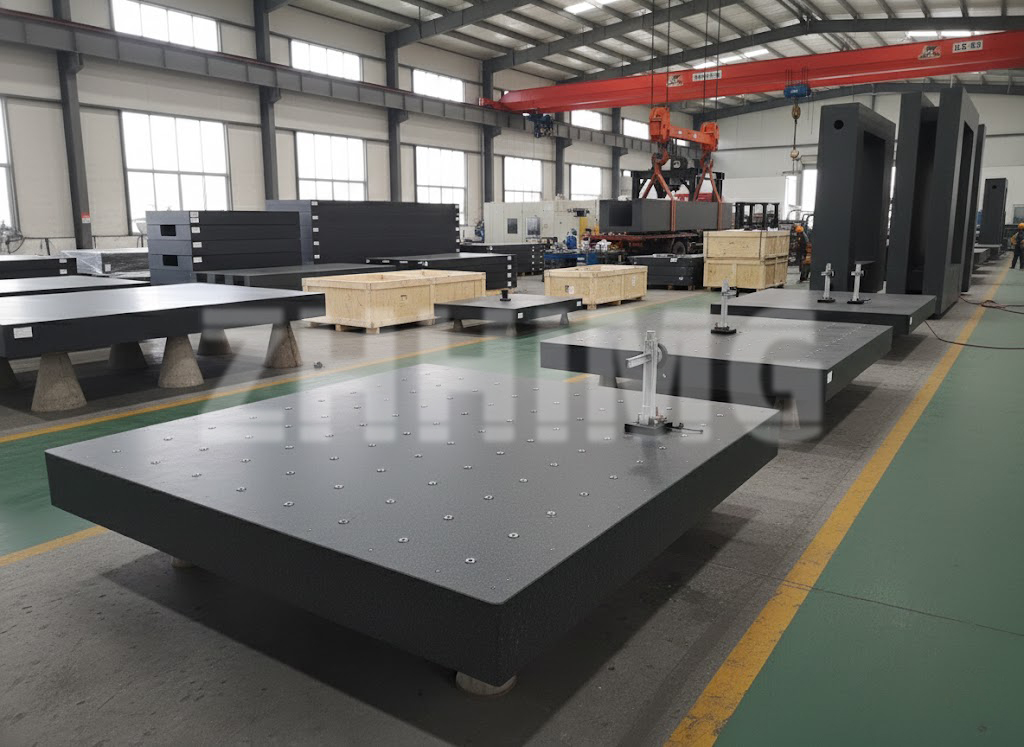
Granite surface plates, often crafted from high-quality black granite or diabase, have become the gold standard for modern metrology laboratories. The primary allure of granite lies in its geological history. These stones are formed over millions of years, undergoing natural aging that effectively eliminates internal stresses. When a manufacturer cuts and polishes a block of granite, they are working with a material that has already achieved a state of dimensional equilibrium. This natural stability means that a granite plate is highly resistant to warping or twisting over time, provided it is supported correctly.
One of the most significant advantages of granite in a laboratory setting is its thermal stability. In the realm of precision measurement, temperature is the enemy. Metals expand and contract with heat, and even a slight fluctuation in the ambient temperature of a lab can cause a metal plate to expand enough to throw off sensitive measurements. Granite has a very low coefficient of thermal expansion—significantly lower than that of cast iron. This means that if the temperature in your facility fluctuates by a few degrees, the granite plate will remain virtually unchanged, preserving the accuracy of your readings. This property makes granite the ideal choice for environments where maintaining a perfect恒温 (constant temperature) is difficult or expensive.
Furthermore, granite is a non-metallic material, which brings two distinct benefits: it is non-magnetic and immune to rust. In a lab environment where delicate electronic components or magnetic gauges are used, a cast iron plate can introduce interference. Granite, being chemically inert, will never rust. This eliminates the need for the constant application of protective oils that are required for iron plates. A granite plate can be kept clean and dry, reducing the risk of contaminating the parts being measured. If a liquid is spilled on a granite plate, it can be wiped away without fear of corrosion, whereas the same spill on a cast iron plate could lead to pitting and permanent damage if not addressed immediately.
The surface finish of a granite plate is another area where it excels. Through advanced lapping and polishing processes, granite can achieve a mirror-like finish that is incredibly smooth. This smoothness reduces friction for sliding measuring instruments and ensures that there are no microscopic peaks and valleys to trap dirt or debris. When a granite surface is struck or damaged—for instance, if a heavy part is accidentally dropped on it—the material tends to chip or form a depression. Crucially, it does not form a “burr” or a raised edge around the impact site. In metrology, a raised burr is disastrous because it lifts the measuring instrument, causing false readings across the entire surface. A depression in granite is easier to isolate and often has less impact on the overall flatness of the surrounding area.
The Strength of Cast Iron: Durability and Versatility
While granite dominates the high-precision laboratory, cast iron surface plates hold their ground firmly in industrial inspection areas, tool rooms, and heavy manufacturing settings. The primary argument for cast iron is its toughness. Cast iron is a ductile material compared to the brittle nature of stone. It can withstand significant shock and impact without shattering. In a busy workshop where heavy castings, weldments, or steel parts are frequently placed on the inspection table, a granite plate might crack under the stress. A cast iron plate, however, will absorb the shock.
The maintenance of cast iron is often misunderstood. While it is true that iron requires protection from rust, a well-maintained cast iron plate can last for decades. The traditional method of maintaining these plates involves keeping a thin film of oil on the surface. This oil not only prevents rust but also acts as a lubricant for sliding parts. Additionally, the surface of a cast iron plate is often “scraped” by hand. This manual process creates a pattern of tiny pockets on the surface. These pockets are not defects; they are functional. They serve as reservoirs for lubrication and trap any microscopic dust or swarf that might be present, preventing it from interfering with the measurement. This “wringing” action allows for a very specific type of tactile feedback that many veteran machinists and inspectors prefer.
Another distinct advantage of cast iron is its repairability. If a cast iron plate becomes worn or damaged, it can be re-scraped or re-ground to restore its original accuracy. This is a skilled trade, but it allows a damaged plate to be brought back to life, essentially resetting its service life. In contrast, while granite can be resurfaced, the process is different and often requires specialized equipment to re-lap the stone. For many industrial users, the ability to simply scrape a plate back to flatness in-house or locally is a major logistical advantage.
Cost is also a significant factor. Generally, cast iron plates are less expensive to manufacture than their granite counterparts, particularly for very large sizes. While large granite blocks are available, the cost of sourcing and machining massive, defect-free stone can be prohibitive. Cast iron can be cast into large, complex shapes, including those with T-slots, which are essential for clamping down large workpieces. This versatility makes cast iron the preferred choice for assembly and welding fixtures, where the plate serves as a workbench as much as a measuring tool.
Comparative Analysis: Making the Right Choice
When deciding between granite and cast iron for your metrology lab, you must look beyond the material itself and consider the application. If your primary concern is ultra-high precision—such as in a calibration lab, a CMM room, or an optical inspection center—granite is almost invariably the superior choice. Its resistance to temperature changes, lack of magnetic interference, and low maintenance requirements create a stable environment for sensitive instruments. The fact that it does not rust means you can operate in a clean room environment without worrying about oil mist or corrosion particles contaminating your products.
However, if your “lab” is actually a floor-level inspection area within a machine shop, or if you are inspecting heavy, rough castings, cast iron may be the more pragmatic solution. The risk of dropping a heavy steel part on a granite plate is a liability that many shop managers prefer to avoid. The durability of iron, combined with its lower initial cost and the ability to repair it via scraping, makes it a robust asset in a harsh environment. Furthermore, if your inspection process involves a lot of sliding heavy parts or requires the use of clamps and fixtures, the self-lubricating nature of a scraped iron surface and the availability of T-slots provide functional benefits that stone cannot match.
It is also worth noting the “hybrid” approach. Many advanced facilities utilize both. They might use a massive cast iron table for the initial setup and rough alignment of heavy parts, and then move the part to a dedicated granite plate for the final, high-precision measurement. This workflow maximizes the strengths of both materials: the toughness of the iron for the rough work, and the stability of the granite for the fine work.
Conclusion
Ultimately, the debate of “Granite vs. Cast Iron” is not about which material is objectively better, but which is better for you. Granite offers the pinnacle of stability, precision, and ease of maintenance, making it the undisputed champion of the modern, climate-controlled metrology lab. Cast iron offers resilience, versatility, and cost-effectiveness, securing its place as the rugged backbone of industrial inspection. By carefully evaluating your environmental conditions, the nature of the parts you inspect, and your long-term maintenance capabilities, you can select the surface plate that will serve as the most reliable foundation for your quality assurance program. Whether you choose the natural stability of stone or the rugged durability of iron, the key lies in understanding the physics behind the material and respecting its limitations.
Post time: Apr-29-2026