
In the aerospace industry, the margin for error is not just small; it is non-existent. The manufacturing of aircraft components involves working with some of the most challenging materials known to engineering, such as titanium, Inconel, and high-strength carbon fiber composites. These materials are essential for the safety and performance of modern aircraft, but they place immense stress on the machinery used to shape them. As the demand for lighter, faster, and more fuel-efficient aircraft grows, the precision required in manufacturing these parts has reached microscopic levels. At the heart of this precision lies a component that is often overlooked but is absolutely critical: the machine base.
For decades, steel and cast iron were the standard materials for machine bases. However, as the tolerances in aerospace manufacturing have tightened, the limitations of metal bases have become apparent. Thermal expansion, vibration, and internal stress are the enemies of precision. This is where custom granite machine bases have emerged as a superior engineering solution. Granite, specifically high-quality black granite or diabase, offers a unique combination of physical properties that make it the ideal foundation for the high-stakes world of aerospace production.
The Physics of Precision: Why Granite?
To understand why granite is the material of choice for aerospace engineering, one must look at the physics of the manufacturing environment. Aerospace parts are often large and complex, requiring long machining times. During these extended periods, the temperature in a factory can fluctuate. Steel and cast iron have relatively high coefficients of thermal expansion. This means that as the ambient temperature changes, or as the machine itself generates heat, the metal base expands and contracts. While this movement might be microscopic, in the world of aerospace tolerances—often measured in microns—it is enough to render a part useless.
Granite, by contrast, has an incredibly low coefficient of thermal expansion. It is dimensionally stable. A custom granite base will maintain its geometry and flatness even when the surrounding environment fluctuates. This thermal stability ensures that the alignment of the machine tool remains constant, regardless of the time of day or the heat generated by the cutting process. For an aerospace manufacturer, this means that the first part produced in the morning is just as accurate as the last part produced in the afternoon, without the need for constant recalibration.
Furthermore, granite is a non-metallic material. This brings two distinct advantages: it is non-magnetic and immune to rust. In the machining of aerospace components, coolants and lubricants are used heavily. A steel base can rust if the protective coating is compromised, leading to surface degradation that affects machine accuracy. Granite is chemically inert; it will not rust or corrode. Additionally, its non-magnetic nature ensures that there is no magnetic interference with sensitive electronic measuring systems or sensors that are often integrated into modern aerospace manufacturing cells.
Engineering Custom Solutions for Complex Applications
The term “custom” in custom granite machine bases is not merely a buzzword; it is a necessity. Aerospace components are rarely simple blocks; they are often complex, aerodynamic structures with intricate geometries. Therefore, the machines that build them—and the bases that support them—must be equally complex. A standard, off-the-shelf base is rarely sufficient for the specialized needs of an aerospace OEM (Original Equipment Manufacturer).
Engineering a custom granite base involves a deep understanding of the specific application. It begins with the design phase, where engineers must calculate the load requirements, the center of gravity of the moving parts, and the dynamic forces generated during machining. Granite bases are often designed with complex internal structures or specific external geometries to accommodate linear motors, cable carriers, and coolant management systems.
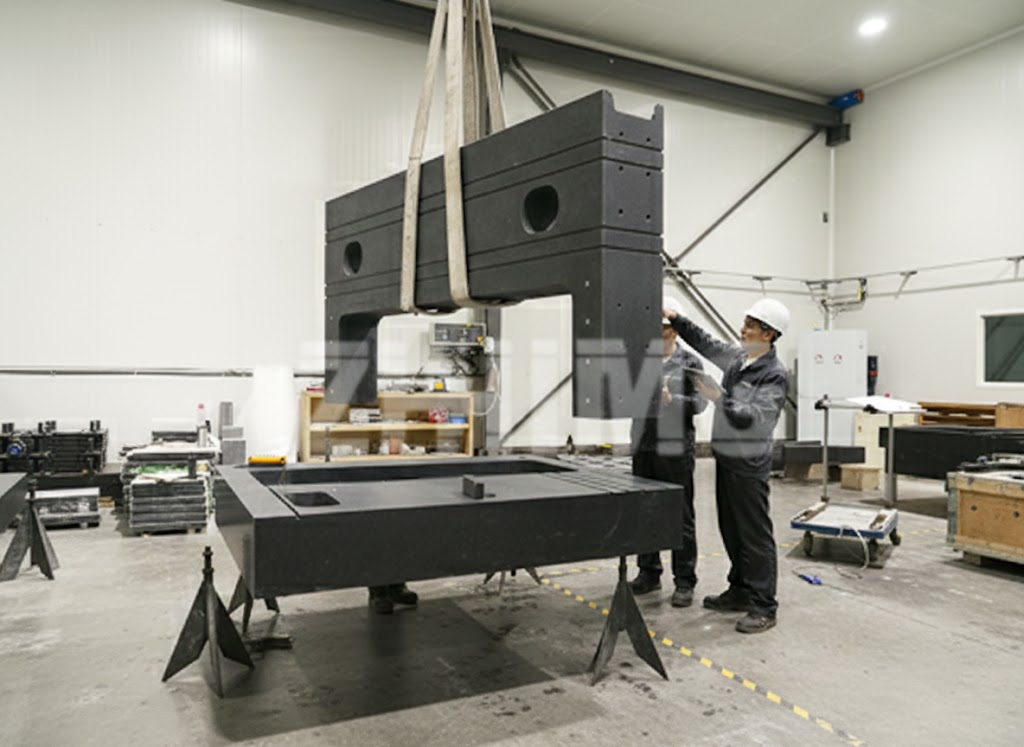
One of the key engineering features of a custom granite base is the integration of mounting points and inserts. Unlike metal, where you can simply drill and tap a hole anywhere, granite requires precise planning. During the manufacturing process, stainless steel inserts or threaded bushings are bonded into the granite at exact locations. These inserts provide the necessary mounting points for linear guides, spindles, and other machine components. The bonding technology used today is incredibly advanced, creating a joint that is often stronger than the surrounding stone. This allows for the creation of a “monolithic” structure where the granite acts as a single, cohesive unit, providing unparalleled rigidity.
Moreover, custom granite bases can be engineered to be hollow or filled with polymer concrete to further enhance their damping properties. This customization allows manufacturers to optimize the weight-to-stiffness ratio of the machine. In aerospace manufacturing, where floor space is at a premium and machine footprint matters, the ability to design a base that is compact yet incredibly stable is a significant advantage.
Vibration Damping and Surface Finish
In the machining of aerospace structures, such as wing ribs or fuselage frames, surface finish is paramount. These parts often require minimal post-processing, meaning the machining center must produce a near-perfect finish directly off the machine. Vibration is the primary cause of poor surface finish, manifesting as “chatter” marks on the part.
Granite possesses superior vibration damping capabilities compared to steel or cast iron. Its natural density and internal structure allow it to absorb and dissipate vibrational energy rapidly. When a cutting tool engages with a hard material like titanium, it generates significant shock and vibration. A steel base might transmit this vibration back into the cutting head, causing chatter. A granite base absorbs this energy, effectively isolating the cutting process.
This damping characteristic is crucial for high-speed machining (HSM), which is common in aerospace manufacturing to reduce cycle times. The ability of the granite base to remain stable and vibration-free allows the machine to run at higher speeds and feed rates without sacrificing surface quality. This results in smoother surfaces, longer tool life, and reduced scrap rates. For an aerospace manufacturer, where a single scrapped titanium part can represent thousands of dollars in lost material and machining time, the return on investment for a granite base is often realized quickly through improved yield rates.
Durability and Maintenance in Harsh Environments
Aerospace manufacturing environments can be harsh. They involve heavy chips, aggressive coolants, and constant movement. A machine base must be durable enough to withstand these conditions while maintaining its accuracy over decades of use.
Granite is an incredibly hard material. It is resistant to wear and abrasion. Unlike metal ways that can wear down over time due to friction, a properly engineered granite guideway maintains its geometry. If a granite surface is accidentally dented or chipped—for example, if a heavy tool is dropped on it—the surrounding area remains unaffected. In metal, a dent often raises a burr around the impact site, which can interfere with the movement of bearings or slides. In granite, the impact creates a local depression without raising the surrounding surface, making it much more forgiving and easier to maintain.
Furthermore, the maintenance of granite bases is generally lower than that of metal bases. There is no need for scraping or re-grinding to maintain flatness, as the stone does not warp. While metal bases may require periodic re-alignment due to stress relief or thermal cycling, a granite base, once installed and leveled, tends to stay that way. This long-term stability reduces machine downtime and maintenance costs, which is a critical factor for aerospace manufacturers operating on tight production schedules.
The Future of Aerospace Manufacturing
As the aerospace industry moves towards Industry 4.0 and smart manufacturing, the role of the machine base is evolving. It is no longer just a passive support structure; it is an active part of the machine’s precision ecosystem. Custom granite bases are increasingly being integrated with temperature sensors and strain gauges to monitor the health of the machine in real-time.
The use of granite allows for the creation of “direct drive” machines, where the motor is mounted directly onto the granite base, eliminating the need for gearboxes and belts that introduce backlash and vibration. This direct coupling of the motor to the stable granite foundation allows for faster acceleration and more precise positioning, which is essential for the complex 5-axis machining required for modern aerospace components.
In conclusion, the choice of a machine base is a strategic decision for any aerospace manufacturer. While cast iron and steel have served the industry well in the past, the demands of modern aerospace engineering—tighter tolerances, harder materials, and higher speeds—require a material that offers superior stability and performance. Custom granite machine bases provide the engineering solution necessary to meet these challenges. By offering unmatched thermal stability, vibration damping, and design flexibility, granite bases are enabling aerospace manufacturers to push the boundaries of what is possible, ensuring that the aircraft of tomorrow are built with the precision of today. Whether for a gantry mill machining composite molds or a high-speed router cutting aluminum skins, custom granite is the foundation upon which aerospace excellence is built.
Post time: Apr-29-2026