
How Thickness Determines Rigidity and Anti-Deflection Performance
A granite tri square is often placed on granite surface plates and pressed lightly against workpieces or machine guide rails for squareness checking. If the thickness is too thin, the tool body lacks sufficient rigidity. Under its own weight or slight contact pressure, the vertical arm will produce subtle bending deflection. This tiny deformation cannot be observed visually, but it will introduce errors in perpendicularity readings. Such errors become more obvious for longer custom tri squares.
On the other hand, excessive thickness brings unnecessary dead weight. Operators may struggle to move and position the heavy tri square, increasing the risk of accidental collision that can damage the precision measuring edge. ZHHIMG engineers evaluate the overall size and application scenario before recommending the proper thickness. Our high-density black granite of 3100kg/m³ has excellent rigidity, so we can balance structural stiffness and convenient handling during customization, avoiding the two extremes of insufficient rigidity and overweight design.
Thickness Impacts Thermal Uniformity and Environmental Adaptability
Many users ignore that thickness also affects thermal response. When the granite tri square is moved from storage room to workshop, temperature changes occur. A workpiece and measuring tool with inconsistent thickness will warm up or cool down at different rates, creating uneven thermal distribution. This condition causes slight distortion of the right angle and reduces repeatability of squareness measurement.
Reasonable thickness design ensures uniform heat conduction across the whole granite tri square. The compact crystal structure of premium black granite with low thermal expansion coefficient further minimizes thermal deformation. Compared with low-density marble alternatives, properly sized granite tri squares maintain stable geometric performance even under fluctuating workshop temperature. ZHHIMG rejects marble, which has loose texture and is prone to deformation, to guarantee reliable long-term measurement.
Thickness Relates to Vibration Resistance and Edge Protection
Workshop ambient micro-vibration is everywhere. A tri square with inadequate thickness is more sensitive to vibration, which may cause slight rocking when placed on the reference plate. This rocking shifts the contact line between the measuring edge and workpiece, leading to unstable readings. Adequate thickness improves the overall inertia of the tri square. It sits firmly on the datum surface and suppresses micro-vibration interference during inspection.
Moreover, sufficient thickness protects the precision working edges. Granite edges can chip under impact. A thicker body distributes impact force better than a thin one. In daily workshop use, minor bumps are less likely to damage the right-angle edge, extending the service life of the custom granite tri square. 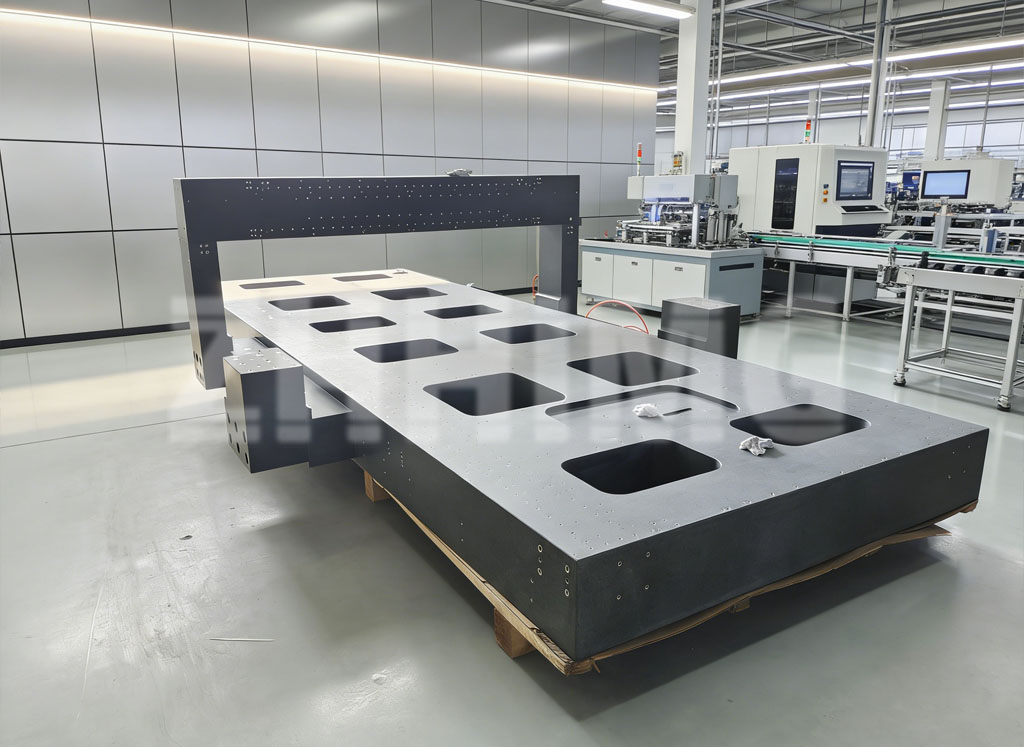
Custom Thickness Matching: Combined with Application Scenarios
ZHHIMG customizes granite tri squares with tailored thickness schemes for different use cases. Small-size tri squares for bench-top gauge calibration can adopt relatively thin thickness for easy handheld operation. Large tri squares used to check machine frame perpendicularity require increased thickness to maintain rigidity under self-weight. For high-precision metrology lab applications, we optimize thickness to achieve balanced thermal stability.
All custom granite tri squares are processed in our 10,000㎡ constant temperature and humidity workshop with shockproof trenches. Experienced lapping technicians with over 30 years of experience finish the right-angle working surfaces. Every finished tool is inspected with German Mahr indicators and British Renishaw laser interferometer. The inspection data can be traced to metrology institutes and meets DIN, ASME, JIS and GB standards. Our full ISO and CE certifications plus global patents ensure consistent quality for overseas buyers.
Conclusion: Thickness Is a Key Factor in Custom Granite Tri Square Design
Thickness selection directly affects rigidity, anti-deflection capability, thermal stability, vibration resistance and edge durability of custom granite tri squares. It is unwise to only focus on length and squareness tolerance when placing custom orders. Suitable thickness matching according to your actual inspection scenario guarantees stable, repeatable measurement results.
Following our commitment of “No cheating, No concealment, No misleading”, ZHHIMG provides full technical consultation for custom granite measuring tools. Adhering to the quality policy “The precision business can’t be too demanding”, we help global metrology customers select the optimal thickness specification and manufacture reliable granite tri squares for precision alignment and squareness verification.
Post time: Sep-22-2026