
In sub-micron manufacturing and metrology, structural accuracy is highly dependent on environmental stability. As the semiconductor and precision instrumentation industries transition toward nanometer-scale resolutions, ambient micro-vibrations and thermal fluctuations present significant challenges to structural inspection. If a precision structure experiences subtle seismic disturbances or localized temperature shifts, the data from high-end optical sensors, X-ray equipment, and laser interferometers can become distorted.
To mitigate these environmental variables, precision manufacturers must treat the production floor not merely as a workspace, but as an active component of the metrological loop. Adhering to the principle that “if you cannot measure it, you cannot produce it,” optimizing cleanroom engineering and structural isolation is essential for achieving international calibration standards.
The Physics of Environmental Interference in Ultra-Precision Lapping
When engineering granite components, such as air bearings, tri-square rulers, or heavy-duty machine beds, final tolerances are often brought down to the nanometer level. At this scale, two primary environmental vectors can instantly compromise geometric stability:
-
Acoustic and Mechanical Resonance: Vibrations from heavy overhead cranes, nearby industrial traffic, or conventional HVAC systems propagate through standard factory floors as seismic waves. These waves introduce microscopic deflections into the granite matrix during the final hand-lapping stages, causing geometric errors.
-
Thermal Expansion Coefficients: Even with a highly stable material like high-density black granite (≈ 3100 kg/m³), localized temperature gradients cause volumetric variations. A fractional temperature spike can warp a 5000mm granite bed beyond its specified flatness tolerance before it even reaches the customer.
Isolation Engineering: Design of a Military-Grade Metrology Environment
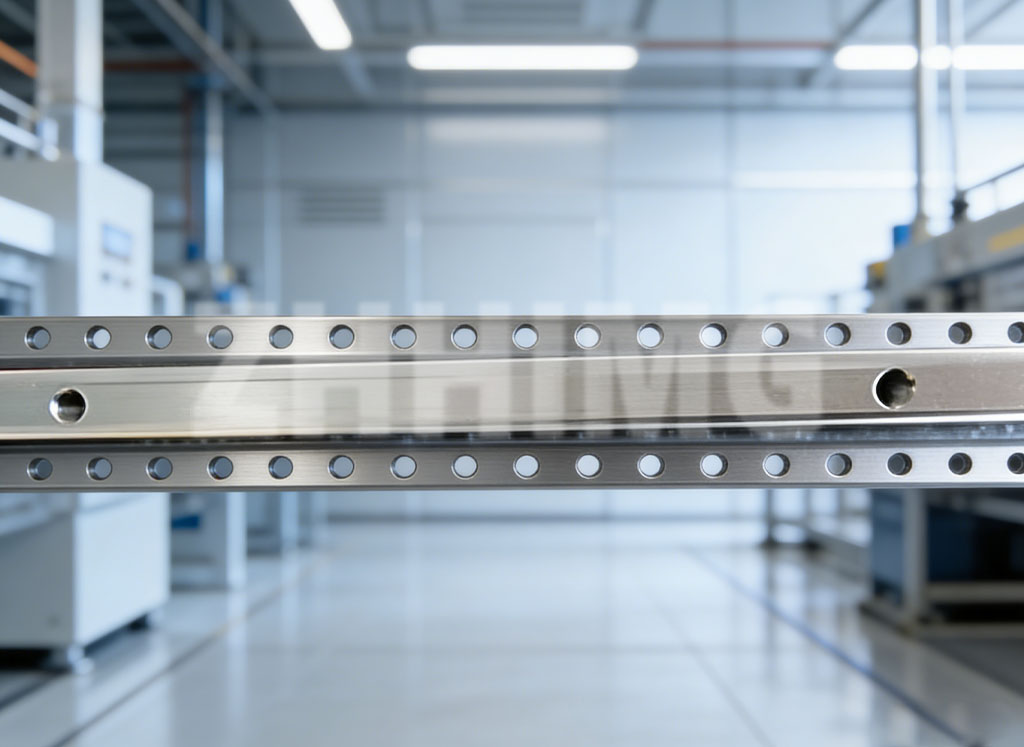
To achieve uncompromised geometric accuracy, the physical infrastructure surrounding the machining and assembly process must be decoupled from external kinetic energy. Industrial engineering facilities, such as the specialized 10,000 m² constant temperature and humidity cleanrooms developed by ZHHIMG®, utilize advanced mechanical isolation techniques to counteract ambient disturbances.
Sub-Floor Mass and Structural Damping
Standard industrial concrete floors are highly susceptible to elastic deformation under shifting payloads. Advanced metrology environments require specialized foundations to absorb low-frequency kinetic energy:
-
Heavy-Duty Foundation Casting: Utilizing ultra-hard concrete mixtures poured to a uniform thickness of no less than 1000mm. This massive structural volume acts as a high-inertia dampener against subterranean acoustic waves.
-
Peripheral Isolation Trenches: Surrounding the critical measurement and assembly zones are dedicated anti-vibration isolation trenches measuring 500mm in width and 2000mm in depth. These continuous voids effectively decouple the inner metrology slab from the rest of the manufacturing complex, reflecting and refracting peripheral shear waves away from sensitive assembly zones.
Kinematic Attenuation: Silent Overhead Logistics
Conventional overhead material handling equipment introduces substantial friction, gear noise, and structural oscillation directly into the facility’s building columns. To prevent this kinetic transmission, cleanrooms tailored for semiconductor-grade granite assembly utilize specialized silent crane systems. These systems integrate advanced low-friction polymer tracks, variable-frequency dampeners, and balanced drive assemblies to move loads up to 100 tons without introducing high-frequency resonance into the structural floor.
Achieving National Traceability Through Closed-Loop Metrology
An isolated environment is only effective if verified by calibrated instrumentation. In advanced manufacturing facilities, the testing apparatus must be strictly traceable to recognized national metrology institutes, ensuring compliance across global supply chains—including Germany’s DIN standards, America’s ASME, and Japan’s JIS.
To maintain a closed-loop quality framework, metrologists utilize a tiered inspection array within the isolated cleanroom:
-
Micro-Geometric Deviation: High-sensitivity Mahr dial indicators (0.5um) and Mitutoyo digital micrometers map localized topography and surface roughness.
-
Angular and Planar Alignment: Switzerland-engineered WYLER electronic levels continuously measure pitch, roll, and flatness across multi-meter spans, capturing dimensional variances in real-time.
-
Linear Calibration: Renishaw laser interferometers cross-verify axis straightness and displacement accuracy, validating that large-scale structural bases meet the exact specifications required by linear motor platforms and Automated Optical Inspection (AOI) setups.
Every piece of testing equipment used in these environments must hold active calibration certificates from certified regional bodies, such as the Jinan and Shandong Metrology Institutes, ensuring that all measurement metrics are directly traceable back to National Metrology Institutes.
The Strategic Advantage for High-End System Integrators
For Tier-1 aerospace, semiconductor, and medical equipment OEMs, a precision supplier’s manufacturing environment is just as critical as the final product. Sourcing structural components from facilities that lack environmental isolation increases the risk of latent structural stress—defects that only manifest as alignment failures after the machinery is fully integrated at the client site.
Enforcing rigid operational control through comprehensive compliance—manifested by concurrent ISO 9001, ISO 14001, and ISO 45001 certifications—guarantees that every stage of production occurs under identical, highly controlled parameters. When the manufacturing floor is engineered to eliminate micro-vibrations, the resulting granite components deliver the predictable, permanent geometric stability demanded by the world’s most advanced industrial technologies.
Post time: Jul-13-2026