
In the realm of ultra-precision manufacturing, particularly within semiconductor processing, micro-lithography, and Automated Optical Inspection (AOI), structural loop stiffness and long-term dimensional stability are paramount. The choice of the foundational bed material dictates the entire system’s resistance to thermal deformation, mechanical vibration, and structural deflection over time. While sub-micron level precision is now an industry baseline, a problematic trend persists among low-tier component suppliers: substituting premium precision granite with commercial-grade marble to reduce manufacturing costs.
From an engineering and metrological standpoint, evaluating these two geological structures reveals why commercial marble fundamentally fails to meet the strict parameters required for advanced industrial machinery, and why certified black granite remains the global standard.
1. Material Density and Internal Microstructure
The primary divergence between premium granite and marble lies in their geological formation and resulting mineral matrix. Commercial marble is a metamorphic rock predominantly composed of recrystallized carbonate minerals, such as calcite or dolomite. This composition results in a relatively soft mineral structure with higher porosity.
Conversely, precision-grade black granite—specifically materials engineered under strict structural oversight like ZHHIMG® Black Granite—is an intrusive igneous rock. It features a dense, interlocking crystalline structure rich in gabbro and diabase.
-
Density Dynamics: Standard commercial marble typically exhibits a density ranging between 2,500 to 2,700 kg/m³. In contrast, ZHHIMG® Black Granite achieves a dense matrix reaching approaching 3,100 kg/m³.
-
Engineering Implication: High mineral density correlates directly with superior structural rigidity and lower porosity. High density minimizes moisture absorption, preventing internal hydrostatic pressure variations that cause micro-warping over time. For equipment operating at nanometer resolutions, even a 0.5-micron structural shift can compromise optical alignment or linear motor tracking.
2. Thermal Stability and Co-efficient of Thermal Expansion (CTE)
Semiconductor fabrication facilities and cleanrooms operate under highly regulated environments, yet localized heat dissipation from linear motors, XY stages, and electronic components is inevitable. A structural foundation must possess an exceptionally low Coefficient of Thermal Expansion (CTE) and high thermal inertia to resist localized deformation.
| Material Property | Commercial Marble | ZHHIMG® Black Granite | Engineering Benefit |
| Average Density | ~2,600 kg/m³ | ~3,100 kg/m³ | Higher rigidity, structural mass |
| Porosity & Water Absorption | High (0.5% – 2.0%) | Extremely Low (<0.1%) | Prevents moisture-driven micro-warping |
| Thermal Expansion (CTE) | High & Variable | Minimal and Uniform | Resists localized motor heat distortion |
| Vibration Damping Capacity | Poor (Low Internal Friction) | Excellent (Dense Crystal Boundaries) | Rapid attenuation of high-frequency energy |
Marble features highly isotropic thermal behavior but possesses a significantly higher thermal expansion rate than granite. Furthermore, due to its softer calcite base, marble exhibits localized thermal gradients, causing uneven expansion across a 5000mm base. Precision black granite maintains near-zero structural deformation under localized temperature fluctuations, ensuring that the critical geometric alignments—such as straightness, flatness, and perpendicularity—remain stable during continuous machine operation.
3. Mechanical Rigidity, Hardness, and Hand-Lapping Potential
Industrial metrology and machine bases are subjected to continuous dynamic loads from high-speed linear motor translations. The structural bed must withstand these forces without undergoing elastic deformation.
On the Mohs hardness scale, marble generally scores between 3 and 4, making it highly susceptible to scratching, indentation, and material degradation. Precision black granite ranks between 6 and 7, offering superior resistance to physical wear and deformation.
This hardness factor is directly tied to the final geometric accuracy achieved during the manufacturing process:
-
The Limits of Machining: While advanced CNC grinding centers (such as high-end Nante grinding installations) can achieve micro-level geometries, the final nanometer-level flatness required for AOI and semiconductor stages must be achieved through manual lapping.
-
The Manual Lapping Phase: Experienced technicians—often utilizing over 30 years of manual tactile feedback aligned with international standards like DIN 876 or ASME B89—rely on the material’s hard, uniform crystal structure to remove material precisely down to micron fractions.
-
The Marble Defect: Because marble is structurally soft and chemically unstable (prone to reacting with acidic elements or ambient moisture), manual lapping causes micro-flaking rather than clean abrasion. It cannot consistently hold flat tolerances to the nanometer level across large spans.
4. Vibration Damping and Structural Resonances
High-speed XY linear motor platforms generate substantial dynamic forces during acceleration and deceleration phases. If the machine base lacks adequate internal damping capacity, these forces induce structural resonances, leading to extended settling times and reduced throughput in semiconductor inspection.
The dense, interlocking mineral grains of high-density black granite act as natural acoustic and mechanical dampeners. The internal friction across the crystal boundaries dissipates high-frequency kinetic energy far more efficiently than the softer, uniform crystal matrix of carbonate marble. Choosing a lower-grade marble base inevitably introduces micro-vibrations that distort secondary optical measurements, inspection cameras, and laser interferometry readings.
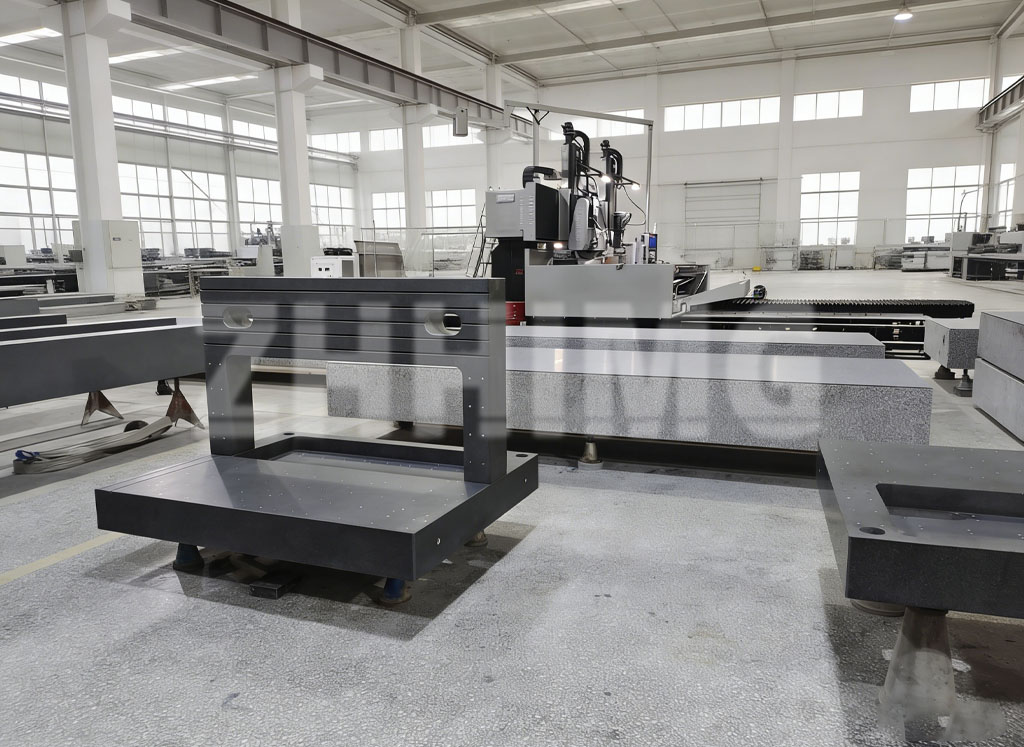
Structural Integrity as an Industry Standard
For global manufacturing entities catering to tier-one electronics, automotive, and aerospace supply chains, equipment reliability cannot be compromised. The use of inferior marble bases under the guise of “industrial stone foundations” constitutes a critical point of failure in high-end machinery design.
Maintaining absolute transparency through rigid quality frameworks—such as holding concurrent ISO 9001, ISO 14001, and ISO 45001 certifications—ensures that material sourcing remains verified. Precision components utilizing genuine ZHHIMG® Black Granite guarantee that from raw block extraction to the final national-institute-traceable metrology calibration, the physical properties conform strictly to the demands of ultra-precision engineering. Under sub-micron tolerances, there is no substitute for structural density and geological stability.
Post time: Jul-13-2026