
In the world of ultra-precision motion control, there’s a component doing something that sounds almost implausible: a precision stage floating on a film of air just a few microns thick, moving with essentially zero friction. This isn’t science fiction. It’s the granite air bearing—and it’s the enabling technology behind semiconductor lithography, wafer inspection, EV battery inspection, and virtually every other application that requires nanometer-level positioning.
What Is an Air Bearing?
An air bearing works by forcing pressurized air through a porous or orifice-fed surface, creating a thin, continuous cushion of air between two surfaces that would otherwise be in physical contact. The load—a stage, a spindle, a moving table—literally floats on this air film, typically somewhere between 5 and 20 microns thick, depending on the design and load requirements.
Because there’s no physical contact between the moving and stationary surfaces, there’s no mechanical friction, no stick-slip behavior, and essentially no wear. This is a fundamentally different situation from a conventional mechanical bearing, which—no matter how well-machined—always has some degree of friction, microscopic surface irregularity, and gradual wear over its operating life.
Why Granite Is the Only Choice for Air Bearings
Air bearings can theoretically be built on various flat, hard materials, but granite has become the standard choice for the stationary bearing surface in high-precision applications.
Flatness Stability Over Time. Because granite has extremely low internal stress compared to machined metal—metal retains residual stress from the casting and machining process, which can cause gradual, tiny dimensional shifts over months or years—a granite bearing surface tends to hold its flatness specification far longer than a metal equivalent. For an air bearing, where the entire performance envelope depends on maintaining a consistent, controlled gap, this stability is critical.
Thermal Stability. The air bearing gap is microscopic—typically 5–20 microns. Thermal expansion of the guide rail changes this gap, altering the bearing’s performance and introducing positioning errors. Granite’s CTE is roughly half that of steel and one-third that of aluminum. This ensures that the nanometer-level positioning accuracy holds true over 24-hour operation cycles.
Damping and Vibration Isolation. Granite possesses a natural damping capacity 10 times greater than steel. When combined with the viscous damping of the air film, the system creates a “double-damping” effect that isolates sensitive payloads from floor vibrations and motor noise. This is critical for applications like electron beam columns and interferometers, where vibration ruins image resolution.
Non-Magnetic, Electrically Inert. In semiconductor and electronics manufacturing environments, avoiding magnetic fields and electrical conductivity near sensitive processes is often a hard requirement. Granite satisfies this without any additional treatment.
The “Double-Damping” Effect
Here’s what makes the granite-air bearing combination uniquely effective. Granite itself provides exceptional damping—reducing machine chatter by up to 10 times compared to cast iron. The air film provides additional viscous damping, smoothing out high-frequency vibrations. Together, they create what engineers call a “double-damping” effect.
This means that a granite air bearing stage isn’t just accurate; it’s quiet. The stage moves smoothly, without the microscopic jitter that plagues mechanical bearings. It settles quickly, without the ringing that can delay measurements. And it maintains its accuracy over years of operation, without the gradual wear that degrades mechanical bearing performance.
Where Granite Air Bearings Actually Get Used
The application list reads like a tour of the highest-precision corners of modern manufacturing and inspection:
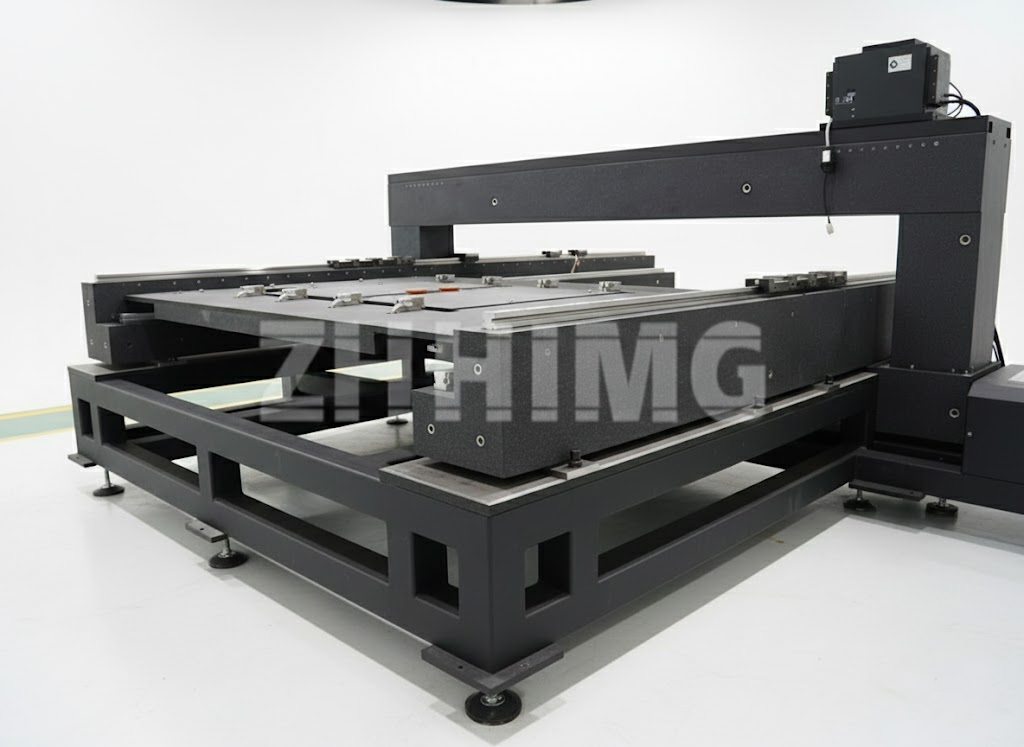
Semiconductor Lithography and Wafer Inspection. Sub-nanometer positioning repeatability is required to align features correctly across a wafer. Granite air bearings provide the frictionless, non-contact motion that enables the precision required for next-generation chip manufacturing。
Coordinate Measuring Machines (CMMs). The combination of precision granite guides and air bearings is the gold standard for CMMs, where stage vibration ruins measurement resolution。 The air bearing’s absence of friction and stick-slip enables positioning in nanometer increments.
Optical and Laser-Based Measurement Systems. Any measurement system that relies on interferometry or optical imaging requires a motion stage that doesn’t introduce vibration or positioning error. Granite air bearings provide the stability required for these demanding applications.
EV Battery Inspection. As electric vehicle battery production scales up, the demand for high-speed, high-precision inspection systems has grown dramatically. Granite air bearing stages provide the speed and accuracy required for inspecting battery cell dimensions, electrode alignment, and other critical parameters.
PCB Drilling and Routing. High-speed PCB drilling requires rapid, precise positioning with minimal settling time. Air bearings enable the fast step-and-settle motion required for high-throughput production。
What Sets ZHHIMG® Apart
Not all granite air bearing components are created equal. The quality of the granite, the precision of the lapping, and the expertise of the craftsmen all determine whether an air bearing performs to specification.
At ZHHIMG®, our ZHHIMG® black granite achieves a density of ≈3100 kg/m³—higher than most European and American black granites—ensuring superior stability and wear resistance. Our master grinders, with over 30 years of hand-lapping experience, achieve the nanometer-level flatness required for air bearing applications. Our 10,000-square-meter constant-temperature workshop, built on a 1000mm-thick ultra-hard concrete foundation with 2000mm-deep anti-vibration trenches, provides the stable environment necessary for producing components of this precision.
And our commitment to quality—summarized in our quality policy, “The precision business can’t be too demanding”—ensures that every granite air bearing component leaving our facility meets the most demanding global standards.
Whether you’re building the next generation of semiconductor lithography equipment, a high-precision CMM, or an EV battery inspection system, the combination of precision granite and air bearing technology provides the foundation for nanometer-level motion control. And at ZHHIMG®, we’ve been mastering that combination for decades.
Post time: Jul-08-2026