
Granite Air Bearings Explained: Working Principles, Advantages, and Industrial Applications
Air bearings are the quiet enablers of ultra-precision motion. Where ball bearings and roller guides carry load through microscopic metal-to-metal contact, an air bearing floats the moving element on a film of pressurized gas a few micrometres thick. There is no contact, no lubricant, no stick-slip, and no wear from motion itself — which is why the most demanding motion systems in metrology, photonics, and semiconductor manufacturing rely on them. Pair the bearing with a granite base and you combine friction-free motion with a thermally stable, dimensionally permanent structural reference. This guide explains how granite air bearings work, what governs their performance, where they are used, and — before you order — the eight parameters you should have ready.
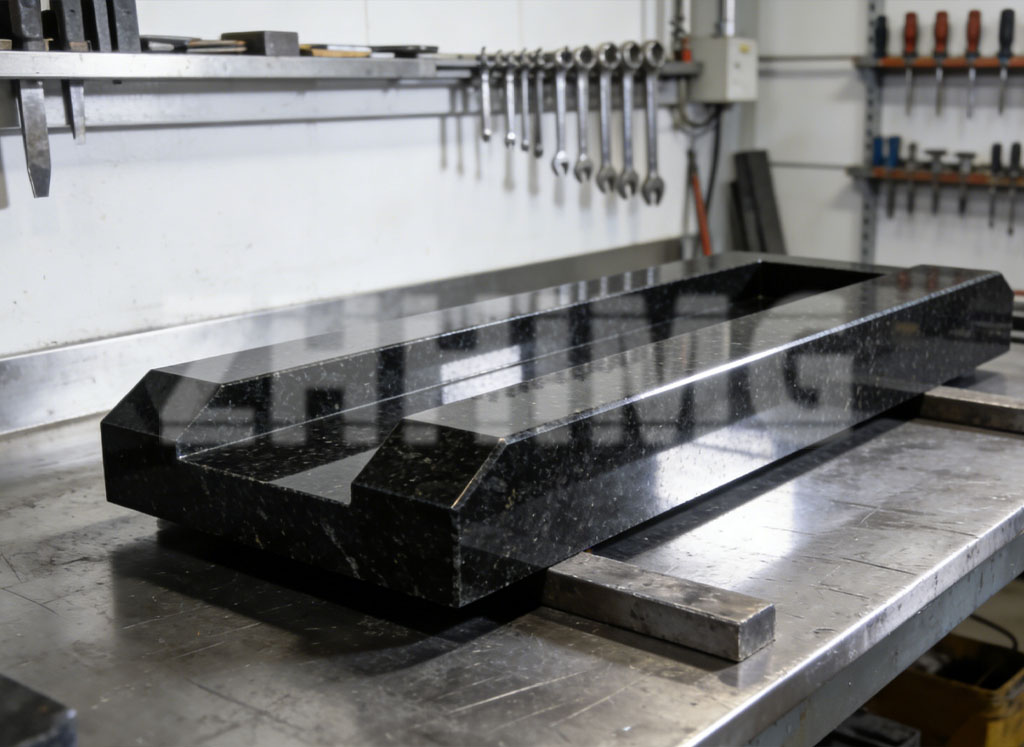
The Working Principle: Load Carried by a Controlled Air Film
The core idea is simple. Pressurized air is introduced between two precisely finished surfaces — the bearing pad and its mating rail or base. The air escapes through a narrow gap, and the pressure distribution inside that gap supports the load. Because the surfaces never touch, the moving element experiences no solid friction: motion is smooth to sub-micrometre resolution, hysteresis is minimal, and the bearing generates essentially no wear over billions of cycles.
What makes this work is not the air itself but the geometry that controls it. The gap must be uniform, the surfaces must be flat and finished to a quality that maintains that uniformity, and the pressure must be regulated so the film neither collapses under load nor becomes so stiff that it amplifies external vibration. The supporting structure matters as much as the bearing: a granite air bearing base provides a datum that does not drift with temperature, so the carefully engineered gap geometry survives the machine’s lifetime.
External Supply vs. Porous vs. Grooved: Know Your Bearing Type
Not all air bearings are built the same, and the internal restriction design — how pressurized air is let into the gap — shapes performance. Three main families exist:
| Design | How It Works | Characteristics |
|---|---|---|
| Orifice (external supply, throttled) | Air passes through discrete machined orifices into the gap; the orifice is the restriction. | Higher load capacity; risk of pneumatically induced self-excited vibration (“air hammer”) if not designed carefully; sensitive to orifice clogging. |
| Porous material | Air flows through a porous plug or surface (e.g., porous graphite/ceramic) that distributes pressure naturally across the face. | Superior stability — the porous medium damps pressure fluctuation; less prone to air hammer; very uniform film; pores demand clean, dry supply air. |
| Grooved / slot-compensated | Shallow grooves or slots machined into the bearing face distribute air along the surface. | Good stiffness distribution; grooves can be tailored to the load case; manufacturing quality of the grooves directly sets performance. |
When evaluating suppliers, ask which design they use and why for your load case. Each type has legitimate applications; what matters is that the restriction design, gap, and supply pressure are engineered together rather than copied from a catalog.
What Governs Performance: Stiffness, Load, Flatness, and Air Quality
Air bearing performance is a system property, and four factors interact:
- Film stiffness. The air gap behaves like a very stiff spring. Stiffness rises with supply pressure and bearing area, and falls with gap size. A smaller gap gives a stiffer, better-damped film — which is exactly why surface quality becomes a performance parameter, not just a cosmetic one.
- Load capacity. Determined by effective bearing area and supply pressure. Higher loads generally call for larger pads or higher pressure, and the design must keep the gap from collapsing at maximum payload.
- Flatness and surface finish. The mating surfaces define the gap. If the granite rail or base is not flat to a few micrometres over the travel, the film thickness varies along the stroke — and with it, stiffness and height. This is why the geometric quality of the granite component is inseparable from the bearing’s rated performance.
- Supply air cleanliness and stability. Particles larger than the gap can block or scratch the bearing; moisture causes adhesion and corrosion of ancillary parts; pressure fluctuation translates directly into position variation. Filtration, dryers, and regulated pressure are part of the bearing system, not optional accessories.
The practical takeaway: a bearing’s datasheet numbers assume the whole chain is right — surface geometry, air supply, and installation. If any link is weak, the system delivers less than the specification promises.
Where Granite Air Bearings Are Used
Precision Motion Platforms
Air-bearing stages for inspection and manufacturing move with nanometre-level smoothness over granite guideways. Linear motor drives pair naturally with air bearings: no mechanical contact means the drive’s fine current control converts directly into fine motion without frictional dead bands. Our granite bases and components for linear motor stages are engineered for exactly this pairing.
Optical Inspection and Metrology
Optical metrology cannot tolerate vibration or friction-induced hysteresis. Air-bearing structures on granite provide the smooth, repeatable motion that autofocus scanning, interferometry, and sensor calibration require — while the granite suppresses floor vibration and thermal drift between measurements.
Semiconductor Equipment
Wafer inspection, lithography stages, and metrology tools combine all the requirements at once: nanometre motion, extreme cleanliness (no lubricant to outgas or spatter), and thermal stability. Air bearings on granite satisfy all three simultaneously, which is why the pairing is standard across the industry. See our granite components for semiconductor equipment for typical configurations.
Ultra-Precision Positioning Systems
Coordinate measuring machines, diamond turning machines, and laboratory positioning systems all use air bearings where the measurement or machining uncertainty budget leaves no room for mechanical friction. In many of these instruments, the granite base is also the reference datum — structure and motion system become one engineered assembly, delivered pre-aligned as in our granite assembly bases.
Eight Parameters to Confirm Before Ordering
An air-bearing inquiry that starts with “we need something like last year’s project” usually ends in redesign. Bring these eight items to the first conversation and quotation becomes fast and accurate:
| # | Parameter | Why It Matters |
|---|---|---|
| 1 | Load (static + moving mass + payload range) | Sets bearing area and supply pressure; undersizing collapses the film. |
| 2 | Travel range and motion profile | Defines guide length, gap uniformity requirement, and whether the bearing pads must cover the full stroke or preloaded zones. |
| 3 | Accuracy requirement (straightness, height variation over travel) | Drives the flatness spec of the granite datum — the geometric budget must be allocated across base and motion. |
| 4 | Air supply available (pressure, dew point, filtration class) | Bearing performance assumes clean, dry, stable air; a facility air line often needs conditioning. |
| 5 | Mounting interface (inserts, hole patterns, datum surfaces) | Cast-in or machined inserts must be positioned before granite machining starts; late changes are costly. |
| 6 | Environment (temperature range, gradients, vibration, cleanliness) | Thermal gradients bend granite like any material; floor vibration sets isolation needs. |
| 7 | Bearing type preference or constraints (orifice / porous / grooved) | Compatibility with your motion control approach and supply air quality; also affects service strategy. |
| 8 | Acceptance method (who measures what, where, with which instrument) | Agreeing the acceptance measurement up front avoids end-of-project disputes; ZHHIMG provides inspection reports with instruments and conditions stated. |
Item 8 deserves emphasis. Air-bearing systems are the rare case where buyer and supplier must agree not only on geometry but on dynamic acceptance — height variation over travel, straightness, sometimes pitch and roll. Defining the instruments and conditions before production protects both sides.
Why Granite and Air Bearings Belong Together
Air bearings demand a datum that does not change. Granite delivers: low thermal expansion, no corrosion, no magnetism, natural vibration damping, and the ability to be hand-lapped to outstanding flatness over large areas. In ZHHIMG’s production, granite bases for air-bearing systems are machined, hand-lapped, and inspected in temperature-controlled conditions, with air-bearing seats and bores machined to mating tolerances so the bearing supplier’s film geometry survives installation. When bearing, base, and assembly come from one engineering conversation, the “system property” problem gets solved where it can be solved — before the parts ship.
Frequently Asked Questions
Do air bearings wear out?
Not from motion — there is no contact. Wear events in practice come from incidents: contaminated supply air scoring the surfaces, accidental contact during loading, or debris ingress. With clean, dry air and sane handling, an air bearing’s performance is effectively limited by its supporting structure, not the bearing itself.
Why is granite preferred over steel for air bearing bases?
Three reasons: granite’s low thermal expansion keeps the bearing gap geometry stable; it cannot rust, so surface quality survives humid environments without coatings; and it can be hand-lapped to flatness grades that maintain film uniformity over long travels. Steel bases can be ground, but they move with temperature and require protective coatings that add their own tolerances.
What happens if the air supply fails during operation?
The film collapses and the carriage settles onto its resting surfaces — which is why designs include landing pads or rest stops at the same geometry as the bearing gap. Sudden loss of air is an emergency condition, not a catastrophic failure, but systems should include pressure monitoring and safe-stop logic.
How clean does the supply air need to be?
Cleaner than most facilities’ general air lines. The filter class must exclude particles comparable to the film gap (micrometre scale), and the air should be dry to avoid moisture carryover. In practice this means a dedicated filtration and drying stage for the bearing supply — a modest cost that prevents the most common field failures.
Can you supply the granite base and the air bearings as one assembly?
Yes. Depending on the project, we manufacture the granite structure with machined bearing seats and supply assembled systems with the bearings integrated and inspected. Where the bearing is customer-specified, we machine the mating geometry to their interface drawing. Either route, the acceptance measurement covers the assembled unit.
Post time: Oct-26-2026