
Ultra-precision motion systems require more than high-quality components. They depend on carefully engineered combinations of materials, bearing technology, structural design, and precision manufacturing. In applications such as semiconductor inspection, optical measurement, coordinate measuring machines (CMMs), and precision positioning equipment, even small variations in geometry or temperature can affect system performance.
Granite and ceramic are two materials used in demanding precision engineering applications. However, granite air-bearing structures and ceramic air-bearing components serve different roles depending on the system design. Understanding their properties, limitations, and application requirements is essential when selecting components for an ultra-precision motion system.
In this guide, we compare granite and ceramic in air-bearing applications, explain the engineering factors that influence performance, and outline how to choose a suitable solution for your equipment.
1. What Is an Air Bearing?
An air bearing uses a thin film of pressurized air to separate moving surfaces. This non-contact operating principle minimizes mechanical contact and friction, making air bearings useful in applications that require smooth motion, low wear, and precise positioning.
Compared with conventional contact bearings, air bearings can offer several advantages:
- Low friction during motion
- Minimal mechanical wear under suitable operating conditions
- Smooth and stable movement
- Low particulate generation from bearing contact
- High positioning repeatability when properly designed and controlled
Air-bearing systems are used in semiconductor manufacturing equipment, optical inspection systems, precision measuring machines, high-speed spindles, and other advanced industrial applications.
However, an air bearing’s performance does not depend on material selection alone. Bearing geometry, air supply pressure, restrictor design, operating clearance, surface flatness, structural stiffness, and environmental conditions all contribute to the final result.
2. What Is a Granite Air-Bearing Structure?
Precision granite is widely used as a structural material for machine bases, guideways, reference surfaces, and other components in ultra-precision equipment.
In an air-bearing motion system, a granite component may serve as a precision reference surface, guideway, supporting structure, or integrated air-bearing base, depending on the design. The air film is created by the bearing system; granite provides the structural or functional surface required by that system.
Precision granite is valued for several engineering characteristics:
Dimensional stability: Properly selected and manufactured granite can provide stable geometry under suitable environmental conditions.
Vibration damping: Granite can help reduce the transmission and persistence of vibration within a machine structure. Actual performance depends on component geometry, mounting, and system dynamics.
Corrosion resistance: Granite does not rust like unprotected steel or cast iron, although its interfaces, inserts, and other assembled components may require protection.
Precision surface finishing: Granite surfaces can be ground and lapped to meet specified flatness and surface-finish requirements.
Custom structural design: Granite components can be manufactured with specified dimensions, mounting features, holes, recesses, and interfaces, subject to design and manufacturing feasibility.
These properties make precision granite a potential choice for equipment that requires a stable structural reference and carefully controlled motion.
3. What Are Ceramic Air-Bearing Components?
Technical ceramics are used in precision engineering because of their hardness, wear resistance, and material-specific thermal and mechanical properties. Depending on the ceramic composition, they may also offer high stiffness, low density, electrical insulation, or favorable thermal characteristics.
Common engineering ceramics include alumina, silicon nitride, and zirconia. Their properties differ, so they should not be treated as interchangeable materials.
In air-bearing systems, ceramic may be used for selected bearing components, precision surfaces, shafts, or other parts where the design benefits from its particular material characteristics. The exact application depends on the ceramic grade, component geometry, manufacturing process, and bearing architecture.
Potential advantages include:
- High hardness and wear resistance
- High stiffness for suitable ceramic grades
- Low density for some ceramic materials compared with metals
- Good dimensional performance in appropriately designed components
- Electrical insulation where the selected ceramic provides it
Ceramics also present engineering challenges. Some grades can be brittle and sensitive to impact or tensile stress. Complex shapes and tight tolerances may require specialized machining and finishing, which can affect cost and lead time.
For this reason, ceramic is often selected for specific functional components rather than automatically replacing the entire machine structure.
4. Granite vs. Ceramic: Key Differences
Granite and technical ceramics are not direct substitutes in every air-bearing design. A meaningful comparison must consider the role of each material within the complete motion system.
| Evaluation factor | Precision granite | Technical ceramics |
|---|---|---|
| Typical role | Machine base, guideway, reference surface, or structural component | Selected precision or functional components |
| Vibration behavior | Often useful for structural vibration damping | Depends on ceramic composition, geometry, and mounting |
| Stiffness | Depends on granite properties and component geometry | Often high for suitable ceramic grades |
| Thermal behavior | Depends on the granite, dimensions, temperature gradients, and support conditions | Varies substantially by ceramic grade |
| Wear resistance | Suitable for many precision reference applications; contact conditions matter | Often excellent, depending on composition and application |
| Corrosion behavior | Generally resistant to rust; interfaces may need protection | Many grades have good chemical resistance, depending on the environment |
| Manufacturing | Grinding, lapping, and specialized hole or feature machining | Specialized ceramic forming, grinding, and finishing |
| Design considerations | Component size, support, inserts, flatness, and handling | Brittleness, geometry, joining, finishing, and thermal expansion |
| Typical selection priority | Stable, accurately finished machine structures | Material-specific performance in selected precision components |
Important: There is no universal winner. Performance depends on the material grade, component design, manufacturing quality, operating conditions, and acceptance criteria.
5. Vibration Damping and Structural Stability
Vibration is a critical consideration in ultra-precision equipment. External disturbances, drive systems, nearby machinery, and internal motion can influence measurement accuracy and positioning stability.
Granite is often considered for machine bases and reference structures because it can provide useful vibration-damping characteristics. A properly designed granite base can help control structural vibration, but it does not eliminate the need for vibration analysis, suitable foundations, and appropriate isolation where required.
Ceramics may offer high stiffness and other useful mechanical properties, but stiffness and damping are different characteristics. A material with high stiffness does not necessarily provide high damping.
When comparing granite and ceramic, engineers should evaluate:
- The natural frequencies of the complete structure
- Structural stiffness under expected loads
- Vibration transmission through mounting interfaces
- Moving mass and acceleration requirements
- External vibration and foundation conditions
- The effect of the bearing and drive system on dynamic behavior
For a large precision machine base, granite may be attractive when structural stability and vibration damping are important. For a smaller component that requires high stiffness, wear resistance, or a specialized material property, a ceramic solution may be more appropriate.
The final decision should be based on the assembled system rather than isolated material specifications.
6. Thermal Stability and Temperature Control
Temperature variation can affect the dimensions of precision components and the geometry of an entire motion system. Thermal gradients may also introduce deformation even when the average temperature change is relatively small.
Both granite and ceramics can be used in precision applications, but their thermal behavior varies with composition, dimensions, and operating conditions.
When evaluating a granite component, engineers should consider its coefficient of thermal expansion, temperature uniformity, mounting arrangement, and exposure to heat sources.
For ceramic components, the selected grade’s thermal expansion, thermal conductivity, and temperature resistance must be evaluated against the intended application. These properties vary considerably between ceramic materials.
The system-level assessment should include:
- Operating temperature range: Define the expected temperature and permitted variation.
- Temperature gradients: Identify motors, electronics, light sources, and other potential heat sources.
- Component geometry: Evaluate how thermal expansion affects critical dimensions and alignment.
- Mounting constraints: Avoid introducing unnecessary stress through incompatible interfaces.
- Thermal stabilization: Establish suitable warm-up and measurement procedures where necessary.
For demanding metrology or optical inspection systems, material selection should be supported by thermal analysis and, where appropriate, testing under representative operating conditions.
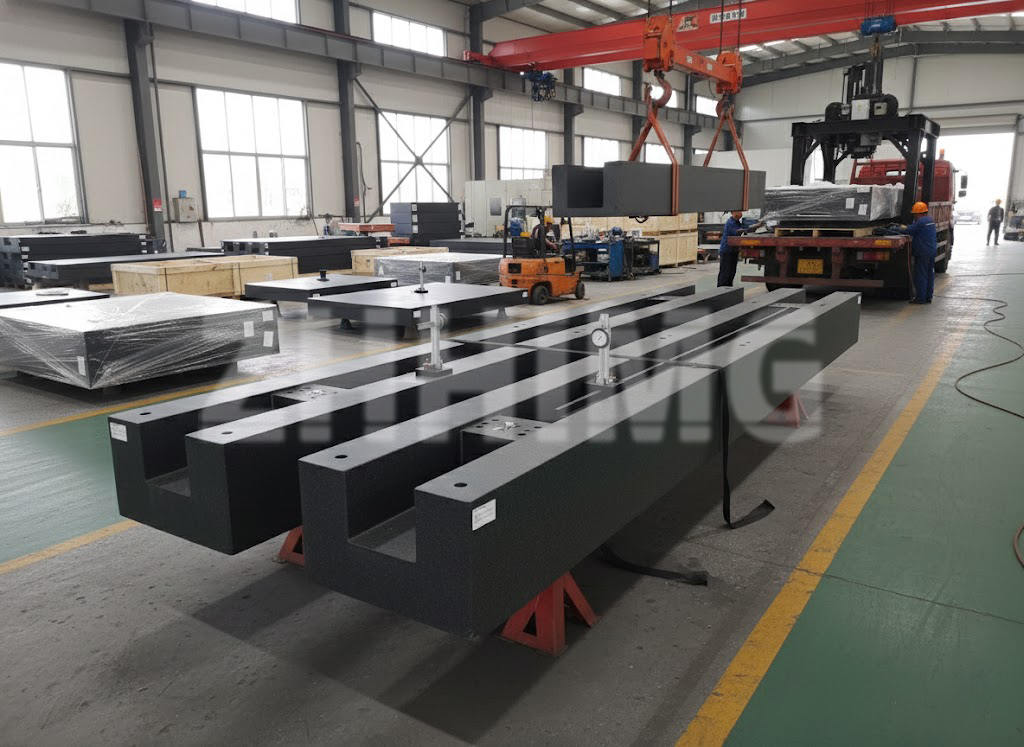
7. Why Surface Flatness and Air-Gap Control Matter
An air-bearing system depends on a controlled gap between the bearing surfaces. Surface geometry and alignment can therefore influence bearing stiffness, load capacity, motion smoothness, and stability.
A surface that does not meet the required flatness or parallelism specifications may cause variations in the operating clearance. The consequences depend on the bearing design and control conditions.
Important parameters include:
- Flatness: The deviation of a surface from its specified reference plane.
- Parallelism: The relationship between two relevant surfaces or axes.
- Surface finish: The texture and roughness of the functional surface.
- Bearing clearance: The operating gap between the bearing surfaces.
- Air supply conditions: Pressure stability, cleanliness, flow, and restrictor configuration.
- Alignment: The relationship between the guideway, bearing, and moving component.
These parameters must be specified according to the actual bearing architecture. For example, a porous-media air bearing and an orifice-restricted air bearing may have different design and surface requirements.
A granite component should therefore be ordered against a defined engineering specification, not simply described as “high precision.” Flatness, parallelism, surface finish, dimensional tolerances, and inspection methods should be agreed upon before manufacturing.
8. Porous Air Bearings vs. Orifice-Restricted Air Bearings
Material selection is only one part of air-bearing design. The method used to supply and distribute air also affects performance.
Two common approaches are porous-media bearings and orifice-restricted bearings.
Porous-media air bearings
These bearings distribute air through a porous material, creating a distributed air supply across the bearing surface.
Depending on the design, potential benefits include relatively uniform air distribution and favorable stiffness characteristics. The porous material, permeability, surface geometry, and air cleanliness must be carefully controlled.
Orifice-restricted air bearings
These bearings introduce air through discrete orifices or restrictors. Their performance depends on the number and arrangement of the restrictors, supply pressure, bearing clearance, and geometry.
They can be suitable for many precision motion applications, but the design must account for pressure distribution, stability, and manufacturing tolerances.
Neither approach is automatically superior in every application. The appropriate design depends on load capacity, required stiffness, clearance, motion speed, manufacturing capability, air quality, and maintenance requirements.
When specifying a granite air-bearing component, clarify whether the granite is the guideway or reference surface, whether the air-bearing elements are integrated into the component, and which party is responsible for the bearing design and validation.
9. How to Choose the Right Material for Your Application
The most suitable material depends on the equipment’s performance requirements, component function, and operating environment.
Semiconductor and optical inspection equipment
These applications may require stable reference structures, controlled vibration, precise alignment, and careful thermal management.
A precision granite base or guideway may be suitable when structural stability and surface accuracy are priorities. Ceramic components may complement the design where specific mechanical, thermal, electrical, or wear characteristics are required.
Coordinate measuring machines and metrology systems
Metrology equipment depends on reliable reference geometry and controlled environmental conditions.
Precision granite is widely used in measuring-machine structures and reference components. The required grade, calibration method, and acceptance criteria should be specified according to the measuring task and applicable standards.
High-speed positioning systems
High-speed systems must balance stiffness, moving mass, acceleration, damping, and thermal behavior.
Ceramic components may be attractive where reducing moving mass or obtaining a particular material property benefits the design. Granite may be more appropriate for a stationary base or guideway. The complete assembly should be evaluated for dynamic performance.
Precision manufacturing equipment
Machine tools, laser processing systems, and automated inspection equipment may require custom mounting features, large reference surfaces, or integrated structural components.
Granite can be considered for the structural foundation, while ceramics or metals may be used for selected functional parts. The optimal arrangement depends on load, motion, accuracy, environment, and budget.
10. What to Specify When Requesting a Granite Air-Bearing Component
A clear technical specification helps the manufacturer evaluate feasibility and provide a more accurate quotation.
Before contacting a supplier, prepare the following information:
- Application: Describe the equipment and the function of the granite component.
- Drawings: Provide dimensioned 2D drawings and 3D CAD files where available.
- Material requirements: Identify the requested material and any applicable material specifications.
- Critical dimensions: Specify flatness, parallelism, straightness, perpendicularity, and dimensional tolerances as applicable.
- Surface requirements: Define the required finish and identify functional bearing or reference surfaces.
- Air-bearing design: Clarify whether the supplier provides only the granite component or also the integrated bearing features.
- Loads and motion: Provide static and dynamic loads, travel, speed, acceleration, and relevant duty cycles.
- Environmental conditions: State operating temperature, humidity, cleanliness, and vibration constraints.
- Interfaces: Identify mounting holes, inserts, recesses, datum features, and assembly requirements.
- Inspection and documentation: Specify inspection reports, calibration requirements, traceability, and acceptance criteria.
If the bearing design is still under development, share the system’s performance targets and invite the manufacturer to review the proposed component structure.
11. Why Consider ZHHIMG® for Precision Granite Components?
ZHHIMG® supplies precision granite components and custom machine structures for industrial precision applications. Depending on project requirements, these components can be designed for measuring equipment, precision machinery, and advanced manufacturing systems.
When evaluating a supplier for a granite air-bearing structure or guideway, buyers should consider material selection, machining capability, surface finishing, dimensional inspection, and the ability to manufacture components according to approved drawings.
ZHHIMG®’s manufacturing profile includes precision granite components, machine bases, and gantry assemblies. For a project involving air-bearing technology, the required scope should be confirmed in advance, particularly whether the order covers the granite structure alone or a complete engineered bearing assembly.
For a technical review or quotation, provide your drawings, tolerance requirements, application details, and expected operating conditions.
Explore the ZHHIMG® website to learn more about the company’s precision engineering capabilities.
12. Frequently Asked Questions
Is granite better than ceramic for air bearings?
Not in every case. Granite is often used for machine bases, guideways, and precision reference surfaces, while ceramics may be selected for particular functional components. The best option depends on the bearing design, material grade, dimensions, and operating requirements.
Can granite be used directly as an air-bearing surface?
Yes, granite can serve as a precision surface in appropriately designed air-bearing systems. However, the bearing must be engineered around the required surface geometry, air distribution, operating clearance, load, and motion conditions. Suitability must be confirmed for the specific design.
Do granite air bearings require lubrication?
Air bearings use a pressurized air film rather than conventional liquid or grease lubrication at the bearing interface. They still require a suitable air supply, appropriate filtration, and operating procedures defined by the system design.
What affects the accuracy of a granite air-bearing system?
Important factors include surface flatness, parallelism, bearing clearance, air supply stability, structural stiffness, temperature variation, vibration, alignment, and the performance of the motion-control system.
Are ceramic components always more precise than granite components?
No. Achievable precision depends on the component’s material, geometry, manufacturing process, finishing method, inspection equipment, and acceptance criteria. Neither material guarantees a particular accuracy without supporting specifications and measurement results.
What information is needed for a custom granite air-bearing quotation?
Manufacturers generally need component drawings, dimensions, critical tolerances, surface-finish requirements, mounting details, load conditions, operating environment, and inspection requirements. If air-bearing elements are included, the bearing design and performance targets should also be specified.
Conclusion
Granite and ceramic offer different advantages in ultra-precision motion systems. Granite is a strong candidate for machine bases, guideways, and stable reference structures, while technical ceramics can be valuable for selected components requiring specific mechanical, thermal, electrical, or wear properties.
The most effective solution comes from matching each material to its intended function and evaluating the complete system—including bearing architecture, surface geometry, air supply, thermal behavior, and dynamic performance.
For engineers and equipment manufacturers developing custom precision machinery, a well-defined technical specification and a capable manufacturing partner are essential to achieving the required performance.
Planning a custom precision granite component or air-bearing structure? Contact ZHHIMG® with your drawings and technical requirements to discuss manufacturing feasibility and inspection needs.
Post time: Oct-28-2026