
When engineers design a piece of precision equipment — a CMM, an inspection platform, a laser system, a linear motion stage — one of the earliest and most consequential decisions is what the structural base will be made of. It’s rarely a simple “best material” answer; each option trades off differently across cost, weight, thermal behavior, and dynamic performance. Here’s how the main candidates compare.
Cast Iron: The Traditional Default
Cast iron has been the default machine tool base material for well over a century, and for good reason: it’s strong, machinable, relatively inexpensive at scale, and well understood. Its main weaknesses in high-precision applications are thermal conductivity — it heats and cools relatively quickly, which can create thermal gradients — and internal casting stresses that can slowly relax over years, causing gradual, hard-to-predict dimensional drift. Cast iron remains a solid choice for general machine tools where absolute micron-level long-term stability isn’t the primary requirement.
Granite: The Metrology Standard
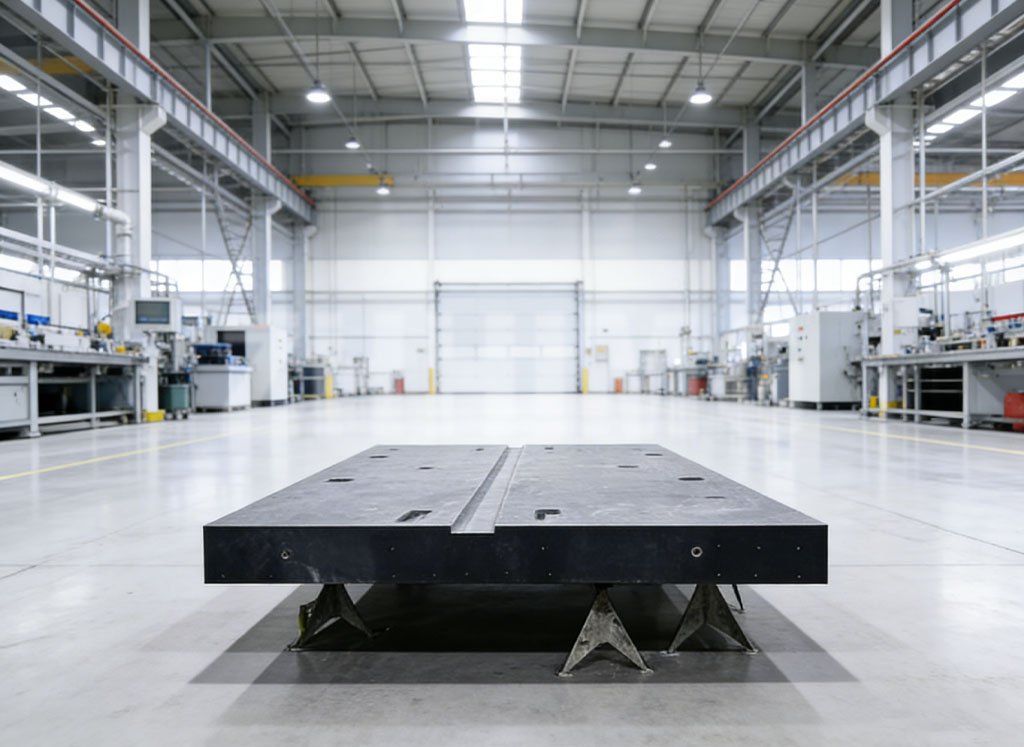
Natural granite is prized for its high internal damping (it absorbs vibration rather than transmitting it), low and predictable thermal expansion, and long-term dimensional stability, since it has no casting-related internal stress to relax over time. Its main drawbacks are weight (granite is dense, so large bases are heavy and require robust support structures) and brittleness — granite doesn’t tolerate sharp impact loads well, and edges or corners can chip if mishandled. These trade-offs are usually acceptable given granite’s stability advantages, which is why it remains the standard base material for CMMs, optical measuring instruments, and semiconductor metrology platforms.
Ceramic: For Extreme Environments
Precision ceramics (such as certain alumina or silicon carbide formulations) offer even better thermal stability than granite in some cases, along with high stiffness and excellent wear resistance. Ceramics are more expensive to produce, especially in large sizes, and machining them requires specialized processes. They tend to be reserved for applications where their specific advantages — extreme thermal stability, chemical inertness, or very high stiffness-to-weight ratio — justify the added cost, such as certain semiconductor process equipment or high-end optical systems.
Mineral Casting (Polymer Concrete): The Synthetic Alternative
Mineral casting — a mix of granite aggregate and epoxy resin, cast into a mold — offers some of granite’s damping and stability benefits while allowing more design flexibility, since it can be cast into complex shapes with integrated features (mounting points, cable channels, and so on) that would be difficult or impossible to machine into solid natural stone. It generally has somewhat lower stiffness than solid granite and its long-term aging behavior depends heavily on resin formulation and curing quality, but it has become a popular choice for machine tool bases and structural components where geometric complexity matters as much as raw stability.
Carbon Fiber: Where Weight Is the Priority
Carbon fiber composite structures offer an exceptional stiffness-to-weight ratio and very low thermal expansion along the fiber direction, making them attractive for large-span structural beams and bridges in precision equipment where minimizing moving mass matters — for example, gantry bridges on large-format inspection or laser systems, where lower mass allows faster acceleration without sacrificing stiffness. Carbon fiber structures are typically more expensive to engineer and manufacture than the alternatives above and are usually reserved for specific structural elements (like a moving bridge or beam) rather than an entire machine base.
Making the Choice
In practice, the “right” material depends on the specific failure mode an engineer is trying to avoid:
- If long-term dimensional drift under normal conditions is the main concern → granite or ceramic.
- If complex geometry and integrated features matter more than absolute maximum stiffness → mineral casting.
- If minimizing moving mass on a fast-moving axis is the priority → carbon fiber, often paired with a granite or mineral-cast base.
- If cost and general-purpose machinability are the primary constraints → cast iron remains a reasonable choice for less demanding tolerance requirements.
Many high-end systems today actually combine materials — a granite base for the stationary structure, paired with a carbon fiber bridge for a moving gantry, for instance — using each material where its particular strengths matter most, rather than forcing a single material to do everything.
ZHHIMG (Zhonghui Group) manufactures precision granite, ceramic, mineral casting, and carbon fiber structural components for CMMs, semiconductor equipment, and other precision machinery.
Post time: Jul-30-2026