
Granite Surface Plate Accuracy Grades Explained: AA, A, B and DIN 876
When procurement engineers specify a granite surface plate, the most critical decision is not just the size or the price. It is the accuracy grade. A Grade B plate might be perfectly fine for a rough machine shop floor, but it will fail immediately in a semiconductor inspection lab or a CMM calibration environment.
At ZHHIMG, our mission is to promote the development of the ultra-precision industry. To do that, you need to understand exactly what Grade AA or Grade A means, how different global standards compare, and how we achieve nanometer-level flatness in our 10,000 square meter constant-temperature workshop.
1. What Do Accuracy Grades Actually Measure?
Accuracy grades define the maximum allowable deviation from a perfect plane across the entire surface of the plate. This is called flatness tolerance.
Flatness is typically measured in microns (one-thousandth of a millimeter) or micro-inches. For ultra-precision applications, we measure in nanometers (one-millionth of a millimeter). The lower the number, the flatter the plate.
Several factors determine these grades:
- • Surface Texture: Higher grades require a finer, more uniform surface finish to ensure accurate contact with measuring tools.
- • Diagonal Deviation: The tolerance is often checked not just lengthwise and widthwise, but also across the diagonals of the plate.
- • Local Flatness: Even if the overall plate is flat, high-grade plates must not have localized hills or valleys that could rock a precision level.
2. Standard Accuracy Grades: AA, A, and B
While specific tolerances vary based on the physical size of the plate (a 1000mm plate has a tighter absolute tolerance than a 4000mm plate), the hierarchy of grades remains consistent across most international standards.
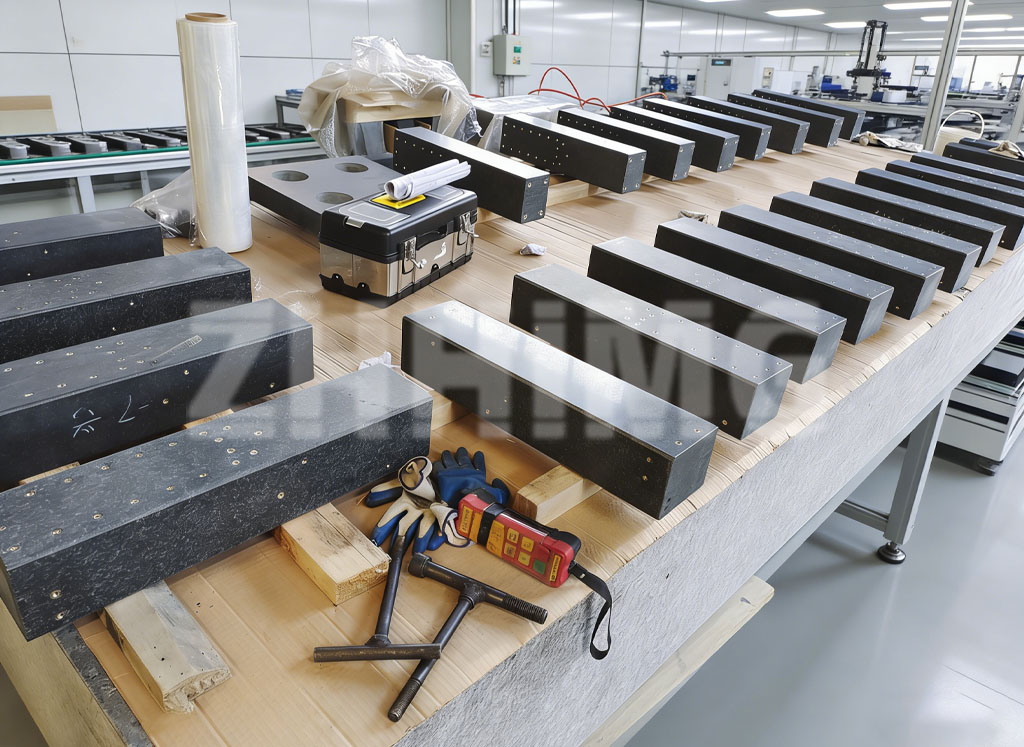
Grade AA (Ultra-Precision / Laboratory Grade)
- • Application: Calibration labs, semiconductor equipment assembly, laser interferometer reference, and high-end CMM tables.
- • Requirement: This is the highest commercial grade. Achieving Grade AA requires grinding in a strict constant-temperature and constant-humidity environment. At ZHHIMG, our Grade AA plates are finished by master craftsmen with over 30 years of experience, achieving flatness that approaches the nanometer level.
Grade A (Precision / Inspection Grade)
- • Application: Final inspection of precision parts, tool room setups, and assembly of high-precision optical equipment.
- • Requirement: Suitable for most industrial quality control tasks. It offers a balance between high accuracy and cost-effectiveness.
Grade B (General Purpose / Workshop Grade)
- • Application: General machining, layout work, and marking out parts on the shop floor.
- • Requirement: Used where extreme precision is not critical, but a stable, flat reference surface is needed for general fabrication.
3. Global Standards Comparison: DIN, GB, and ASME
Different countries have historically used different standard systems. However, modern manufacturing often requires cross-compatibility. At ZHHIMG, our workers are trained on all major international standards to ensure our products meet your specific regional requirements.
Germany: DIN 876 / DIN 875
The German DIN standard is widely regarded as one of the strictest and most respected benchmarks in precision metrology. DIN 876 specifically covers surface plates. If a client specifies DIN Grade 0 or DIN Grade 1, they are usually referring to this rigorous system. Our team is fully certified to work to DIN 876, DIN 875, and DIN 650 standards.
China: GB/T 4485
The Chinese national standard (GB) for granite surface plates aligns closely with international norms but has specific testing methods for flatness deviation. We strictly adhere to GB/T standards for domestic projects and often use them as a baseline for our internal quality control.
USA: ASME B89.3.1 / GGG-P-463C
In the United States, the ASME standard (and the older military specification GGG-P-463C) defines surface plate grades (Grade AA, A, B). For our American clients, such as 5th Axis and various metrology institutes, we ensure full compliance with ASME tolerance tables.
Other Standards
We also manufacture to JIS (Japan), BS (UK), TOCT (Russia), and EIE (France) standards, ensuring that no matter where your factory is located, our plates integrate seamlessly into your existing measurement ecosystem.
4. How We Achieve and Verify Nanometer-Level Flatness
Claiming high accuracy is easy; proving it is hard. Our no cheating, no concealment policy means we rely on hard data, not marketing promises.
The Environment: Flatness cannot be measured or achieved in a normal factory. Temperature changes cause materials to expand and contract. Our 10,000 square meter workshop is maintained at a strict constant temperature and humidity. The floor is poured with ultra-hard concrete (over 1000mm thick) and surrounded by 2000mm deep vibration-dampening trenches to eliminate ground vibration.
The Equipment: We use the world’s best measurement tools, all calibrated by the Shandong Provincial Institute of Metrology and traceable to the National Institute of Metrology:
- • Renishaw Laser Interferometers (UK): For long-range straightness and flatness.
- • WYLER Electronic Levels (Switzerland): For high-precision angular measurement.
- • Mahr Dial Indicators (Germany): Providing 0.5 micron resolution.
The Human Element: Machines get us close, but our master craftsmen get us to the final micron. Our grinding masters can feel deviations of a few microns through their hands, acting as living electronic levels to polish the surface to perfection.
5. Choosing the Right Grade for Your Application
Not sure which grade you need? Here is a quick guide:
- • Are you calibrating other measuring tools? You need Grade AA.
- • Are you assembling semiconductor or PCB drilling equipment? Grade AA is highly recommended to ensure the stability of the air bearings and linear motors.
- • Is this for a university research lab (like NUS or Stockholm University)? Grade AA or high-end Grade A is standard.
- • Is this for a general welding or fabrication shop? Grade B will serve you well and save budget.
At ZHHIMG, we don’t just sell plates; we provide the foundation for your precision. Whether you need a standard Grade B ruler or a custom 6-meter Grade AA granite base for a CMM, we have the capacity and the certification to deliver.
Need a custom tolerance chart for your specific project? Contact our engineering team today to discuss your DIN, ASME, or GB requirements.
Post time: Nov-23-2026