
Many professionals in precision manufacturing face a tough problem: newly accepted reference platforms gradually lose flatness and drift in accuracy after being put into service, requiring re-grinding back at the factory. Such accuracy degradation rarely results from daily wear. It arises mainly from slow release of residual internal stress hidden inside substrates, which distorts the reference surface. Among various metrology reference carriers, granite surface plates effectively avoid deformation caused by stress release thanks to low internal stress. Once machined, they can retain high precision for a long time and serve as the preferred reference for long-term stable metrology.
Internal stress is invisible tension trapped inside materials. Metal substrates such as cast iron and steel easily accumulate massive residual stress during casting, forging and cutting. Even after aging treatment before delivery, internal stress can hardly be fully eliminated. It will release slowly under temperature fluctuations, continuous load and long-time static placement, causing tiny invisible warpage. For nano and micro-level precision inspection, minimal deformation can distort the reference plane and trigger continuous drift of measured data, leading to frequent calibration and rework, which raises operating costs. Low-cost stone gauges carry similar risks: poor-quality stone accumulates heavy stress during quarrying and cutting. Although their precision seems qualified in the short run, deformation emerges after months of placement and accuracy declines rapidly.
High-quality granite raw blocks are carefully selected. The rock has experienced natural geological aging over millions of years, with original internal stress fully released. The raw stone will go through dedicated static curing after quarrying and cutting. Large blocks are stored at the stone yard so that new stress generated during cutting can dissipate slowly before grinding. This is critical for low-stress finished products, minimizing deformation risks in advance. Only blocks with stable status and qualified stress relief are transferred to the constant-temperature workshop for fine grinding.
Machining procedures are also designed to control stress. In rough machining, excess stone is removed gradually to prevent fresh stress accumulation from heavy one-off cutting. Static stabilization intervals are reserved between grinding passes to balance the internal state before further processing. Finishing is completed in a constant-temperature and vibration-isolated workshop to avoid extra stress induced by temperature differences. After grinding reaches target flatness, finished plates are kept for static observation to track flatness changes. Products are allowed to be packaged and shipped only after confirmation that no deformation comes from slow stress release. 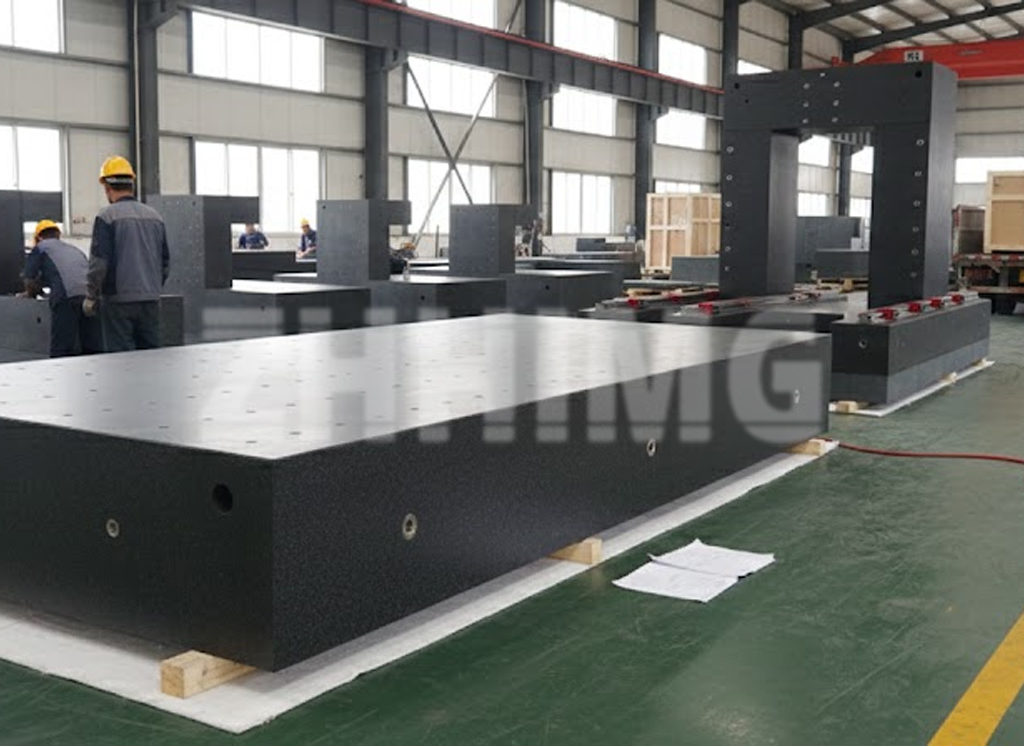
The most obvious benefit of stress-free characteristics is long-term accuracy retention. Once a low-stress granite surface plate is machined to final form, its reference geometry stays stable over decades without heavy overload or severe impact. Accuracy degrades extremely slowly. Compared with metal platforms and inferior stone gauges, it requires far less rework and re-grinding and maintains consistent metrology performance. For metrology labs, university research platforms and semiconductor calibration stations demanding long-term stable references, these granite plates reduce gauge replacement and downtime for re-verification, ensuring continuous and reliable data for production and research.
In ultra-precision industries, the reliability of a reference benchmark is not only judged by precision at delivery, but also by its stability years or decades later. Eliminating internal stress means removing a long-term hidden threat to accuracy. ZHHIMG establishes a full stress-control workflow covering raw material selection, stone storage, staged machining and post-production observation. This keeps granite surface plates free from deformation induced by internal stress. With stable substrate properties, the plates preserve high precision after machining. Following the quality policy that no requirement is too strict for precision engineering, ZHHIMG provides long-lasting stable metrology references for the global ultra-precision industry.
Post time: Sep-24-2026