
Granite is usually the best choice when a machine needs long-term flatness, vibration damping and thermal stability; cast iron wins on cost and machinability; ceramic wins on stiffness and low moving mass. This guide compares the three so engineers and buyers can match the material to the machine.
Why the Base Material Matters
A machine base is the reference everything else is built on. If it moves, bends or rings, no guide rail, linear motor or sensor on top of it can recover the lost accuracy. In CMMs, semiconductor inspection tools, laser systems and ultra-precision CNC machines, the base has to do four jobs at once:
- Stay flat and straight for years, not just on the day it is inspected.
- Resist temperature change, so the machine does not drift between morning and afternoon.
- Absorb vibration from motors, floors and moving axes instead of passing it to the workpiece.
- Carry load without creep, including heavy gantries, stages and optics.
No single material is best at all four. Granite, cast iron and precision ceramic each win in different places, which is why the right choice depends on the machine.
Granite vs. Cast Iron vs. Ceramic at a Glance
The figures below are typical ranges for each material family. Exact values vary by grade and supplier, so always confirm them against a material certificate.
| Property | Black granite | Gray cast iron | Alumina ceramic |
|---|---|---|---|
| Density (kg/m³) | about 3,000–3,100 | about 7,100 | about 3,900 |
| Thermal expansion (10⁻⁶/K) | about 5–8 | about 10–12 | about 7–8 |
| Thermal conductivity (W/m·K) | about 2–3 | about 45–55 | about 25–30 |
| Vibration damping | Very high | Good | Low |
| Stiffness (Young’s modulus) | Moderate | Moderate to high | Very high |
| Corrosion and rust | None | Needs coating | None |
| Magnetic | No | Yes | No |
| Dimensional stability over time | Excellent | Good (stress relief needed) | Excellent |
| Large-size capability | Very good | Very good | Limited by firing and grinding |
| Relative cost | Medium | Low to medium | High |
Read the table as a trade-off, not a ranking: granite leads on damping and stability, ceramic on stiffness, and cast iron on cost and ease of adding features such as ribs and threaded fixings.
Granite: The Standard for Stability and Damping
Granite is the traditional choice for metrology and ultra-precision equipment, and for good reasons. Dense black granite is cut from a rock that has been stable for millions of years, so it has no internal stress to release the way a casting or weldment does.
Strengths
- Vibration damping: granite absorbs vibration far better than steel or aluminum, which helps stages settle faster and keeps measurements quiet.
- Thermal stability: low thermal expansion and low thermal conductivity mean it reacts slowly to room-temperature swings.
- Lapped surfaces: granite can be ground and hand-lapped to very tight flatness, and it does not burr when scratched, so a nick does not raise a ridge.
- No rust, no magnetism: it needs no coating, and it does not disturb magnetic sensors or linear motors.
- Large sizes: a single piece can be machined to several meters in length, which removes joints that would otherwise add error.
Limits
- It is brittle, so it does not suit impact loads or thin, unsupported sections.
- Threaded fixings need inserts, because granite cannot be tapped like metal.
- Its stiffness is moderate, so very light, high-acceleration axes may call for ceramic instead.
Best for: coordinate measuring machines (CMMs), semiconductor and wafer inspection tools, AOI and X-ray/CT systems, femtosecond and picosecond laser machines, XY stages, linear-motor platforms and air-bearing guideways.
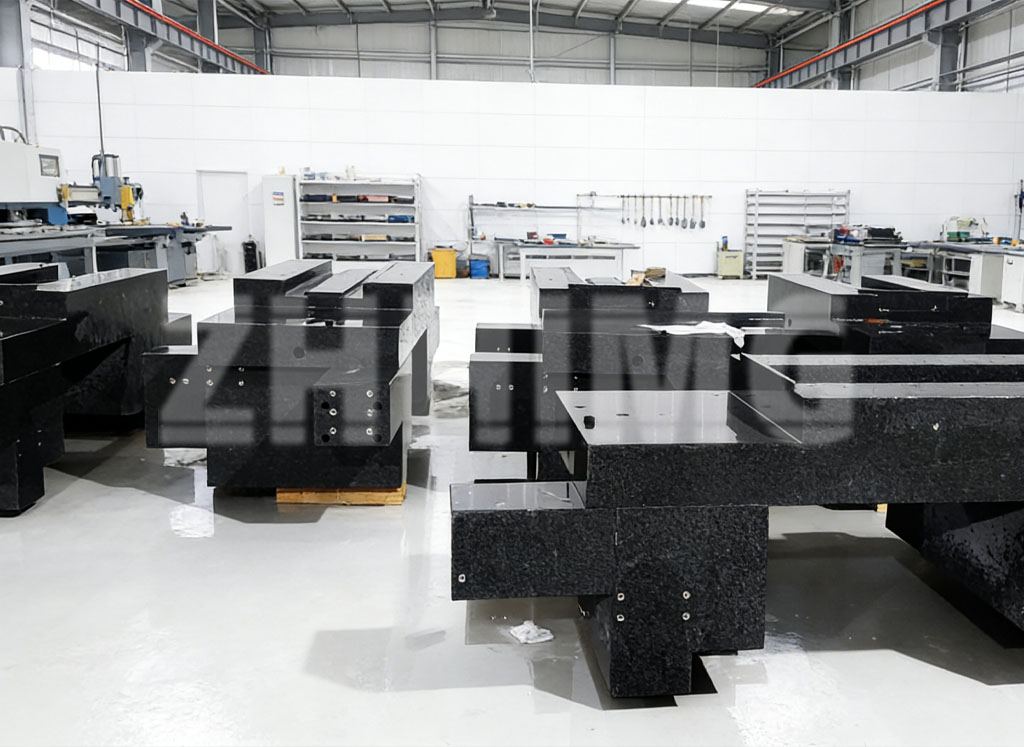
ZHHIMG machines its black granite (density about 3,100 kg/m³) into bases, beams, gantries, air-bearing components and assemblies. See the precision granite component range for examples.
Cast Iron: Cost-Effective and Easy to Machine
Cast iron has carried machine tools for more than a century. It is easy to cast into ribbed, complex shapes, takes threads directly, and costs less than most precision materials.
Strengths
- Lower cost and shorter lead time for medium production volumes.
- Good damping for a metal, better than steel, thanks to the graphite flakes in gray iron.
- Easy to add features: ribs, pockets, threaded holes and mounting faces can be cast or machined in.
- Strong under load, with good compressive strength for heavy axes.
Limits
- Higher thermal expansion and conductivity than granite, so it follows room temperature more closely and needs a well-controlled environment.
- Internal stress: castings must be aged or stress-relieved, or they can slowly distort.
- Rust: exposed surfaces need paint or plating, and scratches raise burrs that affect measuring surfaces.
- Magnetic, which can interfere with some sensors and motors.
Best for: general CNC machine tools, grinding machines, heavy-duty equipment and applications where cost and load capacity matter more than nanometer-level thermal stability.
Precision Ceramic: Maximum Stiffness for Light, Fast Motion
Technical ceramics such as alumina and silicon carbide are the stiffest of the three. Their stiffness-to-weight ratio makes them attractive when a part has to move, not just sit still.
Strengths
- Very high stiffness and excellent wear resistance.
- Low weight for the stiffness, which helps high-acceleration stages and beams.
- Stable and inert: no corrosion, no magnetism, and very little dimensional drift.
- Fine surface finish that suits air-bearing and vacuum applications.
Limits
- Cost: ceramic is the most expensive option, especially at large sizes.
- Size limits: firing and grinding become difficult as parts grow.
- Low damping: ceramic tends to ring, so it often needs to be paired with a damped base.
- Brittle, with machining done by diamond grinding rather than cutting.
Best for: moving beams and stage carriages, air-bearing guideways, precision measuring components, wafer handling and vacuum equipment.
In many high-end machines the answer is a combination: a granite base for damping and stability, with ceramic parts on the moving axes.
How to Choose: Material by Application
| Application | Best fit | Why |
|---|---|---|
| CMM and metrology machines | Granite | Stability, damping and long-term flatness |
| Semiconductor and wafer inspection | Granite, with ceramic on moving axes | Vibration control plus low moving mass |
| Femtosecond / picosecond laser machines | Granite | Quiet, thermally stable platform |
| AOI, X-ray and industrial CT | Granite | Low vibration and no magnetic interference |
| Air-bearing stages and guideways | Granite or ceramic | Flat, wear-free reference surfaces |
| General CNC machine tools | Cast iron or mineral casting | Cost and easy integration of features |
| High-acceleration beams and carriages | Ceramic or carbon fiber | Stiffness at low weight |
A quick decision rule:
- If vibration and thermal drift limit your accuracy, choose granite.
- If budget and complex shapes matter most, choose cast iron or mineral casting.
- If moving mass and stiffness matter most, choose ceramic for the moving parts.
- If you need all three, combine them: a granite base carrying ceramic or carbon-fiber moving parts.
What to Check Before You Buy a Granite Base
Not every “granite” base performs the same. Some suppliers substitute softer, lower-density stone or marble because it is cheaper, and the difference only shows up after the machine is in service. Before you order, ask for:
- Material identity and density. Black granite for precision work is dense, about 3,000–3,100 kg/m³. Marble and light-colored granite are typically lighter and more porous.
- Material certificate. Ask for documented density, water absorption and compressive strength.
- Inspection method. Flatness, parallelism and squareness should be measured with calibrated instruments, for example electronic levels, laser interferometers and indicators with a stated resolution.
- Calibration traceability. The instruments should carry current calibration certificates traceable to a national metrology institute.
- Machining environment. Final grinding and measurement should happen in a temperature-controlled, vibration-isolated workshop, because the measuring conditions limit the accuracy you can verify.
- Size and weight capability. Confirm the supplier can machine and inspect your part in one piece, rather than joining sections.
- Quality system. Look for ISO 9001 quality management, plus ISO 14001 and ISO 45001 for environmental and safety management, and CE marking where it applies to your product.
- Standards. Confirm the standard the part is built to, for example DIN, ASME or JIS for flatness grades and tolerances.
ZHHIMG manufactures from its own ZHHIMG® black granite (about 3,100 kg/m³), measures parts in a controlled-environment workshop, and can machine single pieces of up to 100 tonnes and 20 m in length. Send your drawing and we will review the material and tolerance requirements with you.
Frequently Asked Questions
Is granite better than cast iron for a machine base? For stability, damping and corrosion resistance, yes. Cast iron is cheaper and easier to add features to, so it remains a good choice for general-purpose machines in controlled environments.
Why not use marble instead of black granite? Marble is softer, more porous and usually less dense, so it wears faster and absorbs moisture. Precision equipment should use dense black granite with a documented density.
Can granite be used with linear motors and air bearings? Yes. Granite is non-magnetic and can be lapped to a very flat, stable surface, which makes it a common base for linear-motor platforms and air-bearing guideways.
Can you combine granite and ceramic in one machine? Yes, and many high-end systems do. A granite base provides damping and a stable reference, while ceramic parts on the moving axes reduce mass and add stiffness.
How do I get a quote? Send a drawing or the key dimensions, flatness requirement, load and application to ZHHIMG through the product page, and the engineering team will advise on material and tolerance.
Conclusion
Choose granite when stability and vibration damping decide your accuracy, cast iron when cost and complex features decide your budget, and ceramic when stiffness at low weight decides your motion performance. For most metrology, semiconductor and laser equipment, a dense black granite base is the foundation that lets the rest of the machine do its job.
Post time: Nov-13-2026