
Why the Machine Base Material Matters
For most ultra-precision equipment, granite is the best all-round machine base material, but cast iron, mineral casting and technical ceramics each win in specific situations. The right choice depends on what your machine must hold steady: position, temperature, vibration, or all three.
A machine base is more than a support. Every axis, guideway and sensor references it, so any movement in the base shows up directly as error in the part or the measurement. A base that deflects, creeps or expands with room temperature will limit accuracy, however good the stages above it are.
This guide compares four common base materials, granite, cast iron, mineral casting (polymer concrete) and precision ceramics, so you can match one to your equipment before you request quotes.
What a Machine Base Has to Do
A good machine base does five jobs at once: it stays stable, resists temperature drift, absorbs vibration, resists deflection, and can be finished and assembled to tight tolerances.
- Long-term dimensional stability. Low internal stress and no creep, so the flatness measured at delivery is still there years later.
- Thermal stability. Low thermal expansion and low thermal conductivity, so room-temperature changes move the base slowly and only slightly.
- Vibration damping. Enough internal damping to dissipate energy from motors, motion stages and the floor, which keeps settling time short.
- Stiffness for its weight. Enough rigidity that moving mass and process loads do not deflect the structure.
- Machinability and integration. The ability to be ground, lapped, drilled and fitted with inserts, air bearings, rails and mounts.
No single material is best at all five, so the choice is a trade-off rather than a ranking.
The Four Materials, One by One
Granite
Granite is the usual first choice when accuracy and long-term stability matter most. Dense natural stone has aged for millions of years, so it carries almost no residual stress, and lapped surfaces reach micron and sub-micron flatness. It is non-magnetic, does not rust, and damps vibration far better than metal.
Its limits are real. Granite is brittle, so impact and point loads need care, and threaded features need bonded inserts instead of tapped holes. Stone quality also varies widely: low-density or porous stone performs worse, which is why density and material test data should be part of any quotation. ZHHIMG® Black Granite has a density of about 3,100 kg/m³.
Typical uses: CMMs, optical inspection (AOI), semiconductor equipment, laser machines, PCB drilling machines, air-bearing stages. See ZHHIMG granite components.
Cast Iron
Cast iron is strong, tough and easy to modify. Ribbed castings give high stiffness, holes can be tapped directly, and repairs are straightforward. It is a sound choice for machines that see heavy loads or shock.
The trade-offs are higher thermal expansion and lower damping than granite, plus the need for stress relief, scraping or grinding, and corrosion protection. It is also magnetic, which matters for some inspection and semiconductor tools.
Typical uses: machine tools, presses and large frames with impact loads. See precision metal casting.
Mineral Casting (Polymer Concrete)
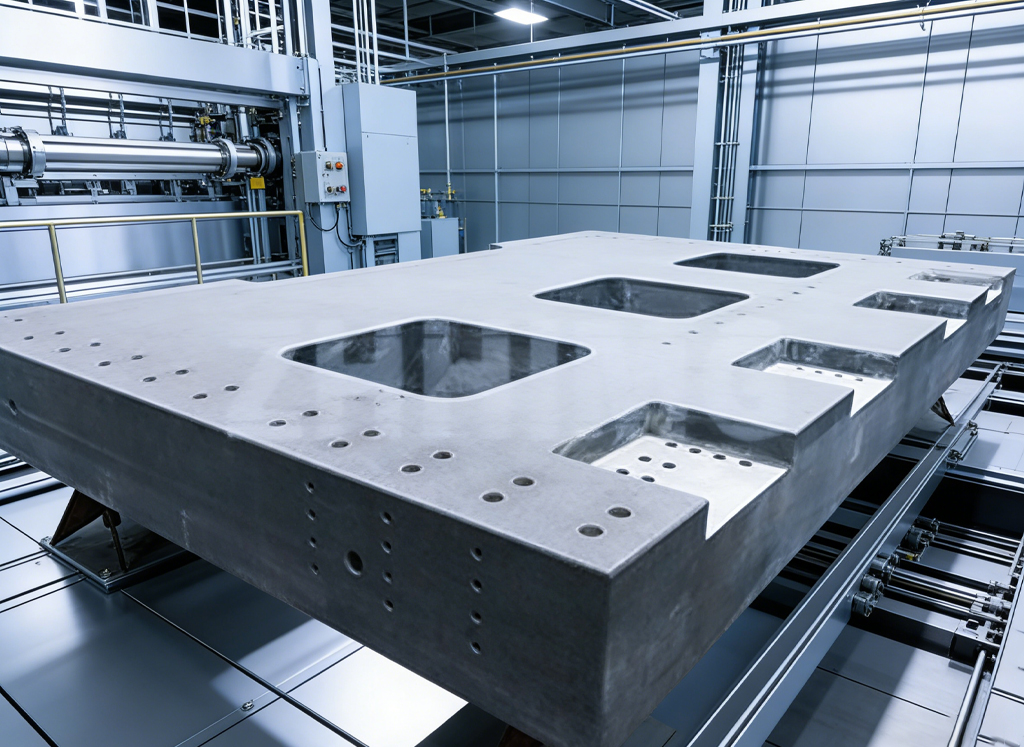
Mineral casting bonds mineral aggregate with epoxy resin and casts it in a mould. Its damping is very high, and complex shapes, inserts, cooling channels and cable ducts can be cast in, which reduces machining and cost in series production.
It is less stiff per section than steel or granite, and it needs tooling investment. Tolerances come from the mould and from post-machining of reference surfaces, so it suits repeat production better than one-off bases.
Typical uses: high-speed machine tools, grinders and series-production equipment. Our mineral casting buyer’s guide covers inserts, interfaces and acceptance in detail.
Technical Ceramics
Alumina and silicon carbide offer very high stiffness, high hardness, low thermal expansion in some grades, and excellent wear resistance. They are the choice when low moving mass and high stiffness matter, as in semiconductor stages, beams, guideways and reference rulers.
They cost the most, have size limits, and need long, demanding processing. For that reason ceramics are usually used for critical components mounted on a granite or mineral casting base, not for the whole base.
Typical uses: wafer-handling stages, air-bearing guideways, measuring rulers, precision beams. See precision ceramic components.
Side-by-Side Comparison
Granite and mineral casting lead on damping and thermal behavior, cast iron leads on toughness and ease of modification, and ceramics lead on stiffness.
| Property | Granite | Cast iron | Mineral casting | Technical ceramic |
|---|---|---|---|---|
| Density (kg/m³) | 2,600–3,100 | 7,000–7,200 | 2,300–2,600 | 3,100–3,900 |
| Thermal expansion (10⁻⁶/K) | 4–8 | 10–12 | 10–16 | 4–8 |
| Vibration damping | High | Low to moderate | Very high | Low |
| Stiffness (Young’s modulus, GPa) | 50–100 | 90–150 | 30–50 | 300–400 |
| Magnetic | No | Yes | No | No |
| Corrosion | None | Needs coating | None | None |
| Shape complexity | Moderate (machined) | High (cast and machined) | Very high (cast in mould) | Limited |
| Practical size | Very large | Large | Large | Small to medium |
| Cost for large bases | Medium to high | Medium | Low in series | Highest |
These are approximate typical values from industry references. They vary by grade and supplier, so confirm them against the supplier’s data sheet and test reports.
How to Choose by Application
Start from what limits your accuracy, then pick the material that protects it.
| Application | First choice | Why | Also consider |
|---|---|---|---|
| CMMs and metrology equipment | Granite | Thermal stability, lappable reference surfaces, long-term stability | Ceramic beams for moving axes |
| Semiconductor inspection and process tools | Granite base, ceramic stages | Low vibration, non-magnetic, light moving parts | Mineral casting for cost-sensitive series |
| Femtosecond and picosecond laser machines | Granite | High damping and thermal stability keep the beam position steady | Mineral casting |
| PCB drilling and high-speed XY stages | Granite or mineral casting | Damping under fast acceleration | Cast iron where accuracy needs are lower |
| Series-production machine tools | Mineral casting or cast iron | Cost, cast-in features, damping | Granite for grinding and finishing machines |
| Heavy machining with shock loads | Cast iron | Toughness and repairability | Mineral casting with steel inserts |
If your machine needs air bearings, granite is usually the natural partner, because its lapped surface can serve as the bearing reference. Our article on granite air-bearing guideways covers the design and inspection questions.
Seven Questions to Ask Any Supplier Before You Order
Two bases made from the same material type can perform very differently, so ask for evidence, not just a material name.
- What exactly is the material? Ask for the material name, density and test data. Low-density stone or marble sold as granite is a known problem in this industry, and density is a quick first check.
- How is flatness measured? Ask which instruments are used, such as electronic levels, autocollimators or laser interferometers, and whether calibration is traceable to a national metrology institute.
- Where is the base finished and inspected? Final lapping and measurement should happen in a temperature- and humidity-controlled room on a vibration-isolated floor.
- How are inserts and threaded features installed and tested? Ask about bonding method, pull-out testing and positional tolerance of the holes.
- Can the supplier assemble and inspect the full unit? Pre-assembly with rails, air bearings and mounts before shipping reduces surprises on your line.
- What documents come with the order? Expect an inspection report with measured values, drawings, and quality certifications such as ISO 9001. ZHHIMG holds ISO 9001, ISO 14001, ISO 45001 and CE certifications.
- What are the size, weight and lead-time limits? Confirm that the supplier can machine, handle and ship your largest piece.
Frequently Asked Questions
Is granite better than cast iron for a machine base?
For precision work, usually yes. Granite has better damping, lower thermal expansion and no corrosion, and it holds its flatness for years. Cast iron is better when the machine sees heavy shock loads or needs frequent modification.
Is mineral casting as accurate as granite?
Not by itself. Mineral casting damps vibration very well and is economical in series, but its reference surfaces depend on the mould and on post-machining. For the highest accuracy, granite is usually preferred, or mineral casting is paired with ground steel or granite reference surfaces.
Can a whole machine base be made from ceramic?
It is possible for small to medium sizes, but cost and size limits make it uncommon. Ceramics are normally used for beams, stages, guideways and rulers that sit on a granite or mineral casting base.
How is precision granite different from marble?
Precision granite is harder and denser, and is typically chosen for low porosity and stable behavior. Marble is softer and more porous, so it wears faster and is a poor substitute for metrology and machine-base use. Ask for density and test data to confirm what you are buying.
Can granite bases be customized with holes, slots and inserts?
Yes. Granite can be machined with through holes, T-slots, steps and dovetail grooves, and fitted with bonded thread inserts, to match your drawing.
Choosing the Right Base for Your Machine
Choose granite when accuracy and long-term stability come first, mineral casting when you need damping and cast-in features at volume, cast iron when toughness and easy modification matter, and ceramics for the lightweight, stiff parts that move.
Many high-end machines combine them, for example a granite base carrying ceramic beams on air bearings. The best result comes from choosing each material for the job it does best.
ZHHIMG manufactures precision granite, ceramic, metal and mineral casting components from one group, so we can compare options against your drawing instead of promoting a single material. Send us your drawing, size, accuracy target and application through our contact page, or browse granite components, mineral casting and ceramic components first.
Post time: Oct-30-2026