
When it comes to manufacturing precision components, the foundation upon which measurements are taken matters as much as the instruments themselves. In the world of precision metrology, two materials have dominated the stage for over a century: granite and cast iron. Both serve as the backbone of measurement tables, surface plates, machine bases, and coordinate measuring machine (CMM) structures. But which one truly delivers superior performance for modern metrology applications?
The answer, as with most engineering questions, depends on your specific requirements, operating environment, and budget constraints. This article explores the fundamental properties, advantages, and limitations of both materials to help engineers, quality managers, and manufacturing professionals make informed decisions.
Understanding the Core Properties
Before diving into comparisons, it’s essential to understand what makes these materials suitable for precision metrology in the first place. The choice of material for measurement bases and surfaces isn’t arbitrary—it directly influences the accuracy, repeatability, and longevity of metrology equipment. Engineers and quality professionals have spent decades refining these materials to meet increasingly demanding manufacturing tolerances.
Granite used in metrology applications is typically quarried and processed into precision-ground surfaces. The most common type is pink granite from sources like Bangalore, India, prized for its fine grain structure and minimal mineral inclusions. This particular granite variety offers a balanced combination of hardness, uniformity, and workability that has made it the industry standard for surface plates worldwide. Granite is an igneous rock composed primarily of quartz, feldspar, and mica—natural materials that give it unique characteristics shaped over millions of years of geological formation. The mineral composition varies slightly between quarry sources, which is why experienced metrologists often specify particular granite types for critical applications.
Cast iron, on the other hand, is a man-made alloy produced by smelting iron with carbon and silicon. The carbon content (typically 2-4%) creates graphite flakes or spheroids within the iron matrix, giving cast iron its distinctive properties. Metrology-grade cast iron undergoes careful melting, casting, and heat treatment processes to achieve the dimensional stability required for precision applications. The manufacturing process allows for more consistent material properties compared to natural stone, though achieving optimal performance requires careful control of metallurgical parameters.
Dimensional Stability and Thermal Behavior
One of the most critical factors in precision metrology is how a material responds to temperature changes. Even minute thermal expansion or contraction can introduce measurement errors that compound across large workpieces and assemblies. Modern manufacturing tolerances in aerospace, automotive, and semiconductor industries often require measurement uncertainty measured in microns, making thermal management absolutely essential.
Granite exhibits exceptional thermal stability. Its coefficient of thermal expansion is remarkably low and relatively uniform across the material. When subjected to temperature fluctuations, granite deforms less dramatically than metals, and crucially, it deforms more predictably. This predictability allows metrologists to apply compensation algorithms with greater confidence. Additionally, granite conducts heat slowly, meaning temperature gradients within a granite surface plate or table develop gradually rather than creating localized hot spots. This thermal lag can be advantageous in environments where brief temperature fluctuations occur, as the granite’s response is dampened and slowed.
Cast iron expands and contracts more noticeably with temperature changes. However, modern metrology-grade cast iron can be alloyed with elements like nickel and chromium to improve its thermal stability. Some manufacturers produce special alloy cast irons with thermal expansion coefficients approaching those of granite. The key advantage of cast iron in thermal management is its higher thermal conductivity, which helps distribute temperature more evenly across the structure more quickly. This can be beneficial in some controlled environments where achieving uniform temperature quickly is important.
In controlled laboratory environments with strict temperature control (often maintained at 20°C ± 0.5°C or tighter), both materials can perform excellently. The real differentiation emerges in workshop environments where temperature variations throughout the day and across seasons create challenges that material selection can mitigate. Research conducted by national metrology institutes has demonstrated that granite’s thermal behavior is more reproducible under field conditions, making it the preferred choice for calibration laboratories that must maintain traceability to international standards.
Stiffness and Vibration Damping
Precision metrology requires not just dimensional accuracy but also resistance to vibration. Even seemingly minor vibrations from nearby machinery, foot traffic, or HVAC systems can introduce errors in sensitive measurements. The challenge becomes particularly acute when measuring large workpieces that require extended measurement times, during which environmental disturbances are almost inevitable.
Cast iron possesses superior natural vibration damping characteristics. The graphite flakes within the iron matrix absorb and dissipate vibrational energy efficiently. This damping capability makes cast iron particularly valuable in busy manufacturing environments where vibration isolation is challenging. When a CMM or precision machining center uses cast iron as its structural material, the inherent damping helps maintain measurement stability during and immediately after disturbances. The damping also reduces the amplitude of resonant vibrations, preventing the kind of sustained oscillation that can compromise measurement accuracy.
Granite is stiffer than cast iron for a given mass, meaning it deflects less under load. However, granite’s vibration damping is considerably poorer. A granite surface plate can ring like a bell when struck, transmitting vibrations rather than absorbing them. This characteristic makes granite more susceptible to external vibration sources and can lead to longer settling times before measurement readings stabilize. In facilities with poor vibration isolation, this can translate to increased measurement uncertainty or the need for additional isolation measures such as vibration-damping tables or active isolation systems.
For applications in vibration-heavy factory floors, cast iron often provides practical advantages despite granite’s stiffness superiority. The ability to damp vibrations quickly translates to faster measurement cycles and more reliable results. Many modern CMM manufacturers use cast iron or steel for the machine structure while incorporating vibration-damping elements, recognizing that a single material rarely provides the optimal solution for all requirements.
Wear Resistance and Surface Maintenance
The working surfaces of metrology tools experience constant contact with workpieces, fixtures, and instruments. Over time, this contact introduces wear that affects measurement accuracy.
Granite surfaces resist wear exceptionally well under normal use. The material’s hardness and uniform microstructure make it resistant to scratching and groove formation. However, when granite does wear, it tends to wear uniformly, which actually simplifies re-surfacing. Periodic re-grinding can restore granite surfaces to original accuracy with predictable results.
Cast iron surfaces develop wear patterns more rapidly than granite, particularly in high-volume production environments. The iron surface is softer and more susceptible to scratching from debris, part edges, and handling. However, cast iron surfaces can be scraping-grade finished—a process where skilled technicians manually scrape the surface to create a precise, reflective finish with carefully distributed bearing points. This traditional technique allows cast iron surfaces to achieve extraordinary flatness tolerances that complement modern measurement requirements.
Maintenance considerations favor granite for its simplicity. Granite requires only periodic cleaning and occasional re-certification of flatness. Cast iron demands more attention, including regular cleaning to prevent rust (unless properly coated), periodic scraping or re-surfacing, and careful environmental controls.
Cost and Practical Considerations
Budget constraints often influence material selection, and here the materials diverge significantly.
Granite surface plates and tables generally command higher initial prices, particularly for large-format applications. However, their longevity and minimal maintenance requirements often result in lower total cost of ownership over decades of service. A quality granite surface plate can serve reliably for 30, 40, or even 50 years with proper care.
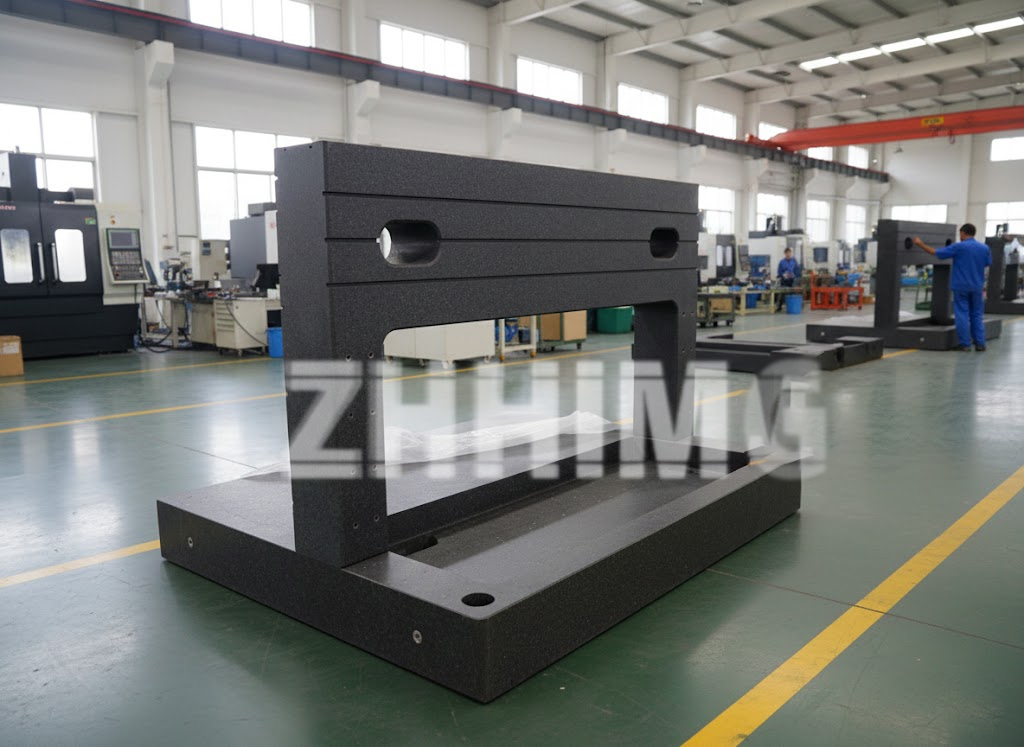
Cast iron typically offers lower initial acquisition costs, especially for custom machine bases and structural components. The lower material and processing costs make cast iron attractive for large-scale manufacturing equipment. However, ongoing maintenance requirements—including rust prevention, wear monitoring, and periodic re-surfacing—contribute to lifecycle costs that can equal or exceed granite over extended periods.
Application-Specific Recommendations
Given the distinct characteristics of each material, certain applications favor one over the other. Making the right choice requires understanding not just the materials themselves but also the specific demands of your measurement processes, production environment, and quality requirements.
Choose granite when:
- Working in temperature-variable environments where thermal predictability matters
- Prioritizing long-term dimensional stability with minimal maintenance
- Operating in laboratory or controlled manufacturing settings
- Working with components requiring measurement across extended periods
- The application involves optical or laser-based measurement systems sensitive to vibration
- Establishing calibration reference standards that will serve for decades
- Conducting dimensional metrology for aerospace and defense applications with stringent traceability requirements
Choose cast iron when:
- Operating in vibration-rich environments where damping is critical
- Prioritizing faster measurement cycle times in high-throughput production
- Working within tightly controlled, climate-managed facilities
- Budget constraints are significant and lifecycle costs favor initial investment
- Custom structural components are required for specialized equipment
- The application involves high-volume production measurement where speed matters
- Building coordinate measuring machines for automotive or heavy manufacturing sectors
Industry surveys and case studies from major manufacturing facilities consistently show that the decision framework above correlates with successful long-term outcomes. Facilities that carefully match material selection to their operational context report fewer measurement-related quality issues and lower equipment maintenance costs over time.
The Hybrid Approach
Modern precision engineering increasingly recognizes that neither material represents a universal solution. Many advanced metrology systems combine materials strategically—for example, using granite for measurement surfaces while employing cast iron or steel for structural elements that benefit from damping. Composite structures using materials like hard stone epoxy can offer compromises between the properties of both traditional options. This approach allows engineers to optimize each component for its specific function rather than forcing a single material to serve conflicting requirements.
Some manufacturers now produce engineered granite composites that incorporate vibration-damping materials within a granite matrix, addressing one of granite’s primary limitations. These composite materials attempt to capture the thermal stability and wear resistance of natural granite while adding the damping characteristics that make cast iron attractive. Early results from these materials show promise, though long-term performance data spanning decades—comparable to what’s available for traditional granite and cast iron—remains limited.
Similarly, advanced cast iron alloys with improved thermal stability are narrowing the gap between traditional material capabilities. These modern alloys incorporate carefully controlled amounts of alloying elements to reduce thermal expansion coefficients while maintaining the beneficial damping properties of cast iron. For new equipment purchases, these advanced materials may offer attractive combinations of properties not available from traditional options.
Making Your Decision
Selecting between granite and cast iron for precision metrology applications requires careful consideration of your specific operational context. Neither material is inherently superior—the optimal choice depends on environmental conditions, measurement requirements, budget parameters, and maintenance capabilities. The consequences of poor material selection can extend far beyond the initial purchase, affecting product quality, customer satisfaction, and manufacturing costs for years to come.
For organizations establishing new metrology facilities or upgrading existing equipment, conducting a thorough analysis of operating conditions often reveals clear advantages for one material over the other. Environmental audits that document temperature variation patterns, vibration sources, and humidity levels provide essential data for material selection. Consulting with metrology equipment manufacturers and referencing industry standards from organizations like ISO and ASME can provide additional guidance tailored to specific applications. Many equipment suppliers offer consultation services that include site assessments to help identify the most suitable material for particular applications.
The most successful precision measurement operations understand that material selection is not a one-time decision but an ongoing consideration that evolves with technology advances, environmental changes, and shifting production requirements. Regular reviews of measurement system performance can reveal when material properties no longer match operational needs, signaling the time for equipment upgrades or modifications. By understanding the fundamental properties and trade-offs of granite and cast iron, professionals can make choices that optimize measurement accuracy, reliability, and cost-effectiveness for their unique circumstances.
Ultimately, both materials have earned their places in precision metrology through decades of reliable service. Your task is to match their capabilities to your requirements—a decision that, when made thoughtfully, pays dividends in measurement confidence and manufacturing quality for years to come. Whether you choose granite, cast iron, or a hybrid approach, the right foundation will support the precision your applications demand.
Post time: May-20-2026