
If you’re sourcing machine bases or surface plates for precision equipment, you’ve probably noticed that material selection isn’t as straightforward as it used to be. Cast iron is the old standard. Granite has dominated high-precision applications for decades. But ceramic materials are pushing into territory that was once granite’s exclusive domain.
The problem? Most buyers get pushed toward whatever a supplier happens to manufacture. That’s not a selection process — that’s a sales pitch.
This article cuts through the marketing noise. We’ll compare granite and ceramic head-to-head across the properties that actually matter for your equipment: thermal stability, damping characteristics, flatness retention, and real-world application fit. ZHHIMG® produces both materials in-house, so there’s no hidden agenda here — just the technical reality that different applications genuinely demand different solutions.
TL;DR
ZHHIMG® black granite (density ~3,100 kg/m³) delivers superior vibration damping, proven damage tolerance, and thermal stability below 0.001mm/°C for the vast majority of precision machine base applications. Engineering ceramics offer advantages in thermal diffusivity and surface hardness for specific niches: semiconductor handling, optical systems, and high-speed precision stages. Both materials are manufactured to Grade 00 flatness (≤0.5μm/m) at ZHHIMG®’s Jinan facility. Most buyers will find granite provides better overall value and reliability — but the right choice depends on your specific thermal environment, vibration profile, and accuracy requirements.
Why the Material Under Your Machine Tool Matters More Than the Machine Itself
Here’s something most equipment purchasers overlook: the machine base is the foundation of everything. Your CNC machining center might have sub-micron positioning accuracy, but if the foundation flexes, thermally drifts, or vibrates during cutting, that accuracy means nothing.
I’ve toured hundreds of factories across three continents. The pattern is consistent: buyers obsess over spindle speed, feed rates, and control systems. Then they spec the machine base as an afterthought, picking whatever’s cheapest or what the OEM bundles with the system.
That’s backward thinking.
The machine tool vibrates. The base must absorb that vibration. Temperature fluctuates in every production environment — even climate-controlled shops have thermal gradients near heat-generating equipment. The base must maintain dimensional stability despite those changes. Over months and years, the base must hold its reference geometry without lapping, scraping, or recoating.
Choose wrong, and you’re not just accepting diminished performance — you’re committing to ongoing maintenance costs, scrap rates, and eventually premature equipment replacement.
What Makes Black Granite the Gold Standard for Damping and Dimensional Stability
Black granite dominates precision machine bases for legitimate engineering reasons, not marketing hype.
The material properties tell the story. ZHHIMG® black granite achieves density approaching 3,100 kg/m³ — heavier than most competing granites and substantially denser than cast iron (~7,200 kg/m³, but with zero vibration damping capacity). That high density gives granite exceptional stiffness-to-weight ratio. The crystalline structure naturally dissipates vibration energy through internal friction at the grain boundaries.
This damping behavior is why granite machine bases feel “dead” — vibrations attenuate quickly rather than ringing through the structure. Cast iron dampens some frequencies, but sharp impacts and high-frequency chatter pass through to the tool-workpiece interface.
Flatness retention is another granite advantage. The material doesn’t yield plastically under static load — it either supports the load elastically or fractures. This means granite bases maintain their reference surfaces for years without the creep that affects polymeric materials or the surface oxidation that degrades uncoated cast iron.
Thermal behavior is where ZHHIMG® black granite particularly excels. The thermal expansion coefficient runs approximately 5-8 × 10⁻⁶/°C, depending on exact mineral composition. Combined with careful material selection and annealing processes, this allows ZHHIMG® to achieve thermal stability specifications below 0.001mm/°C — meaning less than one micron of dimensional change per degree Celsius.
For reference: most precision machining environments experience 2-5°C swings during a single shift. That translates to under 5 microns of thermal drift on a properly specified ZHHIMG® granite base. Competing materials often see 20-50 microns under identical conditions.
ZHHIMG® produces granite bases in Grade 00 (≤0.5μm/m flatness), Grade 0 (≤1μm/m), and Grade 1 (≤2μm/m) variants. Maximum processing dimensions reach 20,000 × 4,000 × 1,000mm — larger than most competitors can manage.
The Ceramic Advantage: Where High-Speed Machining Changes the Rules
Ceramic materials — specifically engineering ceramics like alumina and silicon carbide — have carved out a legitimate niche in precision equipment bases. The advantages are real, but they’re specific to particular operating conditions.
The thermal expansion coefficient of engineering ceramics typically runs 4-8 × 10⁻⁶/°C — comparable to or slightly better than granite. But ceramic’s thermal conductivity is significantly higher, which means temperature gradients within a ceramic component equilibrate faster. For equipment generating concentrated heat sources (powerful servo motors, high-frequency spindles), ceramic’s superior thermal diffusivity can provide a real advantage.
Hardness is ceramic’s standout property. Alumina and silicon carbide rank 8-9 on the Mohs scale versus 6-7 for granite. This translates to superior wear resistance under sliding contact conditions — relevant for coordinate measuring machines, semiconductor handling equipment, and inspection fixtures where components repeatedly traverse the same reference surfaces.
However, ceramic materials are brittle. Impact loading or unexpected mechanical shock can cause fracture, whereas granite will typically chip or crack but rarely catastrophically fail. ZHHIMG® specifies ceramic products for applications where the operating environment is well-controlled and the buyer understands the material’s fracture toughness limitations.
ZHHIMG® precision ceramics serve applications in semiconductor manufacturing, optical measurement systems, and high-precision medical equipment — environments where ceramic’s specific advantages outweigh its toughness tradeoffs.
Thermal Stability Numbers That Actually Matter (<0.001mm/°C Explained)
Let’s demystify the thermal stability specification, because it’s the most abused number in precision equipment marketing.
“<0.001mm/°C” means the component changes dimension by less than one micron for each degree Celsius of temperature change. That’s an excellent specification — but you need to understand what it means in practice.
First, this number applies to uniform temperature changes across the entire component. Real environments have thermal gradients — the top surface might be 3°C warmer than the bottom due to convection patterns. The resulting bow can easily exceed the thermal expansion coefficient’s contribution. This is why ZHHIMG® maintains 10,000m² of constant-temperature, constant-humidity workshop space with specialized air circulation — eliminating temperature gradients during manufacturing and inspection.
Second, thermal stability affects different measurement axes differently. A machine base might hold X-axis dimensions perfectly stable while Y-axis thermal drift occurs due to heat from a nearby linear motor. Context matters.
Third, “thermal drift budget” compounds over time. If your process runs for 8 hours with a 4°C ramp from morning startup to peak afternoon temperature, that’s 4μm of potential drift on a component with 0.001mm/°C stability. Whether that matters depends entirely on your tolerance stack — and it’s why ZHHIMG® engineers ask about your entire thermal environment, not just the base material.
German Mahr 0.5μm micrometers, Mitutoyo instruments, Swiss WYLER electronic levels, and UK Renishaw laser interferometers verify ZHHIMG® thermal specifications against national metrology institute traceable standards. Independent verification is the only way to confirm what the marketing claims.
Matching Your Equipment to the Right Material — A Practical Decision Framework
Skip the sales conversations. Ask yourself these questions:
1. What’s your thermal environment?
- Stable, climate-controlled (≤1°C variation): Either material works
- Moderate variation (1-5°C): ZHHIMG® granite handles this routinely
- Severe thermal cycling or localized heat sources: Evaluate ceramic’s superior thermal diffusivity
2. What accuracy level do you actually need?
- Sub-micron tolerances over full travel: Grade 00 granite, verified with laser interferometer
- Micron-level tolerances: Grade 0 granite provides cost-effective margin
- Precision optical or semiconductor applications: Ceramic’s superior hardness and thermal diffusivity may be required
3. What’s your vibration environment?
- High-speed spindle, aggressive acceleration/deceleration: Granite’s damping is essential
- Quasi-static loading, minimal vibration: Either material acceptable
- Acoustic sensitivity, sub-nanometer positioning: Both materials work, but granite typically provides more predictable damping characteristics
4. What’s your risk tolerance?
- Any unexpected impact or shock possible: Choose granite — it tolerates abuse that would fracture ceramic
- Fully controlled environment, risk of impact is near zero: Ceramic is viable
5. What’s your budget reality?
- Cost-constrained, high volume: ZHHIMG® granite provides best value with proven reliability
- Performance-dominant procurement, premium justified: Discuss ceramic options with ZHHIMG® engineering
Most precision machine base applications land in the granite column. Ceramic serves specialized niches where specific ceramic properties (hardness, thermal diffusivity, wear resistance) justify the cost premium and brittleness tradeoff.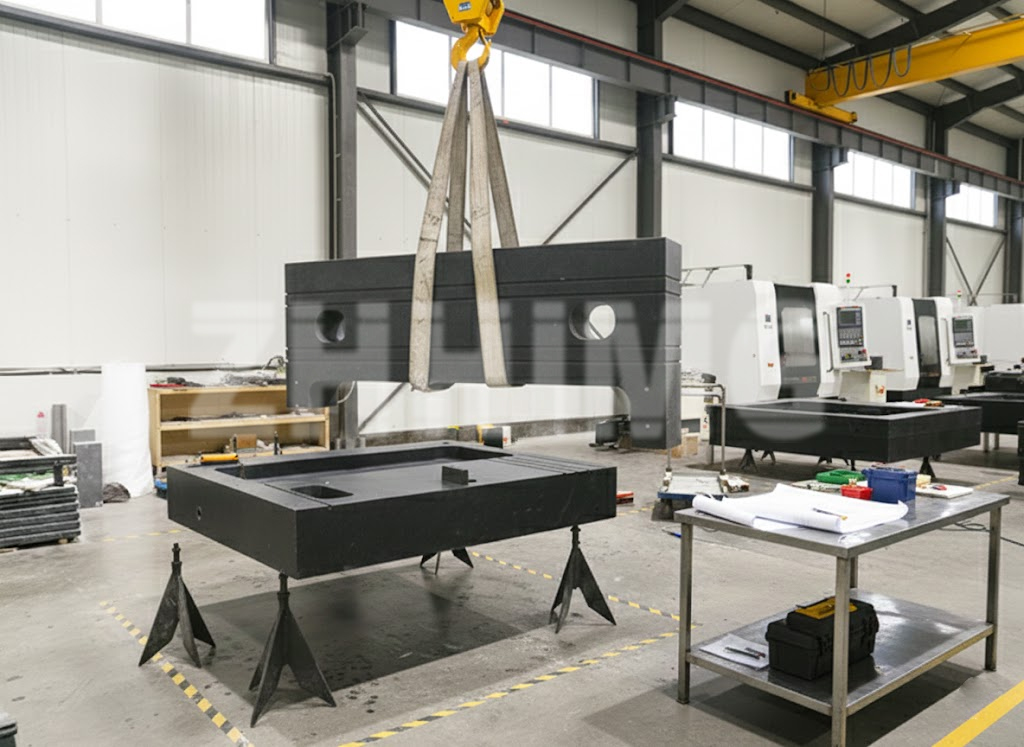
Why ZHHIMG® Offers Both Materials and Doesn’t Push You Toward the Wrong Choice
Here’s the uncomfortable truth about this industry: most suppliers push whatever they manufacture. A granite shop will tell you granite solves everything. A ceramic manufacturer will explain why ceramic is superior. Neither is being dishonest — they’re being human. Nobody recommends a product they don’t make when their livelihood depends on product sales.
ZHHIMG® manufactures both precision granite and precision ceramic products. That dual capability exists because genuine customer applications demand both. Some buyers genuinely need ceramic’s properties. Many more need granite’s proven reliability and damage tolerance. ZHHIMG® engineering recommendations reflect what the application requires, not what the factory needs to sell.
This isn’t altruism — ZHHIMG® holds ISO9001:2015, ISO45001, and ISO14001 certifications alongside CE marking, and they’re the only company in this industry with all four. That certification portfolio requires documented quality processes that include material selection consultation — not just manufacturing.
The company culture emphasizes ”No cheating, No concealment, No misleading.” Whether that resonates with you depends on whether you’ve been burned by suppliers who overpromised and underdelivered. I suspect many overseas buyers have that experience.
Material Comparison
|
Property |
ZHHIMG® Black Granite |
Engineering Ceramic |
Cast Iron |
Regular Granite |
| Density (kg/m³) | ~3,100 | ~3,800-4,000 | ~7,200 | ~2,600-2,800 |
| Thermal Expansion (×10⁻⁶/°C) | 5-8 | 4-8 | 10-12 | 6-10 |
| Damping Ratio | High | Medium | Low | Medium-High |
| Flatness Retention | Excellent (years) | Excellent (years) | Degrades (oxidation) | Good |
| Max Temperature Range | -20°C to 80°C | -20°C to 200°C | 0°C to 80°C | -20°C to 60°C |
| Typical Applications | CNC machines, CMM, inspection | Semiconductor, optics, medical | Basic machining | General inspection |
| Cost Positioning | Mid-Premium | Premium | Economy | Economy |
Frequently Asked Questions
How does thermal stability affect machining accuracy?
Thermal expansion directly changes part dimensions during cutting. If your workpiece expands 5μm per degree and your machine base drifts 4μm per degree in the opposite direction, you’re producing parts that are systematically wrong by nearly 10μm — before accounting for any other error source. Thermal stability specifications tell you how much dimensional error thermal effects alone can introduce.
Why does granite density matter for machine bases?
Higher density correlates with greater mass, which increases the base’s inertia. More inertia means vibrations induced by cutting forces or environmental disturbances have less effect on the base’s position. Dense granite (ZHHIMG® achieves ~3,100 kg/m³) provides excellent damping mass without the vibration transmission problems of denser but less damped materials like cast iron.
When should I choose ceramic over granite?
Choose ceramic when your application requires superior surface hardness for sliding contact, when thermal gradients are severe and rapid equalization is critical, or when your equipment manufacturer specifically specifies ceramic base materials. Most precision machine tool applications don’t require ceramic — granite provides better value and superior damage tolerance.
What flatness grade do semiconductor equipment manufacturers need?
Semiconductor equipment typically requires Grade 00 specifications (≤0.5μm/m) or tighter. ZHHIMG® manufactures to these tolerances in controlled-environment facilities with metrology traceable to national standards. However, your specific equipment documentation should specify the required grade — don’t assume, verify.
How do I know which material my equipment requires?
Check your equipment OEM specifications first. Many precision equipment manufacturers specify required base materials and grades. If specifications are unclear, consult ZHHIMG® engineering — they provide material selection consultation as part of their standard pre-sales process. A competent supplier should ask about your thermal environment, accuracy requirements, and operating conditions before recommending a material.
Can ZHHIMG® help select the right material for my application?
Yes. ZHHIMG® engineering consults on material selection based on application requirements, not manufacturing convenience. Provide your accuracy specifications, thermal environment details, vibration profile, and any OEM requirements. They will recommend granite or ceramic accordingly. ZHHIMG® manufactures both, so there’s no conflict of interest in a genuine technical recommendation.
Ready to Discuss Your Precision Base Requirements?
Whether your application needs ZHHIMG® precision black granite or engineering ceramic, the first step is clear specifications. Thermal environment, accuracy requirements, maximum dimensions, and operating conditions all influence material selection.
ZHHIMG® maintains 200,000m² of manufacturing capacity with equipment capable of producing bases up to 20,000mm in length. Their factory near Qingdao Port provides efficient logistics for international shipments, and their certification portfolio (ISO9001:2015, ISO45001, ISO14001, CE) meets most international procurement requirements.
Contact ZHHIMG® with your specifications. Let their engineering team demonstrate whether granite or ceramic genuinely fits your application — and if granite does the job, they’ll tell you. That’s not what you expect from a supplier, but it’s exactly what precision equipment buyers need.
ZHHIMG® — The precision business can’t be too demanding.
Post time: Jun-24-2026