
When sourcing granite surface plates, granite bases, or precision granite components for metrology and semiconductor equipment, one question comes up again and again: what’s the real difference between granite and marble, and does it actually matter?
The short answer: yes, it matters a great deal. In ultra-precision manufacturing, the material you choose directly affects measurement accuracy, long-term stability, and the service life of your equipment.
The Core Difference: Density and Stability
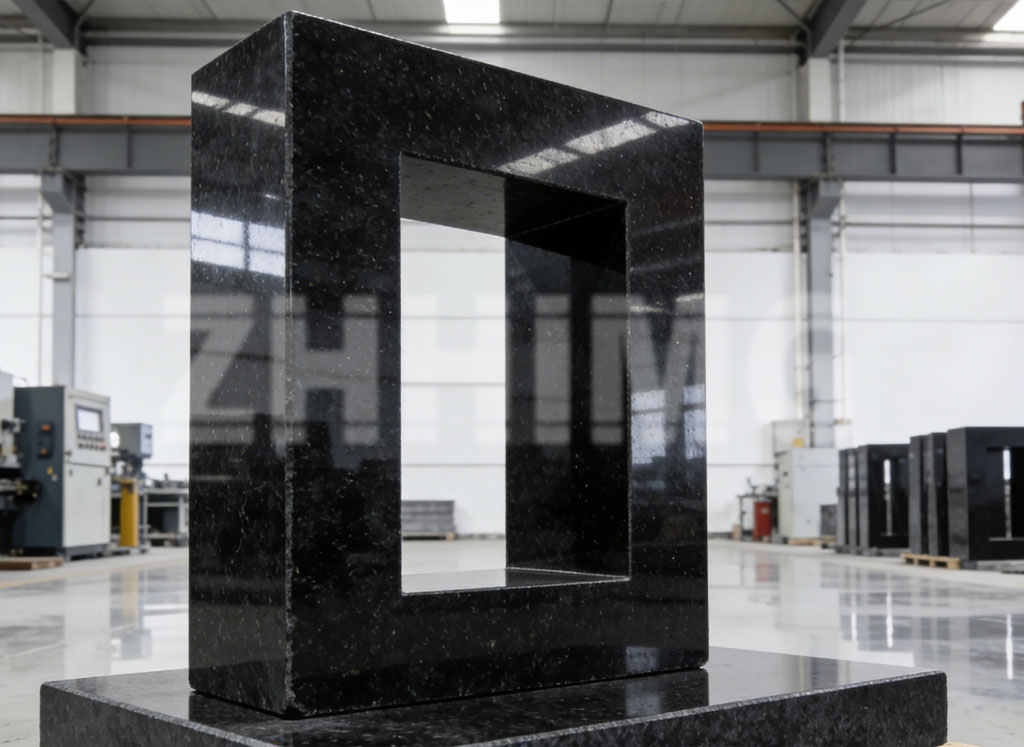
Precision-grade black granite typically has a density of approximately 3,100 kg/m³, with a fine, uniform crystalline structure. This high density gives it excellent dimensional stability, low thermal expansion, and strong vibration damping — all critical properties for metrology bases, CMM frames, semiconductor inspection platforms, and precision assembly fixtures.
Marble, by contrast, is a metamorphic rock with a more variable internal structure. Its density is generally lower, and its composition can include veins, voids, and inconsistent grain patterns. Under temperature changes or mechanical load, marble is more prone to micro-deformation — something that is simply unacceptable in nanometer-level measurement environments.
Why Some Suppliers Still Use Marble
The reason is straightforward: cost. Marble is cheaper to source and easier to machine. For decorative applications or low-precision uses, that may be acceptable. But when a component serves as the reference plane for a coordinate measuring machine, an AOI inspection system, or a laser interferometer setup, “close enough” is never good enough.
Using marble in place of precision granite is not a matter of grade — it is a matter of material suitability. A surface plate made from marble may look similar at first glance, but its flatness will drift faster, its response to temperature changes will be less predictable, and its long-term calibration stability will be inferior.
What to Look for in Precision Granite
Not all granite is created equal. For precision components, the following characteristics are essential:
- High density — around 3,100 kg/m³ or above, ensuring rigidity and vibration resistance.
- Uniform grain structure — no visible veins, cracks, or soft spots.
- Low moisture absorption — to prevent dimensional change over time.
- Stable thermal behavior — minimal expansion or contraction under normal workshop conditions.
- Proven traceability — calibration results should be traceable to national metrology standards.
At ZHHIMG®, all precision granite components are manufactured from high-density black granite selected specifically for metrology-grade performance. Every surface plate, granite base, granite square ruler, and air-bearing substrate is processed and inspected under controlled environmental conditions.
Where Precision Granite Is Used
Precision granite components are found across some of the most demanding industries:
- Semiconductor inspection and lithography support structures
- Coordinate measuring machines and optical measuring systems
- PCB drilling and laser processing equipment
- Precision CNC machine bases and linear motor platforms
- Metrology laboratories and national standards institutions
- Lithium battery inspection, AOI systems, and industrial CT equipment
In each of these applications, the granite component is not just a structural part — it is the foundation of measurement accuracy.
How to Verify Material Quality
If you are evaluating suppliers, consider asking:
- What is the actual density of the granite used?
- Can you provide material certification or test reports?
- What calibration standards are applied — DIN 876, JIS, GB, or others?
- Is flatness verified with traceable metrology equipment?
- Are components processed in a temperature-controlled environment?
These questions help separate precision manufacturers from general stone fabricators.
The Bottom Line
For decorative countertops or architectural cladding, marble has its place. For precision measurement bases, surface plates, granite air bearings, and metrology components, high-density precision granite is the only serious choice.
The difference is not just in appearance. It is in density, stability, repeatability, and the confidence that your measurement reference will remain accurate over time.
Need precision granite components, granite surface plates, or custom granite bases for metrology and semiconductor equipment? Visit www.zhhimg.com to explore ZHHIMG® precision granite solutions.
Post time: Nov-12-2026