
Introduction: Choosing the Right Material Is the First Step Toward Precision
In precision engineering, every micron matters.
Whether it is a coordinate measuring machine (CMM), semiconductor inspection system, optical measurement platform, or ultra-precision assembly equipment, the accuracy of the final system depends on many factors — including sensors, software, mechanical design, environmental control, and most importantly, the stability of the foundation material.
One common question in the precision manufacturing industry is:
What is the difference between granite and marble, and can marble be used as a replacement for precision granite?
Although granite and marble are both natural stones, they have completely different geological structures and physical characteristics.
For applications requiring long-term accuracy, vibration control, and dimensional stability, precision granite has become the preferred material worldwide.
Understanding the difference between granite and marble is essential for anyone involved in precision measurement, machine manufacturing, and advanced industrial equipment.
Granite and Marble: Different Materials with Different Properties
At first glance, granite and marble may look similar because both are natural stones. However, their internal structures are fundamentally different.
Granite: An Igneous Rock Designed by Nature for Stability
Granite is an igneous rock formed through the cooling and solidification of molten materials deep inside the Earth.
Its main components include:
- Quartz
- Feldspar
- Mica
- Other stable minerals
The interlocking crystalline structure gives granite:
- High hardness
- Excellent wear resistance
- Low deformation
- Strong structural stability
These properties make granite highly suitable for precision engineering applications.
Marble: A Metamorphic Rock with Different Characteristics
Marble is a metamorphic rock mainly composed of recrystallized calcite.
It is widely used in:
- Architecture
- Interior decoration
- Sculptures
- Decorative applications
However, marble has different physical characteristics from granite:
- Lower hardness
- Higher chemical sensitivity
- Different thermal behavior
- Lower long-term dimensional stability
While marble is an excellent decorative material, it is generally not the preferred choice for ultra-precision measurement structures.
Why Precision Industries Prefer Granite Over Marble
Precision manufacturing requires materials that remain stable under changing environmental conditions.
The main reasons precision granite is preferred include:
1. Higher Density and Better Structural Stability
Density is one of the important indicators of material performance.
High-density materials generally provide:
- Better stiffness
- Improved vibration damping
- Higher resistance to deformation
ZHHIMG® uses specially selected ZHHIMG® Black Granite for ultra-precision applications.
The material density reaches approximately:
3100 kg/m³
This high-density structure provides excellent support for:
- Granite surface plates
- CMM bases
- Precision machine bases
- Inspection platforms
Compared with lower-performance stone materials, high-quality precision granite provides more reliable long-term stability.
2. Superior Vibration Damping Capability
Modern precision equipment operates at extremely high accuracy levels.
Small vibrations from:
- Motors
- Linear drives
- Factory environments
- Mechanical movement
can influence measurement results.
One of granite’s most valuable properties is its natural vibration damping ability.
The internal crystalline structure of granite allows it to absorb vibration energy effectively.
This is why granite is commonly used for:
- CMM machine bases
- Optical inspection systems
- Semiconductor equipment platforms
- Precision assembly stations
A stable foundation allows sensitive measurement systems to operate more reliably.
3. Better Thermal Stability for Precision Measurement
Temperature variation is one of the biggest challenges in precision engineering.
All materials expand and contract when temperature changes.
However, the amount of deformation and the speed of thermal response are critical factors.
Precision granite provides excellent thermal stability, helping reduce measurement errors caused by environmental fluctuations.
For applications such as:
- Calibration laboratories
- Metrology rooms
- Semiconductor equipment
- Optical systems
maintaining stable geometry is essential.
A granite surface plate that maintains accuracy over time becomes a reliable reference standard for measurement.
4. Superior Surface Performance
Precision measurement requires extremely flat and stable reference surfaces.
Granite surface plates are manufactured through advanced grinding and finishing processes to achieve:
- High flatness
- Low surface roughness
- Excellent wear resistance
They are widely used as:
- Measurement references
- Calibration platforms
- Assembly surfaces
- Inspection foundations
The performance of a surface plate directly affects measurement reliability.
Can Marble Replace Precision Granite?
The simple answer is:
For decorative applications, marble is excellent.
For ultra-precision measurement applications, granite is the preferred choice.
The reason is not appearance, but engineering performance.
A precision measurement platform requires:
- Long-term stability
- Predictable material behavior
- High wear resistance
- Low deformation
- Reliable calibration performance
These requirements are why international standards for precision measurement commonly specify granite as the reference material.
Using unsuitable materials may create hidden problems:
- Reduced measurement accuracy
- Frequent recalibration
- Equipment instability
- Increased maintenance costs
The initial material cost may appear lower, but the long-term impact on precision performance can be significant.
The Importance of True Precision Granite Quality
Even within granite materials, quality differences exist.
Not every granite block is suitable for precision engineering.
Important factors include:
Mineral Composition
Different mineral structures affect:
- Hardness
- Stability
- Machining performance
Material Density
Higher density generally improves:
- Rigidity
- Vibration resistance
- Long-term stability
Internal Stress
Raw stone must be carefully selected and processed.
Internal stress may cause:
- Deformation
- Cracking
- Accuracy changes over time
Precision Manufacturing Process
Producing a precision granite component requires more than cutting stone.
It involves:
- Material selection
- Rough machining
- Aging treatment
- Precision grinding
- Surface finishing
- Accuracy inspection
Why ZHHIMG® Uses Dedicated Precision Granite Materials
At ZHHIMG® (Zhonghui Group), precision granite is not treated as ordinary stone processing.
It is considered an engineered material for ultra-precision applications.
ZHHIMG® Black Granite is specially selected for:
- High density
- Excellent stability
- Superior mechanical performance
The company focuses on manufacturing:
- Precision granite components
- Granite machine bases
- Granite surface plates
- Granite measuring tools
- Granite air bearing structures
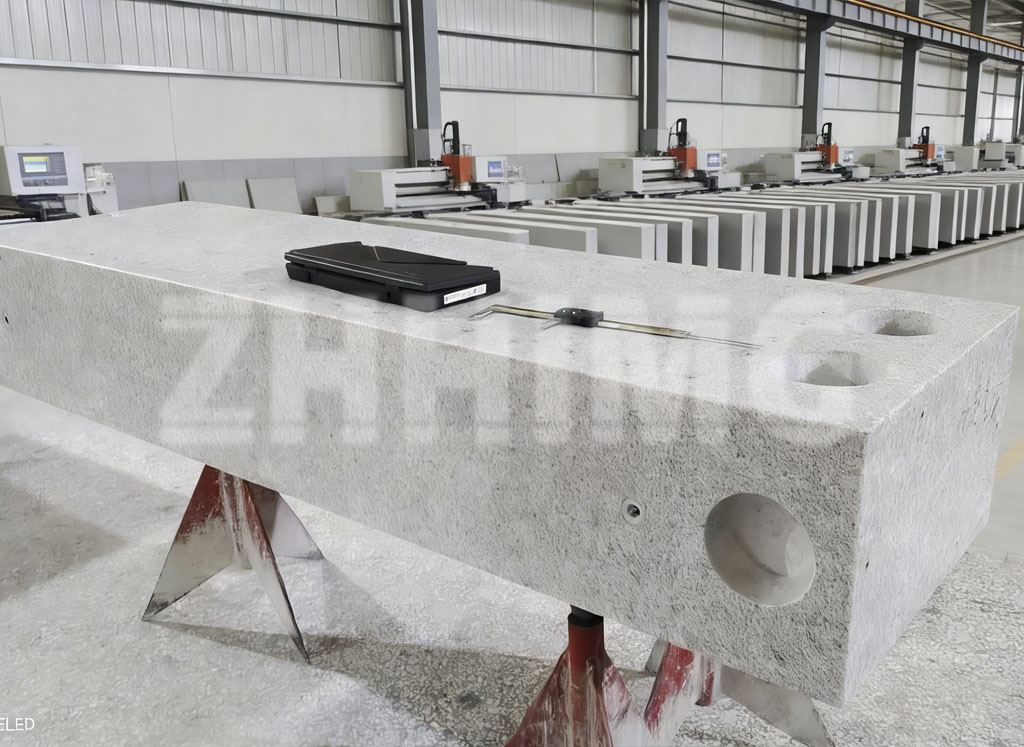
With large-scale manufacturing capability, ZHHIMG® can process large precision granite structures for advanced industrial applications.
The company’s production capabilities include machining:
- Single components up to 100 tons
- Lengths up to 20 meters
- Widths up to 4000 mm
These capabilities support demanding applications in semiconductor, metrology, automation, and precision equipment industries.
Applications Where Precision Granite Is Essential
Coordinate Measuring Machines (CMM)
Granite bases provide:
- Stable reference geometry
- Low vibration transmission
- Long-term measurement accuracy
Semiconductor Manufacturing Equipment
Precision granite supports:
- Wafer inspection systems
- Precision positioning platforms
- Advanced manufacturing equipment
Optical and Laser Systems
Applications include:
- Laser measurement systems
- Optical inspection platforms
- High-resolution imaging equipment
Calibration Laboratories
Granite surface plates are widely used for:
- Dimensional inspection
- Equipment calibration
- Precision assembly
Industry Trend: Higher Accuracy Requires Better Materials
Manufacturing industries are continuously moving toward smaller tolerances.
The development of:
- Semiconductor technology
- Artificial intelligence hardware
- Precision robotics
- Advanced optical systems
- New energy equipment
requires higher mechanical stability.
As precision requirements increase, material selection becomes even more important.
The foundation material is no longer a simple structural component — it is a key factor determining the final accuracy of the entire system.
Conclusion: Precision Granite Is More Than Just Stone
Granite and marble may both come from nature, but their engineering applications are completely different.
Marble is an excellent decorative material, while precision granite is an engineered foundation material designed for accuracy, stability, and reliability.
For precision measurement systems, CMM equipment, semiconductor manufacturing, and advanced industrial applications, choosing the correct material is essential.
The difference between granite and marble is not only about appearance.
It is about:
- Accuracy
- Stability
- Reliability
- Long-term performance
At ZHHIMG®, we believe:
Precision begins with the right material.
Post time: Jul-14-2026