
Introduction: The Foundation of Precision Starts with Material Selection
In ultra-precision manufacturing, achieving high accuracy is not only determined by advanced machining technology or sophisticated control systems. The foundation of every precision system begins with one fundamental factor: material stability.
As industries such as semiconductor manufacturing, optical inspection, precision measurement, and advanced automation continue to demand higher accuracy, traditional engineering materials face increasing challenges. Thermal deformation, vibration transmission, and long-term dimensional instability have become critical limitations in precision equipment design.
This is why precision granite has become an essential structural material for many high-performance industrial applications.
From semiconductor inspection equipment and coordinate measuring machines (CMMs) to laser processing systems and precision motion platforms, granite components provide the stable foundation required for micron-level and even nanometer-level precision.
What Is Precision Granite?
Precision granite refers to specially selected and processed natural granite materials that are manufactured according to strict dimensional accuracy and surface quality requirements.
Unlike ordinary construction granite or decorative stone, precision granite is engineered for applications where mechanical stability and measurement accuracy are critical.
A high-quality precision granite component typically requires:
- Carefully selected raw granite blocks
- Controlled material properties
- Precision machining processes
- Advanced surface grinding technology
- Strict dimensional inspection
- Long-term stability verification
The purpose of using precision granite is not simply to create a strong structure, but to provide a reliable reference platform that maintains accuracy over many years of operation.
Why Semiconductor Equipment Requires Precision Granite
The semiconductor industry represents one of the highest levels of manufacturing precision in the world.
Modern semiconductor equipment involves:
- Extremely small feature sizes
- High-speed motion systems
- Advanced optical inspection
- Precise positioning mechanisms
- Strict environmental control requirements
Even a small amount of structural deformation can influence equipment performance.
For example, thermal expansion caused by temperature changes may affect:
- Wafer positioning accuracy
- Inspection results
- Alignment systems
- Motion repeatability
As semiconductor processes continue moving toward smaller geometries, equipment manufacturers increasingly rely on materials with excellent dimensional stability.
Precision granite provides several key advantages:
1. Excellent Dimensional Stability
One of the most important characteristics of precision granite is its ability to maintain dimensional accuracy over time.
Compared with many metal structures, granite has a lower thermal expansion response and excellent resistance to environmental changes.
This makes granite particularly suitable for:
- Semiconductor manufacturing equipment
- Optical measurement systems
- Precision inspection machines
- CMM structures
- Laser processing platforms
A stable base structure reduces the risk of accuracy loss caused by temperature fluctuations.
For ultra-precision equipment manufacturers, long-term stability is often more important than initial machining accuracy.
A component that achieves high accuracy today but loses stability after several years cannot meet the requirements of advanced manufacturing.
2. Superior Vibration Damping Performance
Precision equipment is extremely sensitive to vibration.
External vibration sources may include:
- Machine operation
- Factory environments
- Motors and motion systems
- Nearby production equipment
Even microscopic vibration can affect measurement results and positioning accuracy.
Granite naturally provides excellent vibration damping characteristics due to its material structure.
Compared with many metal alternatives, granite can absorb vibration energy more effectively, helping equipment maintain stable operation.
This is why granite bases are widely used in:
- Coordinate measuring machines (CMM)
- Precision inspection equipment
- Optical systems
- Semiconductor inspection platforms
- Precision motion stages
A stable granite structure allows sensors and motion systems to perform at their designed accuracy.
3. High Rigidity and Load-Bearing Capability
Precision equipment often requires large structural components that must support heavy loads while maintaining accuracy.
Modern granite manufacturing technology allows manufacturers to produce:
- Large granite bases
- Granite beams
- Granite bridge structures
- Custom granite components
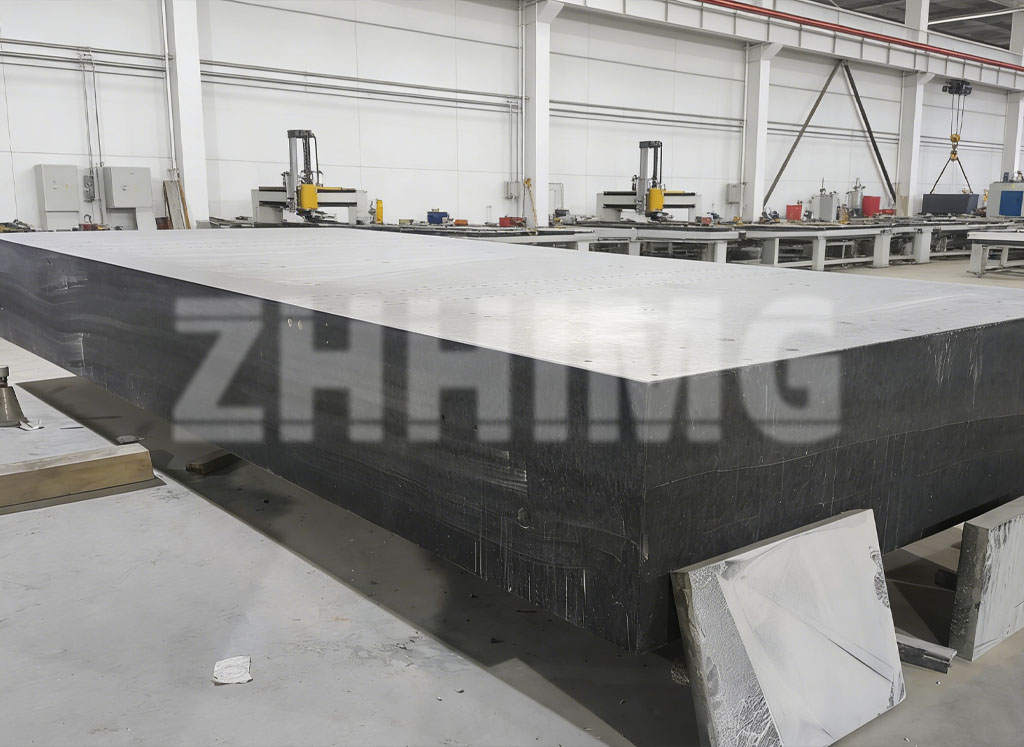
For example, advanced precision granite manufacturers can process extremely large components for industrial applications.
ZHHIMG® (Zhonghui Group) has developed large-scale manufacturing capabilities that allow machining of single granite components with:
- Weight up to 100 tons
- Length up to 20 meters
- Width up to 4000 mm
- Thickness up to 1000 mm
Such capabilities enable granite structures to be used in increasingly large and complex precision systems.
4. Granite Provides Long-Term Accuracy Retention
In precision engineering, repeatability and long-term reliability are critical.
A machine base is not simply a support structure. It is the reference foundation for the entire system.
If the base changes over time, every component mounted on it may experience accuracy deviations.
High-quality precision granite offers:
- Excellent wear resistance
- Stable mechanical properties
- Low maintenance requirements
- Long service life
For industries investing millions of dollars in advanced equipment, maintaining accuracy over decades creates significant economic value.
Precision Granite vs Metal Structures
Metal materials such as steel and aluminum remain important in industrial manufacturing. However, for certain ultra-precision applications, granite offers unique advantages.
| Performance Requirement | Precision Granite | Traditional Metal |
|---|---|---|
| Thermal stability | Excellent | Depends on alloy and environment |
| Vibration damping | Excellent | Generally lower |
| Long-term stability | Excellent | Can experience stress deformation |
| Corrosion resistance | Natural resistance | Requires protection |
| Precision reference applications | Widely used | Limited in some applications |
The selection between granite and metal depends on the specific engineering requirements.
For precision measurement and ultra-stable equipment structures, granite continues to be one of the preferred materials worldwide.
The Importance of Granite Quality in Precision Applications
Not all granite materials are suitable for precision manufacturing.
A common misunderstanding in the market is considering all dark-colored stones as equivalent precision granite.
However, material characteristics can vary significantly depending on:
- Mineral composition
- Density
- Internal structure
- Processing quality
- Long-term stability
For ultra-precision applications, selecting the correct granite material is essential.
ZHHIMG® uses specially selected ZHHIMG® Black Granite, featuring:
- High density
- Excellent stability
- Superior mechanical properties
The density of ZHHIMG® black granite reaches approximately:
3100 kg/m³
This provides excellent structural stability for demanding precision applications.
Some low-cost manufacturers use inferior stone materials or even marble-like materials while marketing them as precision granite. Such practices may reduce initial cost but can negatively affect equipment accuracy and reliability.
At ZHHIMG®, material authenticity and engineering performance are fundamental principles:
No cheating.
No concealment.
No misleading.
Precision Granite Applications in Modern Industry
Today, precision granite components are widely used across multiple advanced industries.
Semiconductor Equipment
Applications include:
- Wafer inspection equipment
- Semiconductor testing systems
- Precision positioning platforms
- Lithography-related equipment structures
Coordinate Measuring Machines (CMM)
Granite is widely used for:
- CMM bases
- Granite guide rails
- Precision reference structures
Its stability helps ensure accurate measurement results.
Optical and Laser Systems
Applications include:
- Laser processing equipment
- Optical inspection systems
- High-precision imaging systems
Automation and Motion Control
Precision granite components are also used in:
- Linear motor platforms
- XY stages
- Precision assembly equipment
- Industrial inspection systems
The Future of Precision Granite in Ultra-Precision Manufacturing
As industries continue developing toward higher automation and smaller manufacturing tolerances, the demand for stable precision structures will continue increasing.
Future trends include:
- Higher accuracy semiconductor equipment
- More advanced metrology systems
- Larger precision structures
- Integrated automation platforms
- Increased demand for thermal stability
Precision granite will continue playing an important role as a foundation material for next-generation manufacturing technologies.
Conclusion: Precision Begins with a Stable Foundation
Ultra-precision manufacturing is a system where every component matters.
Advanced software, sensors, and control systems cannot achieve their full potential without a stable mechanical foundation.
Precision granite provides the combination of:
- High dimensional stability
- Excellent vibration damping
- Long-term accuracy retention
- Reliable structural performance
For semiconductor equipment manufacturers, metrology companies, and precision engineering organizations, choosing the right granite component supplier is a critical decision.
With advanced manufacturing capabilities, strict quality management systems, and decades of precision engineering experience, ZHHIMG® continues to support global industries in developing more accurate, reliable, and advanced manufacturing solutions.
The future of precision starts with the right foundation.
Post time: Jul-14-2026