
Selecting a machine base is rarely a simple material decision. The base influences geometric stability, vibration behavior, thermal response, assembly strategy, maintenance, and ultimately the confidence an operator has in the measurement or machining result.
For global engineering purchasers, quality managers, and laboratory technicians, natural granite and mineral casting are two serious options for precision machine structures. Both can outperform conventional fabricated steel or cast iron in selected applications. They are not interchangeable, however. The right choice depends on whether the equipment is primarily a stable measurement platform, a dynamic machine tool, a complex automation system, or a hybrid assembly with demanding integration requirements.
At ZHHIMG®, we manufacture both precision granite components and mineral-casting structures. In practical project discussions, the most useful question is not “Which material is better?” It is: “What errors must this machine base prevent?”
Natural Granite: A Stable Physical Reference
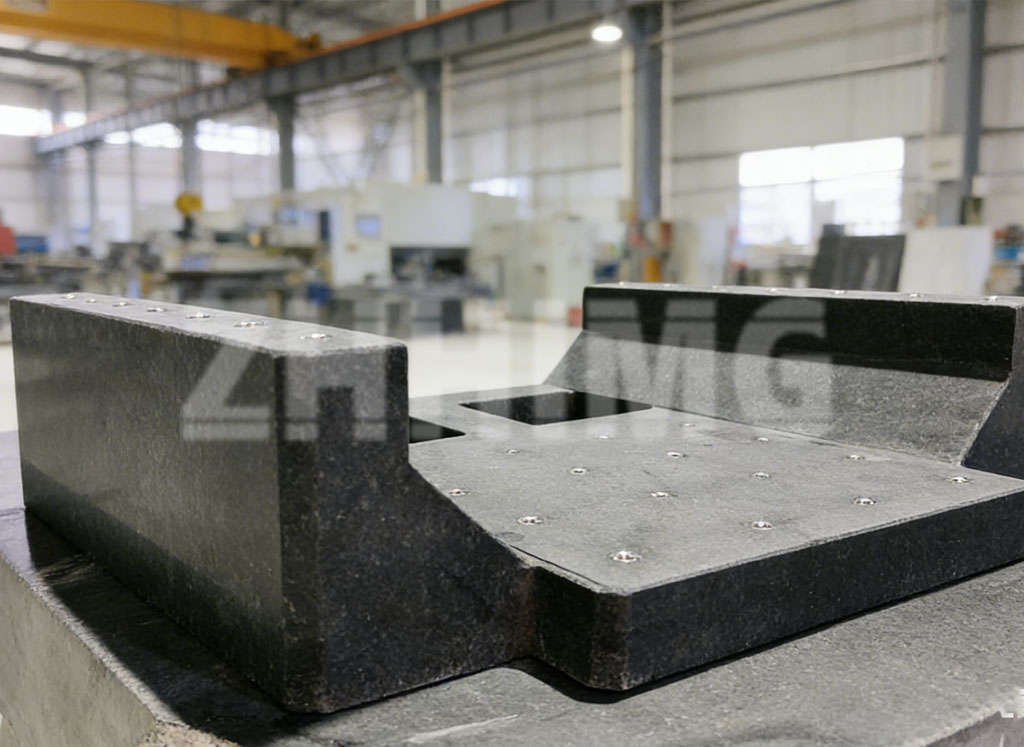
A granite machine base is machined from a natural stone block, then ground and lapped to create reference surfaces. Its appeal comes from long-term dimensional stability, corrosion resistance, electrical insulation, non-magnetic behavior, and favorable thermal characteristics.
For metrology equipment, granite often becomes the preferred starting point because it can provide a highly stable datum surface. Coordinate measuring machines, optical inspection platforms, laser equipment, precision assembly fixtures, guideway measurement systems, and calibration stations frequently benefit from this approach.
Granite’s low thermal conductivity means it does not respond quickly to short-term ambient temperature changes. That can be useful in a controlled inspection environment, where the objective is to reduce rapid thermal disturbance rather than chase fast temperature equalization. Natural granite is also free from the residual stresses associated with welding and many metal casting processes. A carefully selected and properly processed block can therefore provide a stable structural foundation over a long service period. Industry discussions on precision grinding-machine construction similarly highlight granite’s low thermal expansion, low heat conduction, and inherent damping as important design factors.
There are practical limits. Granite is a natural material, so block quality, mineral composition, internal integrity, density, and machining experience matter. A drawing that requires complex internal passages, thin ribs, numerous embedded interfaces, or unusual shapes may become costly or difficult to manufacture from a solid stone block. Large granite structures also require thoughtful lifting, support, transport, and installation planning.
In our production work, the most successful granite-base projects begin with a detailed review of the support layout and assembly interfaces—not only the overall length, width, and height. A very accurate surface is of little value if the installed machine is supported incorrectly or constrained by poorly designed metal interfaces.
Mineral Casting: Flexibility Built into the Structure
A mineral casting machine base, sometimes called an epoxy granite machine base or polymer concrete base, is a composite formed from graded mineral aggregates and a polymer-resin binder. It is cast into a mold rather than cut from one natural block.
This manufacturing route gives designers more freedom. Features such as cable channels, cooling passages, machine cavities, mounting points, reinforcement elements, and embedded inserts can be incorporated into the structure at the design stage. For a complex CNC machine, automated production cell, battery-testing system, or high-speed handling platform, this can reduce secondary machining and simplify final assembly.
Damping is another major reason buyers consider mineral casting. The polymer matrix can absorb vibration energy effectively, particularly in dynamically loaded machinery. A published study comparing an epoxy-granite foundation with cast iron in a vertical machining-center context reported substantially higher damping for the epoxy-granite design; the result should not be treated as a universal material ratio, since geometry and boundary conditions strongly affect machine behavior.
Mineral casting still requires disciplined engineering. Aggregate grading, resin system, resin content, compaction method, curing process, insert design, mold accuracy, and post-machining all influence the final result. Thermal expansion is formulation-dependent, so it should be evaluated alongside the thermal expansion of rails, steel inserts, motors, and other attached components. A material data sheet alone cannot replace system-level thermal analysis.
A Practical Selection Guide
| Selection factor | Natural granite machine base | Mineral casting machine base |
|---|---|---|
| Best-fit applications | Metrology, CMMs, optical inspection, calibration, stable precision platforms | CNC equipment, automation, high-speed systems, complex integrated structures |
| Geometry | Best for solid, relatively simple forms and precision reference surfaces | Strong flexibility for ribs, cavities, inserts, channels, and formed features |
| Thermal behavior | Often selected for long-term dimensional stability in controlled environments | Must be evaluated by formulation and interaction with embedded components |
| Vibration behavior | Good inherent damping and high mass | Often selected where enhanced damping and dynamic energy absorption are priorities |
| Embedded interfaces | Normally added through machining and assembly | Can be cast in, then finish-machined where required |
| Design consideration | Material selection, machining, support points, transport | Mold design, curing, inserts, aggregate/resin process control |
The Decision Is Usually Application-Led
Choose a precision granite machine base when the machine needs a stable, corrosion-resistant physical reference with carefully finished surfaces and minimal long-term geometric drift. This is particularly relevant for metrology platforms, high-accuracy inspection equipment, and assemblies operating in temperature-controlled rooms.
Choose a mineral casting machine base when the structure needs integrated functionality: internal routing, numerous inserts, complicated external geometry, or strong vibration absorption in a dynamic operating cycle. It is often attractive for equipment builders seeking to consolidate several assembled parts into one engineered structure.
Some projects combine both materials. A mineral-cast frame may carry precision granite rails, plates, or measuring references. This hybrid method can balance structural integration with the highly finished surfaces required for critical measurement or motion interfaces.
The material should be selected only after reviewing load cases, target accuracy, operating temperature, vibration spectrum, interface design, installation method, and verification plan. Purchasers should ask suppliers how straightness, flatness, insert position, support conditions, and final assembly geometry will be measured—not simply request a general “high-precision” claim.
ZHHIMG® supports this engineering review with custom granite components, granite machine bases, mineral casting structures, precision machining, and inspection-oriented assembly solutions. For a meaningful comparison, send your drawing, application, required tolerances, load information, and working environment. The right base is the one that makes the finished machine more predictable, not merely the one with the most impressive material description.
Post time: Aug-11-2026