
Granite vs. Mineral Casting vs. Steel Welded Beds: Which is Best for Ultra-Precision Machine Bases?
Every engineer who has specified an ultra-precision machine base has faced the same three-way decision: natural granite, mineral casting, or a steel welded structure. The answer decides not only the price of the machine but its accuracy ceiling, its thermal behaviour, and how it will perform five years from now. This guide walks through the decision the way a design review should: material by material, property by property, with honest attention to where each option wins and where it fails.
One point needs to be made at the start, because it affects everything downstream: not every dark stone sold as “granite” is granite. A market segment of low-cost suppliers substitutes black marble and similar soft stones for precision granite, and the substitution is invisible on a polished surface. We will come back to how to protect yourself from that later in this article, because it is a purchasing risk, not a marketing claim.
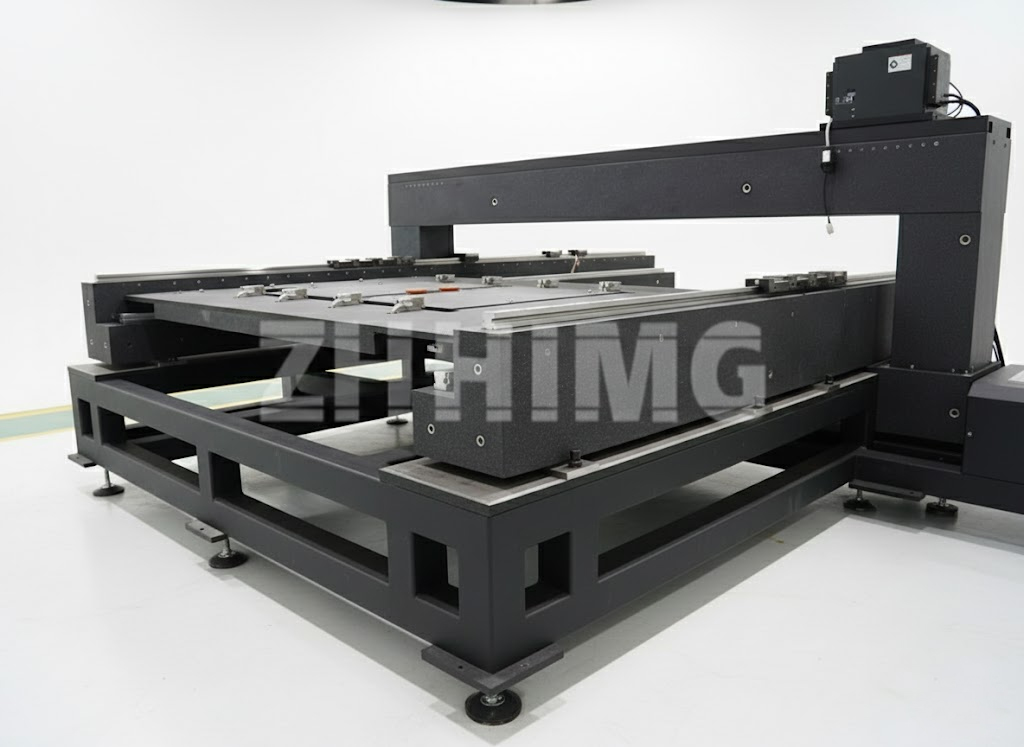
What an ultra-precision base must actually do
A base for semiconductor metrology equipment, a CMM or a precision CNC machine has four jobs. It must hold the geometry of everything mounted on it, which means its own shape must not change. It must not amplify vibration from the floor, the drives or the process. It must not deform under its own weight or the moving mass of the axes. And it must do all of this for the service life of the machine, in an environment whose temperature is controlled but never perfectly constant.
Each of the three candidate materials addresses these jobs differently, and the differences are quantifiable: density, elastic modulus, thermal expansion coefficient, damping capacity and dimensional stability. That is why a serious supplier talks in numbers, not adjectives.
Natural black granite: density and stability as a material fact
Black granite is the densest of the three candidates. Our own precision black granite is specified at approximately 3,100 kg/m³ — a figure that comes from the material data sheet supplied with our components, based on density testing of the actual stone, and which we are happy to have customers verify against the delivered report. Density at this level matters for three reasons: the stone’s crystal structure is fully compacted, its stiffness per unit volume is high, and its internal damping of vibration is a physical property of the interlocked mineral grains rather than an added treatment.
Thermal stability follows from the same structure. Granite’s thermal expansion is low — in the region of 5–8 µm per metre per kelvin, roughly half that of steel — and its thermal conductivity is low as well, so a granite base responds slowly to temperature changes instead of chasing every thermal wave in the room. For a metrology frame or an air-bearing guideway, that combination of slow response and small movement is what keeps the geometry stable between calibrations.
The honest limitations: granite is brittle, so edges can chip under impact, and it cannot be welded or reformed — a damaged area is re-lapped or machined away. It is also the slowest of the three materials to iterate on, because machining stone is a subtractive, labour-intensive process. A custom granite machine base with machined pockets, threaded inserts and rail seats is a manufactured component with a real lead time, not an off-the-shelf part.
Mineral casting: the damping specialist
Mineral casting — epoxy granite, polymer concrete — is a blend of graded mineral aggregates in an epoxy binder, cast at room temperature into a mould. Its outstanding property is damping: the polymer-bound matrix dissipates vibration several times better than metal structures, which is why grinding machines and high-speed automation so often sit on cast mineral beds. Its second strength is design freedom. Cooling channels, cable conduits, mounting inserts and complex hollow geometry can all be cast in, which is difficult or impossible in stone and expensive in steel.
The limitations are equally real. Typical mineral casting formulations are less stiff than granite — elastic modulus is usually somewhat lower — and the material continues to cure very slowly after casting, so dimensional settling must be managed by proper curing schedules before final machining. Large, heavily loaded one-piece structures are possible but the mould becomes a significant investment, which favours series production over one-offs. Thermal expansion is higher than granite’s and varies with the formulation, so the thermal error budget needs to be calculated for the specific mix.
For buyers, the practical conclusion is that mineral casting is not a cheaper granite. It is a different engineering answer with a different centre of gravity: choose it when vibration damping and integrated services dominate the requirement, not when maximum geometric stability per unit mass does. Our mineral casting machine bases and epoxy granite composite components exist precisely because some applications are better served by casting than by stone.
Steel welded beds: speed, serviceability, compromise
Steel weldments are fabricated from rolled sections, welded, stress-relieved and machined. Their advantages are genuine and practical: the shortest lead time for simple frames, the lowest material cost, easy integration of hollow service channels, and the best reparability — a cracked weld is a routine repair, not a replacement. Steel’s elastic modulus is the highest of the three, so thin welded sections can be very stiff for their weight.
What steel cannot escape is physics. Its thermal expansion is roughly twice granite’s, and its thermal conductivity is more than an order of magnitude higher, so a steel base follows room temperature changes quickly and visibly. Welding introduces residual stresses that, if the stress relief is incomplete, relax over months and move the geometry after the machine has been assembled — a notorious source of “the machine was accurate at delivery” problems. And damping is the weakest of the three: a welded structure rings, and precision applications often need added damping treatments to compensate.
Steel remains the right answer for enclosures, support frames around the precision core, machines with modest accuracy requirements, and any structure that must survive rough handling. The mistake is not using steel; it is asking steel to carry the accuracy reference in an ultra-precision machine.
The numbers side by side
The table below gathers the properties that decide base selection. Values are typical published ranges for each class of material; the exact figures for a specific product depend on the stone deposit, the casting formulation or the steel grade, and should come from that product’s test data.
| Property | Precision black granite | Mineral casting | Steel welded bed |
|---|---|---|---|
| Density | ~3,100 kg/m³ (our specification; report supplied) | ~2,300–2,500 kg/m³ | ~7,850 kg/m³ (hollow sections reduce effective weight) |
| Elastic modulus | ~40–60 GPa | ~30–45 GPa (formulation-dependent) | ~210 GPa (steel itself) |
| Thermal expansion | ~5–8 µm/m·K | ~12–20 µm/m·K (formulation-dependent) | ~12 µm/m·K |
| Thermal conductivity | Low (~2–3.5 W/m·K) | Low (~1–2.5 W/m·K) | High (~50 W/m·K) |
| Vibration damping | Good — inherent to the crystal structure | Excellent — several times better than metals | Low — needs added damping treatment |
| Long-term stability | Excellent — geometry is essentially permanent | Very good after full curing | Depends on stress-relief quality; relaxation can move geometry |
| Design freedom | Machined geometry only | Highest — cast-in channels, inserts, hollows | High — welded fabrication, easy revisions |
| Lead time | Moderate to long — machining is sequential | Moderate — mould up front, then parallel casting | Shortest for simple frames |
| Relative cost | Highest for machined precision parts | Moderate; attractive for integrated designs | Lowest for simple structures |
The substitution problem: how to be sure you are buying granite
Because precision granite commands a premium, a segment of the market sells black marble, dolomite or dark limestone as “granite”. On a polished surface the two can be almost indistinguishable to the eye, and the difference only appears when the part fails to hold flatness, wears quickly under sliding contact, or reacts to cleaning fluids. For the buyer, this is the single most damaging quality risk in precision stone sourcing — and it is entirely preventable with documentation.
Three verification steps close the door. First, ask for the material test report for the specific block or batch: density, water absorption and mineral composition, with the test method stated. True dense black granite measures around 3,000–3,100 kg/m³; calcite-based stones measure distinctly lower, typically well below 2,800 kg/m³, and absorb measurably more water. Second, verify physical behaviour on a sample if you can: a water drop on a fresh unpolished face should not darken true granite within a minute, and a drop of dilute acid that effervesces identifies calcite immediately. Third, buy from a supplier who expects these questions. We publish our material data, supply the test report with the component, and treat a customer’s verification as normal due diligence rather than an insult — see our granite material page for the figures we stand behind. If a supplier resists providing data, the resistance is itself the answer.
So which is best?
For the accuracy reference of an ultra-precision machine — the surfaces that carry air bearings, the datum that the metrology is built on — black granite remains the strongest choice: highest density, lowest thermal expansion with slow thermal response, inherent damping, and geometry that does not relax. For vibration-critical structures with complex internal services, mineral casting is the better engineering answer and often the more economical one at series volumes. For frames, enclosures and structures where speed, reparability and cost dominate, steel weldment is the rational choice.
The highest-performance machines usually combine them: granite where geometric truth lives, mineral casting where damping and services live, steel where loads and rough handling live. If you share your machine’s envelope, accuracy targets, dynamic loads and environment, we will review the split across our granite and mineral casting lines and propose a configuration with the test data to back it.
Frequently asked questions
Is 3,100 kg/m³ density guaranteed for every granite component?
Dense black granite used for precision components falls in the region of 3,000–3,100 kg/m³, and our specification is approximately 3,100 kg/m³ with the supporting report. Because natural stone varies by deposit, the binding figure is always the one on the material report supplied with your component — which is exactly why we provide it.
How can I tell if a supplier actually used granite?
Ask for a material test report for the specific batch covering density, water absorption and mineral composition, and check the numbers against the ranges above. Marble and other calcite stones are softer (scratchable well below granite’s hardness), measurably less dense, absorb more water and effervesce with dilute acid. A supplier confident in the material will supply the report without hesitation.
Why not always choose the material with the best damping?
Because damping is only one of the four jobs a base must do. Mineral casting damps best, but granite is more stable and stiffer per volume, and steel is stiffer per mass in thin sections. The best base is the one whose dominant properties match the dominant risk in your application — thermal drift, vibration, or load.
Can granite and mineral casting be combined in one base?
Yes, and it is a proven architecture. A common arrangement uses granite for the lapped reference surfaces and cast mineral for the supporting structure that carries mass, damping and services. The design effort concentrates on the interface: mounting, thermal isolation and making sure vibration does not bypass the damped material.
What should I send for a base material recommendation?
Your machine type and envelope, the accuracy target at the point of measurement, moving masses and accelerations, environmental conditions including temperature stability and floor vibration, and cost or lead-time constraints. We will return a recommendation across granite, mineral casting or a hybrid, supported by material data rather than adjectives.
Post time: Oct-16-2026