
For surface plates, metrology reference surfaces, air-bearing assemblies and ultra-stable measurement platforms, natural precision granite is usually the best choice.
For complex machine bases, equipment frames, semiconductor handling platforms and structures that require embedded inserts, cooling channels or integrated mounting interfaces, mineral casting is often the most practical choice.
UHPC can be suitable for large structural frames and civil-engineering-related bases, but it is less commonly used as a direct substitute for precision granite or mineral casting in nanometer-level metrology applications.
This guide compares natural granite, mineral casting and UHPC for precision equipment bases.
What each material actually is
| Material | Composition | Typical strength |
|---|
| Material | Composition | Typical strength |
|---|---|---|
| Natural granite | Natural igneous rock, machined from solid stone | Very high compressive strength; brittle |
| Mineral casting | Mineral aggregates bonded with epoxy or polymer resin | Good damping; castable complex shapes |
| UHPC | Cementitious matrix with fine aggregates and steel or synthetic fibers | High compressive and flexural strength |
Natural granite is a finished natural material. Mineral casting is a polymer-composite base material. UHPC is a high-performance cement-based material. They overlap in some applications, but they are not interchangeable.
Natural granite: best for reference surfaces and ultra-stable platforms
Natural granite is widely used for surface plates, granite squares, machine bases, air-bearing assemblies and optical inspection platforms.
Key advantages:
- • High dimensional stability
- • Low thermal expansion
- • High compressive strength
- • Excellent long-term flatness when properly supported
- • Non-magnetic and corrosion resistant
- • Suitable for high-precision grinding and lapping
ZHHIMG uses high-density black granite with a density of approximately 3,100 kg/m³ for precision components. This makes it suitable for metrology reference, CMM bases, semiconductor assembly platforms and large-format granite machine bases.
Natural granite is especially strong when the working surface itself must be a precision datum. It is less flexible than mineral casting when many embedded inserts, internal channels or complex cavities are required.
Mineral casting: best for complex, integrated machine bases
Mineral casting, also called polymer concrete or epoxy granite, is made from mineral aggregates and epoxy or polymer resin. It is widely used for machine tool bases, measurement equipment frames, semiconductor platforms and optical inspection structures.
Key advantages:
- • Very high vibration damping, often several times higher than cast iron
- • Low thermal conductivity, reducing sensitivity to local temperature changes
- • Near-net-shape casting, allowing complex internal structures
- • Easy integration of threaded inserts, cable routes, cooling channels and mounting interfaces
- • No rust and good chemical resistance
- • Lower residual stress than many metal castings
Mineral casting is particularly useful when the base must combine structural stiffness, vibration control and integrated mechanical interfaces. It is commonly used for CNC machine bases, vision system frames, laser equipment platforms and semiconductor handling equipment.
Compared with natural granite, mineral casting offers more design freedom. Compared with cast iron, it usually provides better damping and thermal stability.
UHPC: best for large structural frames and heavy-load bases
UHPC is a cement-based high-performance material. It can achieve high compressive strength and good durability, and it is used in bridges, architectural components, heavy equipment foundations and some large machine frames.
Key advantages:
- • High compressive strength
- • Good durability and weather resistance
- • Suitable for large molded structures
- • Can be reinforced with fibers or embedded steel elements
However, UHPC is not automatically the best choice for precision metrology surfaces. Cement-based materials can be more sensitive to moisture, shrinkage and long-term dimensional change than precision granite or epoxy-based mineral casting. For ultra-precision measurement, semiconductor assembly or air-bearing applications, granite and mineral casting are usually preferred.
UHPC becomes more relevant when the equipment base is large, structurally complex, or closely integrated with civil foundations.
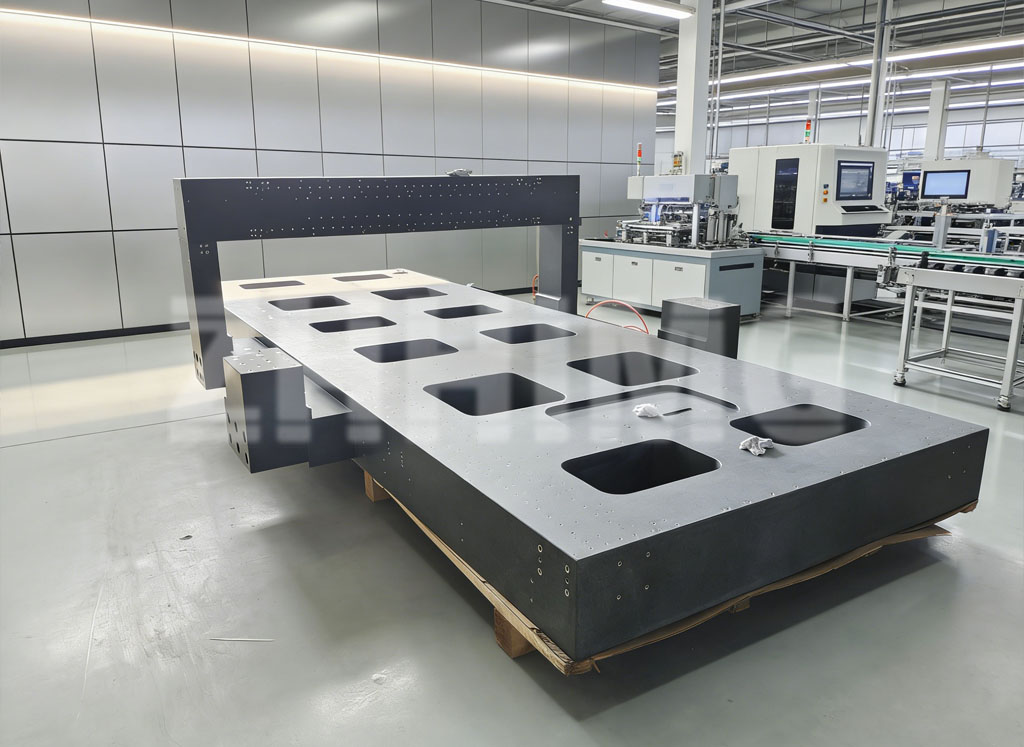
Granite vs mineral casting vs UHPC: comparison
| Factor | Natural granite | Mineral casting | UHPC |
|---|
| Factor | Natural granite | Mineral casting | UHPC |
|---|---|---|---|
| Best use | Surface plates, metrology bases, air-bearing assemblies | Complex machine bases, semiconductor frames, optical platforms | Large structural frames, heavy equipment bases |
| Vibration damping | High | Very high | Moderate to high, depends on formulation |
| Thermal stability | Excellent | Good to very good | Depends on mix design and curing |
| Moisture sensitivity | Low | Low | Higher than granite and epoxy-based mineral casting |
| Design flexibility | Limited by stone machining | High | High |
| Embedded inserts | Possible with drilling and bonding | Easy during casting | Possible with reinforcement and inserts |
| Precision surface | Excellent after grinding | Possible with machining or bonded plates | Less common for nanometer-level surfaces |
| Long-term stability | Very stable when supported well | Stable if formulation and curing are controlled | Requires careful mix and environmental control |
How to choose the right base material
| Application | Recommended material | Reason |
|---|
| Application | Recommended material | Reason |
|---|---|---|
| Surface plate, granite square, reference block | Natural granite | Highest surface accuracy and long-term flatness |
| CMM base, vision system frame | Natural granite or mineral casting | Depends on structure complexity and damping needs |
| Semiconductor wafer handling base | Natural granite or mineral casting | High stability, non-magnetic, low vibration |
| Laser and optical inspection platform | Natural granite | Excellent stability for sensitive optical paths |
| Complex machine base with inserts | Mineral casting | Easy integration of holes, channels and mounting points |
| Large equipment foundation | UHPC or mineral casting | Depends on structural load and environmental exposure |
| Air-bearing assembly | Natural granite | Stable, dense and suitable for precision grinding |
If the working surface must serve as a precision measurement datum, natural granite is usually the safest choice. If the base must integrate many mechanical interfaces, mineral casting often reduces assembly complexity. If the structure is very large and primarily load-bearing, UHPC may be considered.
Why ZHHIMG focuses on precision granite and granite assemblies
ZHHIMG specializes in precision granite components for metrology, semiconductor, optical inspection and precision equipment applications.
Our capability includes:
- • Granite surface plates for reference and inspection
- • Granite machine bases and granite assemblies
- • Granite air bearings and granite structural components
- • Large-format granite components up to 20,000 mm
- • Single-piece capacity up to 100 tons
- • Resurfacing, repair and calibration support
We use high-density black granite with a density of approximately 3,100 kg/m³, selected for its stability, wear resistance and suitability for precision industrial applications. Inspection is carried out with electronic levels, laser interferometers, dial indicators and roughness testers, with calibration traceability maintained through recognized metrology channels.
For projects that require mineral casting, UHPC or hybrid structures, we can review drawings and advise on whether a granite working surface, granite assembly or composite base structure is more suitable.
FAQ: granite, mineral casting and UHPC
Is natural granite better than mineral casting?
Not always. Natural granite is usually better for precision reference surfaces. Mineral casting is often better for complex machine bases that require embedded inserts, cable routes or integrated structural features.
Can UHPC replace granite surface plates?
Generally no. UHPC is a cement-based material and is not commonly used for high-precision surface plates. Natural granite remains the preferred material for metrology reference surfaces.
Which material has the best vibration damping?
Mineral casting typically offers very high damping, often higher than cast iron and competitive with natural granite in structural applications. The exact performance depends on formulation, structure and mounting conditions.
Can granite bases include threaded holes and inserts?
Yes. Granite components can be manufactured with threaded inserts, mounting holes, datum features and handling interfaces according to customer drawings.
When should I choose mineral casting instead of granite?
Choose mineral casting when the base requires complex internal structures, many embedded interfaces, or integrated cooling and cable channels. Choose granite when the highest surface accuracy and long-term flatness are required.
Post time: Nov-18-2026